“I barely managed to borrow even after paying 19.79% interest” — Mid- and low-credit borrowers face being pushed into private lending
- Input
- 2026-09-17 07:03:03
- Updated
- 2026-09-17 07:03:03

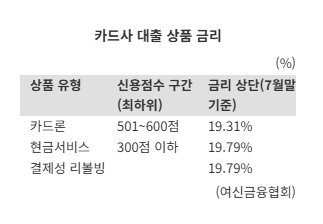
According to the Credit Finance Association on the 17th, the average interest rate among six dedicated credit-card companies offering card loans to borrowers with credit scores of 501 to 600—the lowest credit-score range eligible for card loans—stood at 18.48% as of the end of July. The highest rate was 19.31%.
In July 2021, the statutory maximum interest rate was lowered from 24% to 20% per year, leaving less than 1 percentage point before reaching that ceiling. This means that mid- and low-credit borrowers, who are often turned down by banks or need emergency funds, are borrowing money while bearing the highest cost permitted by law.
Rates on cash advances and revolving credit, a product that carries over part of a loan balance, are at similar levels. Cash advances are offered to borrowers with credit scores as low as 300, and the average rate charged by eight credit-card companies in this range was 19.27%. The highest rate was 19.79%, just 0.21 percentage points below the ceiling. The highest revolving-credit fee rate was also 19.79%.
The problem is that although cash advances and revolving credit are not included in the financial authorities’ debt service ratio (DSR) management, credit-card companies are increasingly likely to reduce lending on their own. This is because interest rates on financial-company bonds, a funding source for credit-card companies, are rising amid tight monetary policy. The three-year rate stood at 4.642% (AA+) as of the 15th.
While there is no ceiling on bond-funding costs, loan rates are capped, leaving credit-card companies with little choice but to reduce lending. Since market interest rates and delinquency rates generally move in the same direction, companies also have a strong incentive to tighten lending standards to manage their financial soundness indicators.
A balloon effect is already emerging. Demand for Online Investment-Linked Financial Business, also known as P2P finance, is expanding. The combined outstanding balance of personal credit loans at the four largest online investment-linked finance companies grew from 405.5 billion won in June to 495.8 billion won in July and 577.2 billion won in August.
However, because roughly 80% to 90% of P2P loans from online investment-linked finance companies are extended through partnerships with savings banks, the sector cannot avoid being indirectly affected by the banking sector’s household-loan volume regulations.
Ultimately, borrowers who cannot secure funds through this channel are pushed toward loan companies or private lenders. The combined outstanding loan balance of 23 loan companies disclosed by the Korea Loan Finance Association stood at 4.1123 trillion won as of the end of June. This is more than eight times the 502.2 billion won in cumulative personal credit-loan investments linked to savings banks’ online investment-linked finance as of July, based on a simple calculation.
A financial-sector official noted, “P2P finance, which mid- and low-credit borrowers rely on, is about one-seventh the size of the loan-company sector, yet it faces even greater regulation. There are serious concerns that low-credit borrowers could end up in high-interest private lending that is not captured in official statistics.”
[email protected] Kim Tae-il Reporter