Jeju Province Development Corporation’s Net Profit Plunges 49.8%; President Kim Do-young to Lead Jeju Samdasoo’s Rebound
- Input
- 2026-09-16 11:01:27
- Updated
- 2026-09-16 11:01:27
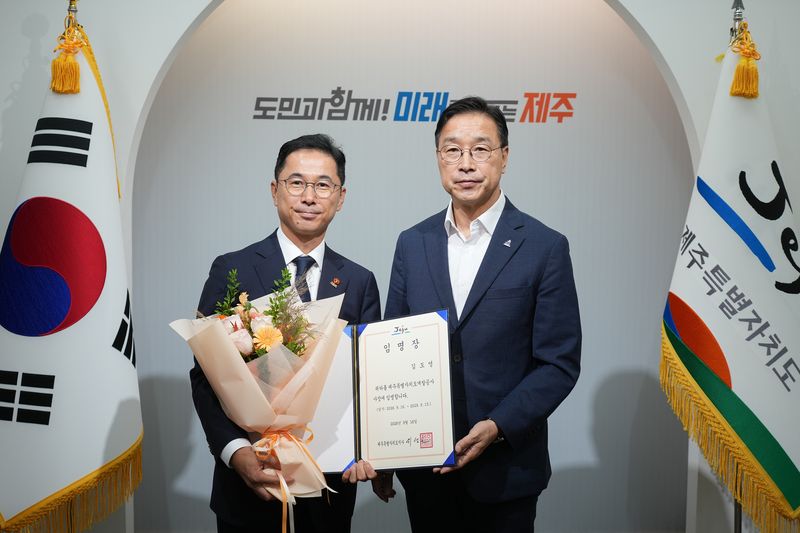
【Financial News Jeju = Reporter Jeong Yong-bok】 Kim Do-young, a former managing director at GS Engineering & Construction with 27 years of experience in sales, distribution, construction, and overseas business at a major private-sector corporation, has been appointed to lead the Jeju Province Development Corporation after its net profit nearly halved last year. He faces the task of improving Jeju Samdasoo’s profitability and expanding into overseas markets while also advancing public housing, regional development, and groundwater conservation—balancing profitability with public responsibility.
Jeju Special Self-Governing Province appointed Kim Do-young, a former managing director at GS Engineering & Construction, as the 13th president of the Jeju Province Development Corporation on the 16th. Governor Wi Seong-gon presented Kim with his letter of appointment at the provincial government office that day.
Kim’s three-year term runs through September 15, 2029.
The Jeju Province Development Corporation is best known as the producer of Jeju Samdasoo, but its role extends beyond the bottled-water business. It is a local public corporation responsible for businesses directly tied to residents’ lives, including citrus processing, public housing, housing welfare, and land and urban development.
The management figures Kim inherited are far from favorable. The Jeju Province Development Corporation’s net profit in 2025 was 31.9 billion won, down 49.8% from 63.5 billion won a year earlier. Its management targets for this year are revenue of 350.2 billion won and net profit of 50.2 billion won. Its cumulative approved target for public housing supply also stands at 4,650 units.
The first area in which Kim will be expected to deliver results is clearly Jeju Samdasoo.
Jeju Samdasoo is a leading brand in South Korea’s bottled-water market, but intensifying competition has made restoring its distribution and sales capabilities a key management priority. At a personnel hearing before the Jeju Provincial Council the previous day, Kim said the goal of securing a 45% market share for Samdasoo would not be easy, but indicated that setting a low target was not an option.
He outlined plans to reorganize logistics and distribution networks, tailor sales strategies to different regions and customer groups, and expand overseas markets. This is also why Kim’s private-sector experience has drawn attention.
Kim was born in Gujwa-eup, Jeju City. He attended Ohyeon High School, graduated from Seoul National University’s Department of Business Administration, and earned a master’s degree in business administration from the same university.
After entering the telecommunications industry in 1997, he worked for major corporations and their affiliates for about 27 years, rising to managing director at GS Engineering & Construction in 2024. He gained experience across management, including sales and exports, strategic planning, new business development, finance, and data-driven distribution management.
At GS Engineering & Construction, he was also responsible for overseas prefabricated-construction projects. Prefabricated construction involves manufacturing major building components in advance at a factory and assembling them on site. Kim also participated in managing related European affiliates, building experience in overseas business.
However, the way a private company achieves results is not the same as the way a local public corporation is operated. While private companies focus on revenue and profit as key performance indicators, the Jeju Province Development Corporation must generate profits while returning the benefits to residents. It must also conserve the groundwater that is the source of Jeju Samdasoo, expand public housing and housing welfare, and contribute to citrus farmers and the regional economy.
This was the backdrop to the Jeju Provincial Council’s Environment and Urban Affairs Committee issuing a “qualified” opinion on Kim after completing his personnel hearing on the 15th, while also identifying how he would reconcile his major-corporation experience with the public mission of a state-owned enterprise as a challenge.
At the hearing, Kim presented balancing profitability and public responsibility as his management principle. His plan is to create greater value by strengthening Samdasoo’s competitiveness and channel the resulting profits into housing stability, cooperation with citrus farmers, development of local talent, and environmental conservation.
Public housing and large-scale development projects will also test the new president’s management capabilities. Alongside supplying public housing through construction and acquisition, the Jeju Province Development Corporation is participating in the Hwabuk 2 Public Housing District project in areas of Hwabuk-dong, Doryeon-dong, and Yeongpyeong-dong in Jeju City.
Kim Do-young said, "I will do my utmost to ensure that the Jeju Province Development Corporation, an enterprise belonging to the residents of Jeju, overcomes its current difficulties and is reborn as a happiness partner for residents leading Jeju’s future."
Governor Wi Seong-gon urged him, saying, "As a public corporation established on Jeju’s precious groundwater, the Jeju Province Development Corporation must secure sustainable growth and the trust of residents. Based on your expertise and leadership, please improve management and identify new growth drivers so that you can lead it to become a public corporation that takes a new leap forward."
Kim’s first test is clear. Whether he can restore Jeju Samdasoo’s revenue and profitability while linking those results to public housing, regional development, and environmental conservation is expected to determine his management performance over the next three years.
[email protected] Jeong Yong-bok Reporter