Byung Joon Jung, Nam Hyeong-du, Kwon Hyeong-Ki, Hong-Gyu Park and Sa Dong-min Named Recipients of National Academy of Sciences Award
- Input
- 2026-09-16 12:00:00
- Updated
- 2026-09-16 12:00:00
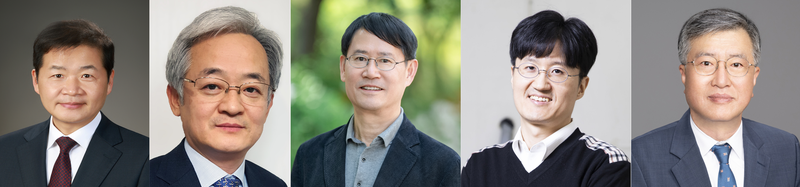
[Financial News] The National Academy of Sciences of the Republic of Korea announced on the 16th that it had selected five recipients for the 71st National Academy of Sciences Award, the country’s most prestigious academic honor: Byung Joon Jung of Ewha Womans University, Nam Hyeong-du of Yonsei University, Kwon Hyeong-Ki of Seoul National University, Hong-Gyu Park of Seoul National University, and Sa Dong-min, an endowed professor at Chungbuk National University. The award ceremony will be held on the 17th in the academy’s conference room in Seocho-gu, Seoul. Each recipient will receive a certificate and 100 million won in prize money.
The recipients are researchers who have conducted in-depth studies of key issues spanning industry and society, from new industrial norms in the age of artificial intelligence (AI) to next-generation semiconductors and the growth engines of the Korean economy.
Byung Joon Jung, the humanities recipient, uncovered extensive historical materials scattered across the United States, the United Kingdom, Japan and other countries, compiling a comprehensive account of independence activist Kim Kyu-sik’s life and activities. By meticulously verifying historical sources, he reconstructed the Provisional Government of the Republic of Korea’s international diplomatic activities, an area that had received relatively limited scholarly attention, thereby broadening the scope of research on modern and contemporary Korean history and the independence movement.
Nam Hyeong-du, the social sciences recipient, directly addressed the problem of major information technology companies using other people’s creative works without permission on a massive scale while developing AI. He pointed out that legal systems created to protect small creators were being transformed into tools that justified unauthorized use by large technology companies, and established new copyright norms suited to the AI era.
Kwon Hyeong-Ki, also a social sciences recipient, offered a new explanation for how the Korean economy continued to grow after the foreign exchange crisis. He identified flexible adaptability arising from Korea’s distinctive competitive structure between the state and the market as a key factor, and proposed an alternative development model capable of driving sustainable growth amid rapid technological change.
Hong-Gyu Park, the basic natural sciences recipient, developed an ultra-small nanolaser that overcomes the limitations of next-generation semiconductor and communications technologies. The device developed by his research team is one-quarter the size of conventional devices and requires approximately one twenty-fourth of the energy to operate. Because it can carry more information in a single optical signal, the technology opens possibilities for high-capacity optical communications and the commercialization of advanced semiconductors.
Sa Dong-min, the applied natural sciences recipient, laid the foundation for eco-friendly agricultural technologies that can address food shortages amid climate change. He identified the principles of specialized soil microorganisms that help plants grow with less stress even in dry or highly saline soil, paving the way for the development of eco-friendly biofertilizers.
Established in 1955, the National Academy of Sciences Award is presented annually to scholars who have made outstanding contributions to the advancement of academic disciplines. A total of 296 people had received the award through last year. Prime Minister Han Seong-sook and Vice Minister of Education Choi Eun-ok will attend the award ceremony, which will begin at 2 p.m. on the 17th.
[email protected] Man-ki Kim Reporter