Korean Research Team Wins First Place at International 'Robot Pathfinding AI Challenge'
- Input
- 2026-09-16 10:19:06
- Updated
- 2026-09-16 10:19:06
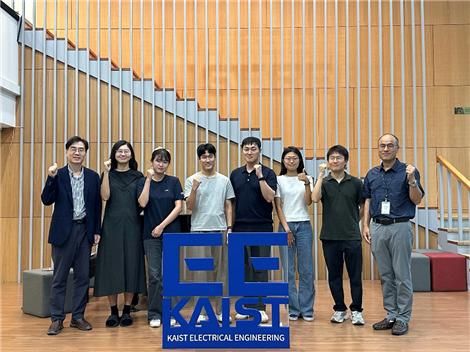
[Financial News] Domestic researchers have taken first place in the world at an international competition with their robot artificial intelligence (AI) technology. It is a robot that understands human speech and finds its destination on its own in an unfamiliar space.
According to the Korea Advanced Institute of Science and Technology (KAIST) and the Electronics and Telecommunications Research Institute (ETRI) on the 16th, a joint team from ETRI and KAIST took first place among 112 participating teams worldwide in the VLNVerse Challenge at the European Conference on Computer Vision (ECCV 2026) held in Malmö, Sweden, on the 9th. Visual-Language Navigation (VLN) is a technology in which a robot understands natural language commands given by humans, examines its surrounding environment with a camera, and moves autonomously to its destination. The core of the technology is that the robot finds its way by understanding both "human speech" and "the space in front of it" together, without requiring humans to manually input movement paths or create precise maps in advance.
The Field Robotics Laboratory at ETRI and Professor Myung-Hyun's research team from the School of Electrical and Electronic Engineering at KAIST participated as a joint team named 'URL-FRRS'. The joint team recorded an average success rate of 90.7% across two evaluations. These included a target search task (coarse), where the robot determines its own path given only a destination (e.g., "Find the blue sofa in the living room"), and a detailed driving task (fine), where the robot understands and executes multi-step instructions in sequence (e.g., "Turn right at the end of the hallway, enter the second door, and stop by the window"). Although they had the same success rate as the second-place team, they secured first place due to a faster submission time in accordance with competition regulations.
ETRI plans to apply the technology verified at this competition to research on 'Guide Dog,' a navigation robot for the visually impaired, and also to on-device VLM-based robot mobility intelligence, utilizing it as a core technology for service robots that move in the same space as humans.
Following this, the KAIST research team also took second place in the 'NaviTrace Challenge' at the OWN workshop of Robotics: Science and Systems (RSS) 2026, held in Sydney, Australia, last July. In this competition, robots are given only a single photo and a short command, such as 'enter the parking lot,' and are asked to determine which path to take.
A KAIST research team developed 'PRISM-Nav,' in which multiple AIs collaborate by dividing roles instead of entrusting all decision-making to a single AI. The team scored 53 points in the competition, placing second behind the joint team of Nanjing University and FIVEAGES.
Previously, Professor Myung-Hyun’s lab took first place at the ICRA 2026 International Challenge, the top conference in the robotics field, and the CVPR 2026 International Challenge, the top conference in the computer vision field, last June.
"This achievement demonstrates that AI can make independent judgments and move in unfamiliar environments without the need for separate additional training," Professor Myung-Hyun stated. "Moving forward, we will expand beyond navigation to tasks such as picking up and moving objects, developing it into a robot that independently verifies and corrects its own judgments."
[email protected] Yeon Ji-an Reporter