Insurers’ Solvency Rose on Stock Gains, but Risk Exposure Also Increased
- Input
- 2026-09-16 12:00:00
- Updated
- 2026-09-16 12:00:00
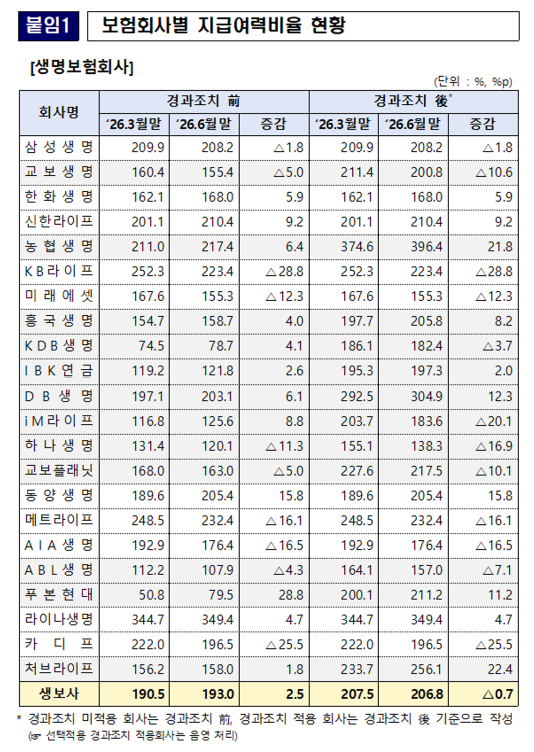
According to the Financial Supervisory Service’s report released on the 16th on insurers’ solvency ratios after transitional measures as of the end of June, insurers’ Korean Insurance Capital Standard (K-ICS) ratio stood at 215.2% at the end of June. This was down 0.8 percentage points from 216.0% in the previous quarter. Life insurers recorded 206.8%, down 0.7 percentage points from the first quarter, while non-life insurers posted 230.9%, up 1.2 percentage points. An insurer’s solvency ratio is calculated by dividing available capital by required capital. It indicates whether an insurer can pay policyholders’ claims on time and reflects the company’s financial condition.
The K-ICS ratio before transitional measures was 203.6%, up 1.1 percentage points from 202.5% in the previous quarter. Life insurers recorded 193.0%, an increase of 2.5 percentage points, while non-life insurers posted 223.9%, up 1.5 percentage points.
K-ICS transitional measures were introduced to mitigate the impact on insurers’ capital soundness that could arise from the implementation of the new solvency regime. They are intended to help insurers adapt to the newly introduced K-ICS system. Twelve life insurers and six non-life and reinsurance companies are applying the transitional measures selectively.
The slight decline in the solvency ratio was driven by rising stock prices. After the transitional measures were applied, available capital totaled 380 trillion won, up 69.1 trillion won, or 22.2%, from the previous quarter. This resulted from net income of 4.5 trillion won and a 61.2 trillion won increase in accumulated other comprehensive income due to higher stock prices. During the same period, required capital rose 32.6 trillion won, or 22.6%, to 176.6 trillion won. Equity risk exposure also increased by 35.2 trillion won as stock prices rose.
By company, Samsung Life Insurance recorded the same ratio of 208.2% both before and after the transitional measures, down 1.8 percentage points from the previous quarter. Kyobo Life Insurance posted 200.8% after the measures, down 10.6 percentage points. Hanwha Life Insurance recorded 168.0%, up 5.9 percentage points. Among non-life insurers, Samsung Fire & Marine Insurance rose 12.7 percentage points to 282.8%, while DB Insurance fell 27.7 percentage points to 204.4%. NH NongHyup Non-Life Insurance rose 65.1 percentage points to 254.7%.
The Financial Supervisory Service said, "We plan to focus our supervisory capabilities on ensuring that insurers maintain sufficient solvency in response to changes in the external environment, including the recent rise in market interest rates. In particular, we will strengthen monitoring aimed at improving capital quality and risk management, focusing on insurers with vulnerable capital structures."
[email protected] Park Moon-soo Reporter