“Does Mixing It with an Ointment Double Its Effect?” Fact-Checking Myths About Vaseline [Excellent Skin Note by Woo Soo-han]
- Input
- 2026-09-16 15:02:24
- Updated
- 2026-09-16 15:02:24
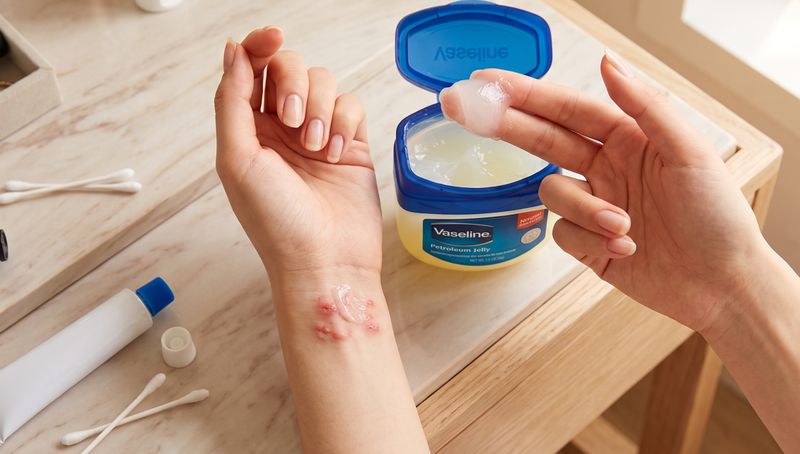
[Financial News] There is a cosmetic product known by the name “Vaseline.” Its ingredient is 100% Petrolatum, which is obtained by refining petroleum. In other words, Vaseline is essentially Petrolatum. Petrolatum is used as a moisturizer, but unlike ordinary moisturizing cosmetics, it does not add moisture to the skin. Instead, it acts as an occlusive agent by forming a protective barrier on the skin’s surface that prevents existing moisture from escaping. This distinctive property has given rise to many myths, such as “Vaseline clogs pores and causes acne” and “Applying Vaseline over an ointment helps wounds heal more effectively.” What is actually true? Let’s examine the facts about Vaseline and Petrolatum.
Does applying Vaseline cause acne?
One of the most common misconceptions about Vaseline is that it “clogs pores and causes acne.” There is insufficient evidence that highly refined Vaseline—namely, Petrolatum itself—is a strong comedogenic ingredient. Therefore, it is difficult to conclude that applying Vaseline will inevitably clog pores and cause acne.
That does not mean, however, that everyone with acne-prone skin should apply a thick layer of Vaseline over their entire face. The American Academy of Dermatology also advises that using Petrolatum on the face may cause breakouts in some people with acne-prone skin. If your skin produces a lot of sebum or is prone to acne, it is generally safer to monitor your skin’s reaction and use Vaseline only on particularly dry areas, such as the lips or around the eyes, rather than applying a thick layer over your entire face.
Use caution when applying it over other cosmetics or ointments
Vaseline’s strong occlusive effect is an advantage, but caution is necessary in some situations. Occluding the skin increases the moisture content of the stratum corneum and may also affect the skin’s absorption of certain topical medications applied underneath.
Dermatologists sometimes deliberately use this principle to enhance the effects of medication. A representative example is occlusive therapy, in which the skin is covered with plastic wrap or a similar material after an ointment is applied. Vaseline is not exactly the same as conventional occlusive therapy using plastic wrap, but because it has a strong occlusive effect, applying a thick layer over a topical medication can produce a sealing effect.
However, particular caution is needed when applying Vaseline over a topical medication. It is best to avoid covering a potent steroid ointment with a thick layer of Vaseline without a doctor’s instructions. If occlusion increases drug absorption, the risk of local corticosteroid side effects, such as skin atrophy and telangiectasia, may also rise.
Products that can naturally irritate the skin, such as Retinol, retinoids, and exfoliating ingredients, may also feel more irritating if completely covered with Vaseline while the skin is sensitive. Rather than assuming that Vaseline is safe to apply over anything because it contains gentle ingredients, you should check which cosmetics or topical medications you are using with it.
What matters more than Vaseline itself is what you apply and how you apply it
Vaseline is not a complex functional cosmetic. Rather than inducing specific biological changes in the skin like brightening or wrinkle-improving ingredients, it performs the relatively simple role of reducing moisture loss by creating a protective barrier on the skin’s surface.
Precisely because of this simple function, it can be useful on various areas, including dry lips, the area around the eyes, and the hands. When the skin is very dry, you can apply it while some moisture remains after washing your face or showering. Alternatively, apply a regular moisturizer first, then spread a thin layer of Vaseline over especially dry areas.
By contrast, applying a thick layer over the entire face every day when it produces a lot of sebum, or automatically covering topical medications or irritating cosmetics with Vaseline, is not suitable for everyone. Ultimately, the key to using Vaseline well is not applying a large amount, but understanding its role on the skin and using it appropriately where needed.
Vaseline does not create new moisture in the skin. Instead, it acts as a powerful protective barrier that prevents moisture already present in the skin from escaping. Understanding this principle can help you use Vaseline more effectively, even though it is not an expensive cosmetic product.

/Director of THE HEAL MAPO
[email protected] Kim Hyun-sun Reporter