U.S. Navy Says It “Could Buy Japanese Frigates,” Creating Contract Opportunities for South Korean Shipbuilders
- Input
- 2026-09-16 09:56:31
- Updated
- 2026-09-16 09:56:31
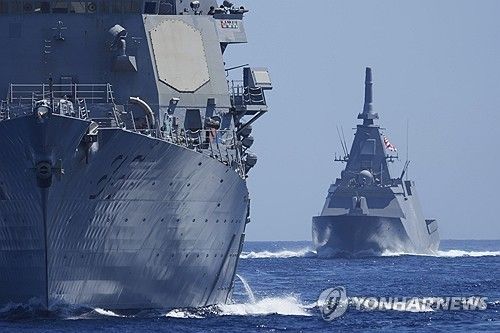
【Financial News, Tokyo = Correspondent Hye-jin Seo】The United States Navy is considering purchasing vessels built in allied countries such as South Korea and Japan, Nihon Keizai Shimbun reported on the 16th. The plan is intended to secure warships quickly in response to China’s military buildup while also rebuilding the U.S. shipbuilding industry.
Several U.S. Navy officials told Nikkei that the service was considering “options to fulfill President Donald Trump’s intention of achieving faster vessel deliveries” while pursuing long-term investment in U.S. shipyards and technology transfers. Another official said, “We could buy several Japanese frigates,” adding, “Japanese vessels are excellent.”
Last month, the White House issued a presidential memorandum allowing overseas companies that establish shipyards in the United States or acquire ownership or a majority stake in existing shipyards to build their initial vessels in their home countries. The strategy is to secure vessels overseas first, then bring the technology and production methods to the United States to restore domestic shipbuilding capacity.
Citing the naval publication USNI News, Nihon Keizai Shimbun reported that frigates built in South Korea, Japan, and Türkiye are under consideration. In Japan, an improved version of Mitsubishi Heavy Industries’ Mogami-class frigate has been mentioned. It has a record of beating South Korea, Germany, and Spain in Australia’s next-generation frigate program, and its automation technology allows it to operate with a smaller crew. The challenge, however, is whether the United States can secure a domestic shipbuilding base and the ability to deliver the vessels quickly.
South Korea is considered a leading candidate because its major shipbuilders have already begun investing in the United States. President Lee Jae Myung also introduced South Korean shipbuilders to President Trump at an international conference in July and conveyed Seoul’s willingness to cooperate on warship construction.
According to USNI News, the specific candidates are South Korea’s Chungnam-class, Japan’s export version of the Mogami-class, and Türkiye’s Istanbul-class guided-missile frigate.
The Chungnam-class is the Ulsan-class Batch III, the latest frigate operated by the South Korean Navy. HD Hyundai Heavy Industries handled the detailed design and construction of the lead ship, while SK Oceanplant and Hanwha Ocean are also participating in the construction of follow-on vessels. Hanwha, which acquired Hanwha Philly Shipyard in the United States, could meet the investment conditions set out in the memorandum, according to some interpretations.
However, the plan is still at the evaluation stage, and no order has been finalized. Acting Secretary of the Navy Hung Cao ordered evaluations of surface combatants, roll-on/roll-off vessels, and oilers for at-sea cargo replenishment to be completed by November 12.
The expansion of China’s naval power is driving the U.S. push to secure vessels quickly. According to Japan’s Ministry of Defense, the number of modern Chinese destroyers and frigates increased 6.9-fold over the 25 years from 2001 to 2026. Because the United States deploys vessels around the world, China’s growing military strength is placing pressure on U.S. forces in Asia.
The Trump administration has prepared a budget proposal allocating $66 billion to naval shipbuilding in fiscal 2027 to construct a total of 34 warships and support vessels. However, U.S. shipbuilding has declined since the Cold War, and the country has recently built only a few commercial vessels a year. As China has grown into the world’s largest shipbuilding nation, the United States is turning to South Korea, the world’s second-largest shipbuilder, and Japan, the third-largest, to supplement its limited construction capacity.
[email protected] Hye-jin Seo Reporter