Jeju Green Hydrogen 50MW Testbed... Government Pushes for Preliminary Feasibility Study for 15-fold Scale
- Input
- 2026-09-16 09:45:20
- Updated
- 2026-09-16 09:45:20
[Financial News Jeju = Reporter Jeong Yong-bok] A large-scale demonstration project is being pursued in Jeju to expand the production facility for 'green hydrogen,' which is produced by splitting water using wind and solar power, by approximately 15 times its current size.
According to the Ministry of Climate, Energy and Environment and Jeju Special Self-Governing Province on the 16th, the government is promoting 50–100 MW-class green hydrogen production demonstration projects centered on regions with a high concentration of renewable energy. In Jeju, a 50 MW-class production demonstration is subject to a preliminary feasibility study.
Water electrolysis is a technology that uses electricity to decompose water into hydrogen and oxygen. When the electricity used for this process is supplied by renewable energy sources such as wind or solar power, carbon emissions during the production process can be reduced, which is why it is called 'green hydrogen'. A 50MW class is the scale of electricity that a water electrolysis facility can receive at once and use for hydrogen production.
Considering that the current Haengwon demonstration complex is 3.3 MW, 50 MW is equivalent to the combined capacity of about 15 facilities of the same size as Haengwon. To be precise, it is about 15.2 times larger.
However, just because the facility is expanded 15-fold does not mean that the actual hydrogen production volume will increase 15-fold. This is because the actual production volume varies depending on the supply of renewable energy, which changes according to wind and sunlight, as well as the facility's operating time and water electrolysis efficiency.
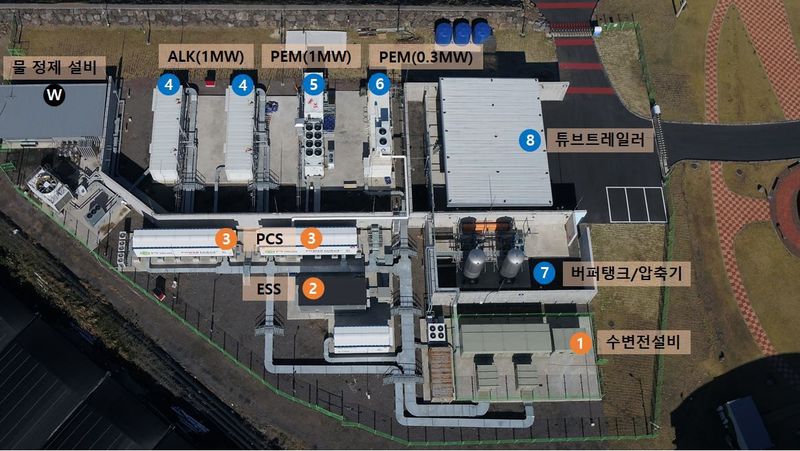
The Haengwon complex was constructed at the Haengwon Wind Farm in Gujwa-eup, Jeju City, through a government demonstration project from 2020 to 2024. The total project cost was 22.2 billion won, with 13.5 billion won in state funds, 1.7 billion won in provincial funds, and 7 billion won in private capital invested.
It consists of a 3.3MW facility combining different types of water electrolysis equipment and is also equipped with an energy storage system and hydrogen compression and shipping facilities.
The maximum daily hydrogen production capacity is designed to be 600 kg. After completing the demonstration project in September 2024, it currently produces about 200 kg per day and supplies it to 17 hydrogen buses and hydrogen passenger cars in the province.
The discrepancy between the maximum production capacity of 600kg and the current production volume of 200kg is another point to consider during the scaling-up process. The facility utilization rate cannot be calculated based on these two figures alone. Actual production volume is influenced by various factors, including renewable energy power supply, operating conditions, and equipment maintenance.
The government is not immediately proceeding with the construction of the 50MW facility. A preliminary feasibility study is a procedure to assess in advance whether the benefits obtained outweigh the costs and whether the project is necessary from a policy perspective, before proceeding with a project that involves large-scale funding. The Jeju 50MW-class green hydrogen demonstration project is also currently undergoing this verification process.
The biggest challenge in scaling up is economic feasibility. The amount of power generated by wind and solar power varies depending on the weather. If the wind weakens or sunlight decreases, the power available to electrolysis facilities also changes. To stably operate a 50MW-class large-scale facility, it is necessary to withstand these power fluctuations while increasing facility utilization rates and lowering hydrogen production costs. This is why the government is paying attention to the 3.3MW demonstration experience already in operation in Jeju.
When the preliminary feasibility study and subsequent review of a 50MW-class project proceed, detailed economic indicators such as water electrolysis efficiency, power consumption, and the cost of producing 1kg of hydrogen are important. If it cannot be proven that hydrogen can be produced more cheaply when scaled up, the economic benefits of scaling up will inevitably diminish.
The Ministry of Climate, Energy and Environment will hold a technology achievement sharing session at the Haengwon Electrolysis Demonstration Complex on the afternoon of the 16th, with the participation of related companies and researchers. They will share experiences gained during the construction and operation of the 3.3MW complex and discuss future directions for electrolysis technology development and large-scale production demonstration.
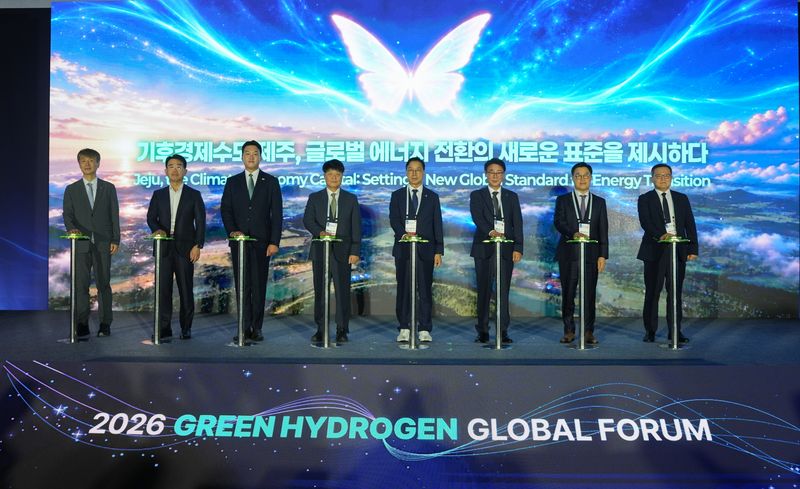
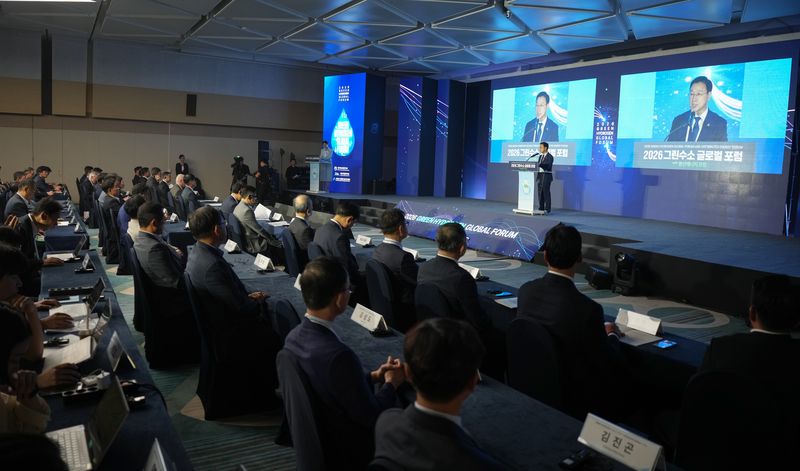
Discussions on international cooperation are also taking place simultaneously in Jeju. The Ministry of Climate, Energy and Environment and Jeju Province are jointly hosting the '2026 Green Hydrogen Global Forum with Distributed Energy Forum' at the International Convention Center Jeju from the 14th to the 16th.
The event, organized by the Green Hydrogen Glocal Leading Research Center at Jeju National University, was attended by 106 institutions, companies, and universities from 9 countries, including the International Energy Agency and the Global Green Growth Institute (GGGI), as well as Germany, Denmark, and Thailand.
The forum is discussing AI-based renewable energy innovation, green hydrogen, the power market, hydrogen production, storage, transportation, utilization, and safety, the expansion of demand for clean hydrogen, and distributed energy.
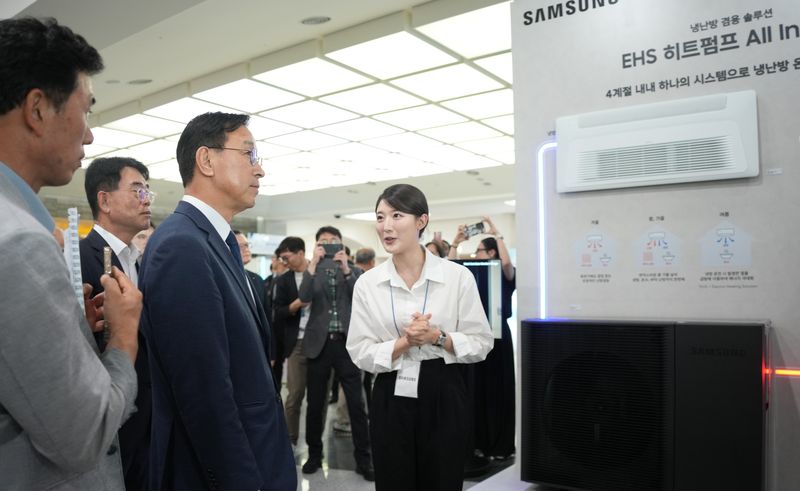
Prior to the opening ceremony on the 15th, Jeju Governor Wi Seong-gon discussed measures to ensure the safety and reliability of hydrogen production, storage, and transportation processes with representatives from the University of Illinois Urbana-Champaign (UIUC). He also discussed energy storage systems, hydrogen and ammonia production, offshore wind power technology, and the possibility of joint research with universities and companies in the Jeju region with global energy company Envision Energy.
Park Deok-yeol, Director General of Hydrogen Thermal Industry Policy at the Ministry of Climate, Energy and Environment, stated, "Jeju is becoming a model example of realizing a clean hydrogen ecosystem by establishing renewable energy-based hydrogen production bases and linking and utilizing them for hydrogen vehicles," adding, "The government will also promote large-scale water electrolysis demonstrations centered on regions rich in renewable energy."
Governor Wi Seong-gon said, "The Climate Economy Capital is a city where clean energy production becomes the economy, generates income, and benefits the residents," adding, "We will create a win-win model where the energy transition makes a tangible contribution to the local economy and the lives of residents."
The next test for Jeju Green Hydrogen lies in economic feasibility rather than the size of the facility itself. As the experience gained from the current 3.3MW facility is expanded to a 50MW facility, which is about 15 times larger, the key challenge determining the success or failure of the large-scale demonstration is whether it is possible to stably produce hydrogen even amidst the erratic power supply of renewable energy and to lower production costs.
[email protected] Jeong Yong-bok Reporter