AIDC Tackles Heat... Korea Research Institute of Chemical Technology and SK Innovation Join Forces to Develop Next-Generation Cooling Materials
- Input
- 2026-09-16 09:38:07
- Updated
- 2026-09-16 09:38:07
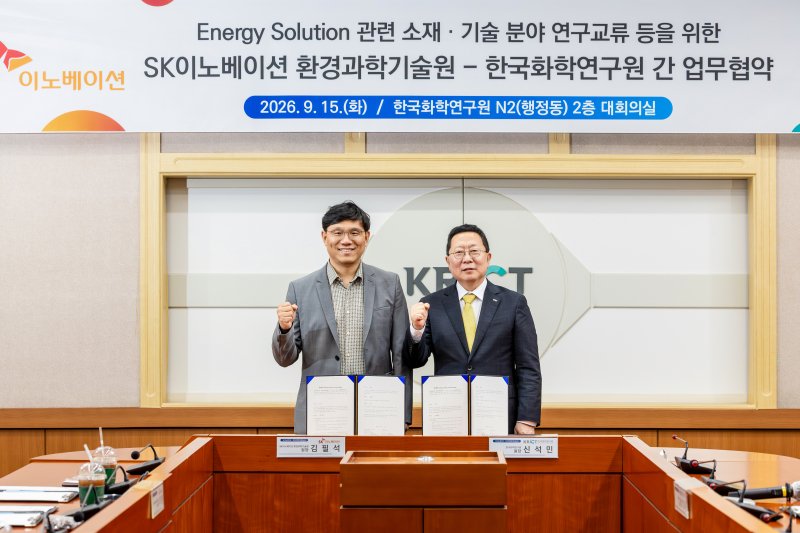
The Korea Research Institute of Chemical Technology and SKI announced on the 16th that they signed a Memorandum of Understanding (MOU) for research cooperation in materials and technologies related to energy solutions on the 15th at the Korea Research Institute of Chemical Technology in Daejeon, attended by Seokmin Shin, President of the Korea Research Institute of Chemical Technology, and Philseok Kim, President of the SK innovation Institute of Environmental Science & Technology.
With the spread of AI technology leading to an increase in data centers using high-performance xPUs on a large scale, the ability to quickly remove the massive heat generated by servers with minimal power consumption is emerging as a key factor in data center competitiveness.
Conventional air cooling has limitations in reducing heat in high-density servers, so two-phase cooling has recently been attracting attention as a next-generation technology. This method can transfer a significant amount of heat as a liquid refrigerant absorbs heat, turns into a gas, and condenses back into a liquid. In this process, it is crucial to use refrigerants and heat dissipation/heat transfer materials that can rapidly absorb heat while operating stably over long periods.
Through this agreement, the two organizations will jointly pursue the identification and execution of national R&D projects in the fields of AI data centers and electrification, the development of thermal management and cooling/heat dissipation materials, the development of high-efficiency and eco-friendly material technologies for power infrastructure, and the exchange of research personnel and sharing of technical information.
The Korea Research Institute of Chemical Technology and SKI are planning research specifically to discover two-phase refrigerants by combining AI and chemical materials technology. The approach involves using machine learning to predict the thermal and physical properties of candidate refrigerant substances, selecting promising materials, and then evaluating key properties such as thermal conductivity and latent heat through actual synthesis and purification.
The research plan currently under review aims for phased research and development, starting with the discovery of new AI-based two-phase refrigerants, followed by the optimization of refrigerant synthesis and purification processes and performance verification at the server and rack levels, and finally demonstrating cooling performance, power efficiency (PUE), and long-term operational reliability in a 500kW-class AI data center environment.
Seokmin Shin, President of the Korea Research Institute of Chemical Technology, stated, "By combining the Korea Research Institute of Chemical Technology's research capabilities in refrigerant and thermal management materials with SK Innovation Co., Ltd.'s R&D experience in the energy sector, we will secure source technologies for core materials that can innovate the power efficiency of AI data centers."
Philseok Kim, President of the SK innovation Institute of Environmental Science & Technology, stated, "To respond to the rapid growth of AI data centers, integrated technological innovation encompassing everything from refrigerants to materials and cooling systems is necessary." He added, "We will strive to proactively secure next-generation energy solution technologies and apply them to actual industrial sites through cooperation with government-funded research institutes, including the Korea Research Institute of Chemical Technology."
[email protected] Yeon Ji-an Reporter