Busan Education Office to Add Cooking Robots to School Cafeterias After Securing Government Funding for Second Straight Year
- Input
- 2026-09-16 09:47:49
- Updated
- 2026-09-16 09:47:49
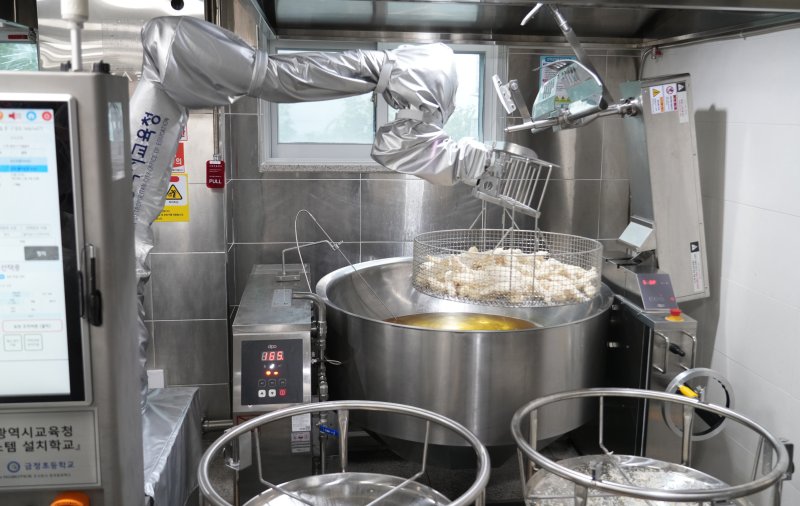
[Financial News] The Busan Metropolitan City Office of Education will deploy additional cooking robots in school cafeterias. Cooking robots first introduced in school cafeterias last year have helped create safer working conditions for cafeteria staff and ensure stable school meal operations.
The Busan Metropolitan City Office of Education announced on the 16th that it had been selected for the Korea Institute for Robot Industry Advancement's (KIRIA) 2026 Service Robot Demonstration Project for the second consecutive year.
As a result, the office will invest 800 million won in total project funding, including 400 million won in government funding—up 60% from last year's 250 million won—to install additional cooking robots at five schools: Changsin Elementary School, Hwajeong Elementary School, Naesung High School, Busan Technical High School and Jangan Jeil High School.
The robots being introduced this year will incorporate a mountable agitator that can use existing cooking pots as well as newly applied robots specialized for each process. These upgrades are based on user feedback and demonstration results from the models introduced last year at Geumjeong Elementary School, Busan Namil High School and Busan Physical Education High School.
Considering each school's cafeteria conditions and menu characteristics, the office plans to supply a stir-frying model to Changsin Elementary School, a soup-and-stew model to Hwajeong Elementary School, a multi-process model to Naesung High School, a frying model to Busan Technical High School, and a sauce-and-braising model to Jangan Jeil High School.
A comparison of working conditions before and after the cooking robots were introduced last year found that the average time spent working in front of cooking pots, where high-temperature and high-risk tasks are concentrated, fell by 69%. The number of tasks requiring physical strength also dropped by 72%. In addition, work intensity, analyzed based on working postures and body movements, decreased by about 50%, significantly reducing physical risk factors such as musculoskeletal strain.
Positive assessments also emerged from meetings and satisfaction surveys conducted with cafeteria staff at schools where the cooking robots were installed.
This year's demonstration project is expected to simultaneously protect cafeteria workers' health, reduce their workload and standardize cooking quality by advancing technologies such as AI vision-based object recognition and automatic control.
The Busan Metropolitan City Office of Education plans to sign an agreement with KIRIA to carry out the project this month. After conducting detailed inspections at the schools selected for installation, it will complete the installation of cooking robots in the cafeterias of all five schools around mid-November, according to each school's schedule.
Superintendent Kim Seok-jun said, "Securing government funding for the second consecutive year has enabled us to expand the introduction of cooking robots in school cafeterias." He added, "We will continue to make every effort to create a safe and sustainable school meal environment by dramatically improving the working conditions of cafeteria staff."
[email protected] Kwon Byeong-seok Reporter