"Hydrogen for Long-Distance Transport"... Hyundai Motor Group Presents Complementary Strategy for EVs
- Input
- 2026-09-16 09:01:13
- Updated
- 2026-09-16 09:01:13
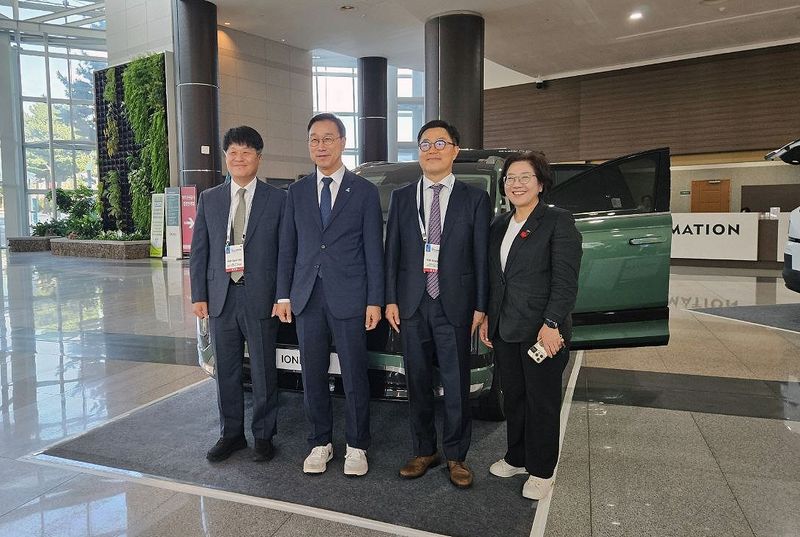
[Financial News] Hyundai Motor Group has presented a strategy to utilize hydrogen electric vehicles in essential transportation sectors, such as long-distance and heavy-duty transport, buses, and logistics. The plan envisions dividing the roles of battery electric vehicles and hydrogen electric vehicles to address rising electricity demand and constraints on expanding the power distribution network. The group also emphasized an energy supply system that stores hydrogen produced from renewable energy and utilizes it when needed.
Utilization of hydrogen in long-distance and essential transportation
Hyundai Motor Group announced on the 16th that it participated in the '2026 Green Hydrogen Global Forum with Distributed Energy Forum,' held at the International Convention Center Jeju for three days starting from the 14th, and shared directions for energy transition and plans for utilizing hydrogen mobility.This event, co-hosted by the Ministry of Climate, Energy and Environment and Jeju Special Self-Governing Province, was attended by 106 institutions, companies, and universities from nine countries, including the International Energy Agency (IEA) and the Global Green Growth Institute (GGGI). Participants discussed the production and utilization of renewable energy-based green hydrogen and measures to expand the demand for clean hydrogen.
At the strategy session on expanding the clean hydrogen demand market held on the 15th, hydrogen electric vehicles and battery electric vehicles were presented as mutually complementary means of transportation based on the characteristics of each technology.
The explanation is that hydrogen electric vehicles have value in long-distance and heavy-duty transportation, where rapid charging, long driving range, and high operational efficiency are required. Sectors requiring stable operation, such as buses, taxis, and logistics trucks, were also cited as key application targets.
Hyundai Motor Group suggested that an energy infrastructure utilizing both electricity and hydrogen is necessary to address increasing power demand, constraints on expanding distribution networks, and charging demand concentrated during specific time periods. The company argued that deploying hydrogen electric vehicles, which do not directly rely on electric charging during operation, into essential transportation sectors could enhance the responsiveness of urban transportation systems.
"Hydrogen mobility is an alternative that can complement electric-based mobility in fields requiring stable operation, such as long-distance transportation and disaster response," said a Hyundai Motor Group official. "We will explore various potential applications linking renewable energy and hydrogen and collaborate with partners to contribute to expanding the clean hydrogen demand ecosystem."
Combination of Renewable Energy and Hydrogen... Demonstration in Jeju
In his congratulatory remarks at the opening ceremony on the 15th, Shin Seung-gyu, Vice President of Hyundai Motor Group, emphasized the need to establish a system for stable energy supply and efficient utilization along with the expansion of renewable energy supply.Vice President Shin explained that storing hydrogen produced from renewable energy and utilizing it when needed can increase the flexibility of the energy system. He also pointed out that Jeju Island can play an important role in demonstrating and expanding this model.
Jeju Island has been expanding its infrastructure for clean hydrogen production and utilization since the start of a 250 kW-class water electrolysis demonstration in 2017. The 3.3 MW water electrolysis complex in Haengwon, Gujwa-eup, has been producing approximately 200 kg of hydrogen per day since September 2024 and supplying it to hydrogen buses and hydrogen passenger cars in the province.
The cumulative number of hydrogen vehicles to be introduced by 2027 is approximately 370, including 290 passenger cars, 76 buses, and 3 trucks. Since starting cooperation with Jeju Island to build an eco-friendly vehicle ecosystem in 2021, Hyundai Motor Group has been continuing its collaboration in the V2G sector, which supplies hydrogen and electric vehicle power to the power grid.
"The combination of renewable energy and hydrogen is an important foundation for turning new possibilities for energy transition into reality," Vice President Shin stated. "Hyundai Motor Group will work closely with Jeju Island to build the future of Korea's hydrogen economy together."
Hyundai Motor Group exhibited the hydrogen electric vehicle 'The all-new NEXO' and the electric vehicle 'Hyundai Ioniq 9' at the forum exhibition space and introduced hydrogen mobility and electrification technologies.
[email protected] Kim Dong-ho Reporter