Korean Air Finalizes Contracts for 103 Boeing Aircraft and GE Engines Worth $60 Trillion
- Input
- 2026-09-16 09:03:47
- Updated
- 2026-09-16 09:03:47
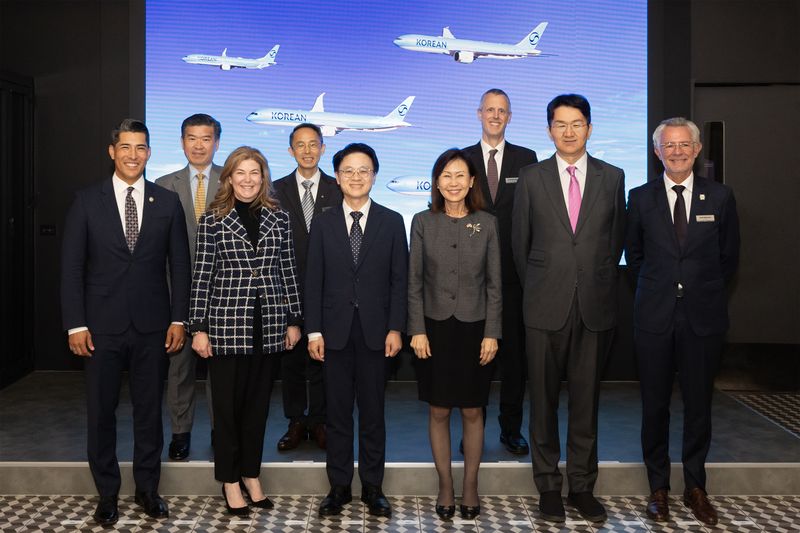
Korean Air announced on the 16th that it had finalized the introduction of 103 next-generation, fuel-efficient aircraft from The Boeing Company in the United States, worth $36.2 billion. It also completed an $8.6 billion contract with GE Aerospace and CFM International to purchase spare aircraft engines and provide engine maintenance services. The agreements convert into definitive contracts the large-scale procurement plan announced last August in Washington, D.C., during an economic delegation’s visit to the United States.■ Walter Cho: “Boeing is Korean Air’s wings, and GE Aerospace is its heart”Korean Air held an event with The Boeing Company at Conrad Seoul in Yeongdeungpo-gu, Seoul, on the 15th, to commemorate the signing of definitive agreements for the MOU on aircraft and engine purchases and services. Attendees included Walter Cho, chairman of Hanjin Group; Stephanie Pope, president and CEO of Boeing Commercial Airplanes; and Gaël Méheust, president and CEO of CFM. Kim Jung-kwan, Minister of Trade, Industry and Energy; Michelle Park Steel, U.S. ambassador to South Korea; James Kim, chairman and CEO of AMCHAM Korea; Hwang Ki-yeon, chairman of KEXIM; and other officials from the Korean and U.S. governments and state-run financial institutions were also present.
At the event, Walter Cho said, “I find it very meaningful that the promise made in Washington, D.C., last year has come to fruition in the form of definitive contracts.” He added, “This agreement goes beyond a simple transaction between companies; it is a milestone of trust that will further strengthen the robust economic and technological alliance between South Korea and the United States.”
He continued, “If Boeing is Korean Air’s wings, GE Aerospace has served as the heart of our aircraft fleet.” He added, “Building on the longstanding partnerships Korean Air has developed with Boeing, GE Aerospace and CFM, we will provide the highest levels of safety and service and faithfully fulfill our role in connecting exchanges and economic development between the two countries.”
The Boeing aircraft Korean Air will acquire under the agreement comprise 20 777-9s, 25 Boeing 787-10s, 50 737-10s and eight 777-8F freighters, for a total of 103 aircraft. The airline will also purchase 21 spare engines from GE Aerospace and CFM International. In addition, it signed a 15-year engine maintenance-services contract with GE Aerospace covering 28 aircraft.■ A foundation for proactive fleet modernization... Results of government support and cooperationThe agreement is viewed as a measure to prepare for medium- and long-term growth following the integration with Asiana Airlines while proactively responding to global aircraft-delivery delays that have continued since the pandemic. Korean Air plans to modernize its fleet and improve operational efficiency by introducing next-generation, fuel-efficient aircraft, while also expanding capacity and improving customer service. The airline intends to raise the proportion of fuel-efficient new aircraft to improve fuel efficiency and reduce carbon emissions.
The agreement is considered significant because it represents more than a transaction between companies; it was achieved through close communication and support from the governments of South Korea and the United States. The Korean government contributed policy support and regulatory improvements to strengthen the competitiveness of the aviation industry, while state-run financial institutions, including KEXIM, continued to cooperate in supporting the smooth implementation of the large-scale investment.
A Korean Air official said, “The MOU signed in Washington, D.C., last year could lead to definitive contracts because of the unwavering trust and cooperation of the governments and financial institutions of South Korea and the United States, as well as our partner companies.” The official added, “Korean Air will continue to strengthen its future competitiveness through the introduction of next-generation aircraft and cooperation with global partners, while contributing to greater exchanges and economic cooperation between South Korea and the United States.”
[email protected] Jung Won-il Reporter