"I Thought My Heart Had Fully Recovered"... Survival Falls When Only Half the Heart Recovers [Health Check]
- Input
- 2026-09-16 08:43:12
- Updated
- 2026-09-16 08:43:12
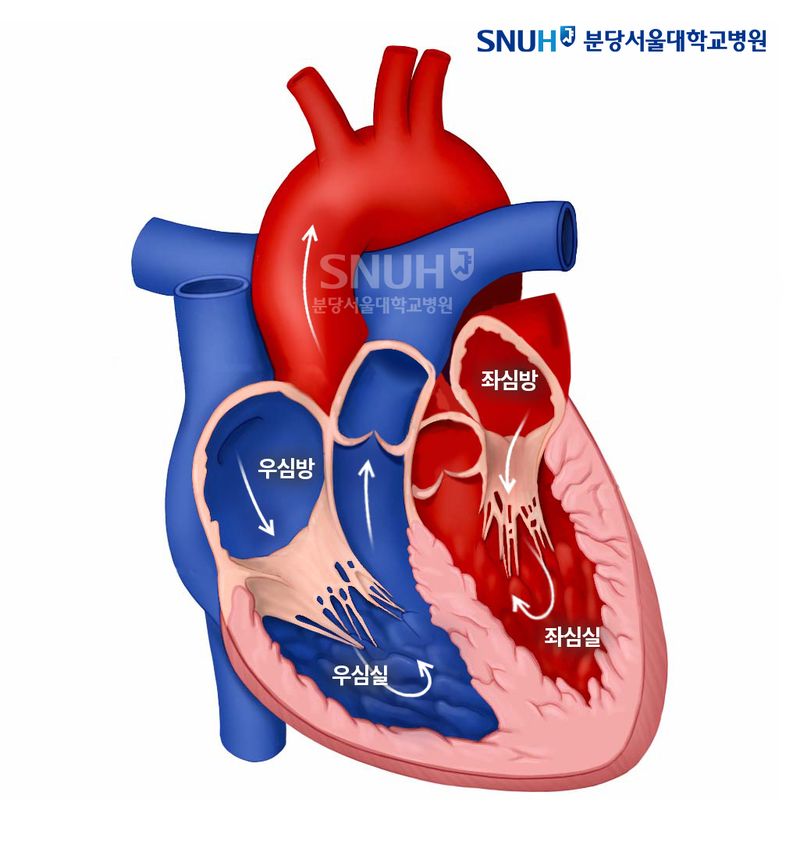
[Financial News] Even if weakened heart-pumping function is restored after heart-failure treatment, survival rates were found to fall sharply if the left atrium does not recover as well.
A research team led by Professors In-Chang Hwang and Ji-Seok Park of the Division of Cardiology at Seoul National University Bundang Hospital announced the findings in collaboration with Professor Hyung-Kwan Kim of the Division of Cardiology at Seoul National University Hospital.
Heart failure is a condition in which damaged heart muscle cannot pump enough blood to meet the body's needs. When the heart's pumping function gradually declines due to conditions such as myocardial infarction or high blood pressure, patients may become short of breath and tire easily even after slight movement. Blood that is not pumped out properly can also build up, causing fluid in the lungs or swelling in the legs.
A type of heart failure in which the heart's ability to eject blood is weakened is called heart failure with reduced ejection fraction. As angiotensin receptor-neprilysin inhibitor (ARNI) therapy, which suppresses hormones that place stress on the heart, has become a standard treatment, the goal has expanded beyond relieving symptoms to restoring the weakened heart to a condition close to normal.
Until now, treatment response had been assessed mainly by focusing on the left ventricle. Because the left ventricle is the heart's main pump for sending blood throughout the body, doctors evaluated treatment response by measuring how much the ejection fraction—the proportion of blood pumped out with each contraction—had increased. For the left atrium, assessment was generally limited to checking how much its size had changed.
The left atrium receives blood returning from the lungs and passes it to the left ventricle. If the left ventricle weakens and cannot pump out enough blood, pressure inside it rises. That burden extends to the left atrium, which transfers the blood, and its function gradually declines over time. It had not yet been established whether a damaged left atrium recovers during treatment or what effect a lack of recovery has on patients.
The research team therefore conducted a study using strain echocardiography, which precisely measures heart-muscle movement and deformation, to examine functional recovery in the left ventricle and left atrium. The researchers analyzed 1,182 heart-failure patients who began ARNI treatment at Seoul National University Bundang Hospital and Seoul National University Hospital between 2017 and 2022 and who had test results available both before treatment and one year later.
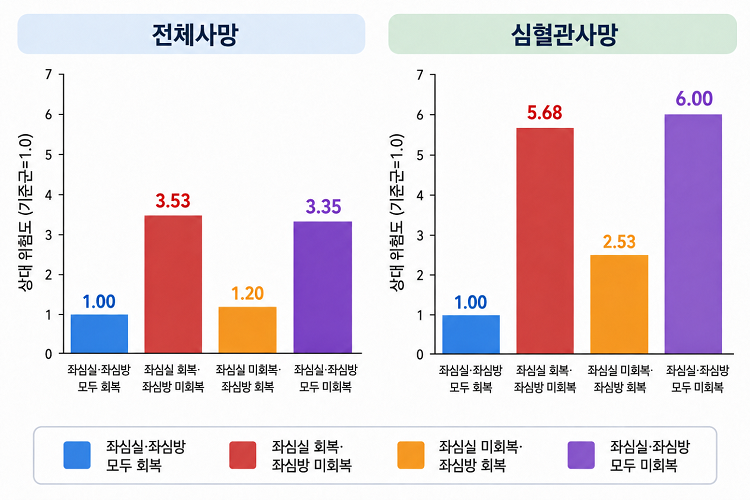
Based on changes over the one-year period, the researchers divided the patients into four groups: recovery of both the left ventricle and left atrium; recovery of the left ventricle only; recovery of the left atrium only; and recovery of neither. They then tracked long-term outcomes for approximately 26 months.
The results showed that even when left ventricular function recovered, the risk of death remained high if left atrial function did not recover as well. Patients whose left ventricular function alone recovered accounted for 11.2% of the total. Compared with patients whose two functions both recovered, they had a 3.53-fold higher risk of all-cause mortality and a 5.68-fold higher risk of cardiovascular death. These figures were similar to the risks among patients whose left ventricular and left atrial functions both failed to recover—3.35-fold and 6.00-fold, respectively.
Patients whose left ventricular function alone recovered continued to show signs of strain, including no reduction in left atrial size and insufficiently lowered pressure inside the heart. The research team explained that the left atrium may have already sustained damage that was difficult to reverse, preventing it from recovering along with the left ventricle.
The researchers conducted an additional analysis to determine whether these patients could be identified using the conventional measures of left ventricular ejection fraction and left atrial size. Although this approach also identified the risk among patients whose two functions failed to recover, it did not clearly reveal the mortality risk among those whose left ventricular function alone recovered. This suggests that conventional tests make it difficult to identify this high-risk group.
The study is significant because it provides evidence that both the left ventricle and left atrium should be assessed when evaluating the success of heart-failure treatment. It also demonstrated the clinical value of strain echocardiography for detecting these changes. The technique is expected to enable more precise identification of high-risk patients who cannot be identified through conventional tests.
Professor In-Chang Hwang said, "Because the left atrium is where the burden the heart has endured over time accumulates, its recovery should be monitored as well. If a patient's left atrial function fails to keep pace, more proactive management may be considered, such as adjusting medication or more carefully checking whether fluid is accumulating in the body."
First author Professor Ji-Seok Park said, "The next task is to determine why left atrial function fails to recover and which patients develop this pattern. We will use cardiac MRI and other methods to identify the actual changes occurring in the left atrium and pursue research into the possibility of recovery."
Meanwhile, the findings were published in the international heart-failure journal European Journal of Heart Failure (EJHF; impact factor 10.3).
[email protected] Medical Correspondent Jeong Myeong-jin Reporter