DoD Inspector General: "Four Months Into Iran War, Ammunition Stocks Are Depleted"—Directly Contradicting Trump's Claim
- Input
- 2026-09-16 03:40:05
- Updated
- 2026-09-16 03:40:05
The Inspector General of the United States Department of Defense officially confirmed on the 15th local time that the U.S. military was experiencing "a strategic ammunition stockpile shortage" because of the Iran war. The report said that Donald Trump had begun the war on February 28 and that more than $22 billion in weapons had been expended over four months, leaving ammunition stocks depleted.
Inspector General Rebuts Claims by Trump and Hegseth
The Inspector General issued a report that directly contradicted statements by President Donald Trump and Defense Secretary Pete Hegseth, who had said there was no ammunition shortage despite the war.
The report marked the DoD's first official acknowledgment of an ammunition shortage since the war began. It indicated that the Iran war launched by Trump had not only triggered a global energy crisis, a sharp rise in Treasury yields, and inflation, but had also put U.S. defense capabilities at risk.
In the Inspector General's report, the office of Michael Duffy, the undersecretary responsible for acquisition and logistics support at the DoD, noted that "ammunition consumption during the war created a strategic stockpile shortage and exposed bottlenecks in ammunition replenishment."
Duffy's office added that although the DoD was seeking to expand ammunition production capacity, the U.S. defense industrial base required "significant lead times." In other words, it takes a long time to order and receive ammunition. The report identified solid rocket motor production, securing high-performance explosives and propellants, and recruiting skilled workers as the biggest bottlenecks.
Up to 30 MQ-9 Reapers Damaged
The report also noted that U.S. ammunition consumption "clearly demonstrates the scope and complexity of the targets Iran selected."
U.S. Air Force Chief of Staff General Kenneth S. Wilsbach had said on the 14th that "it is not easy to annihilate" the Iranian air force and conventional navy, adding, "Iran is no pushover."
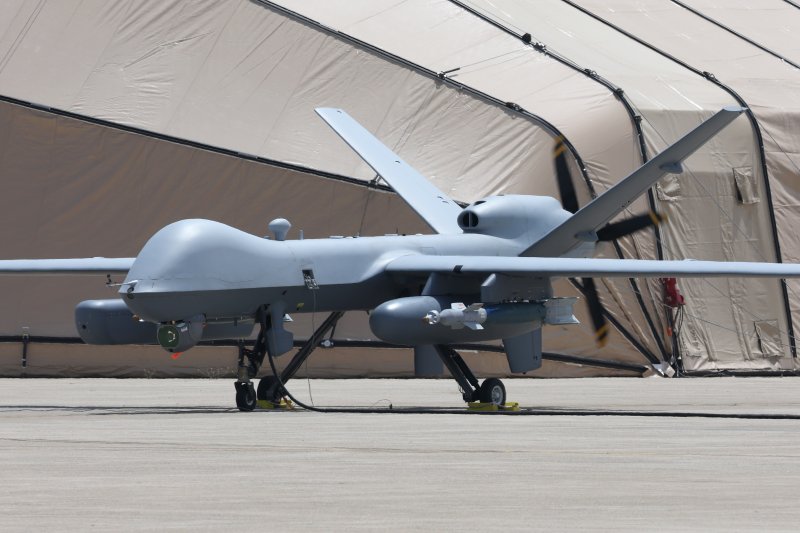
The Inspector General's report also detailed the damage inflicted on U.S. bases and aircraft by Iranian attacks. Twenty-two aircraft and helicopters, including fighter jets and aerial refueling aircraft, were partially damaged or completely destroyed. Up to 30 General Atomics MQ-9 Reapers, the latest unmanned attack aircraft known as the "assassin of the skies," were also damaged or destroyed.
According to the report, United States Central Command (USCENTCOM), which oversees the Middle East, reported that hundreds of U.S. military buildings and facilities in Bahrain, Iraq, Jordan, Kuwait, Oman, Qatar, and Saudi Arabia were hit by Iranian attacks. U.S. diplomatic missions in Iraq, Kuwait, Saudi Arabia, and the United Arab Emirates (UAE) were also attacked by Iran. The damage totaled approximately $184 million.
After Bahrain Naval Base Was Hit, Forces Retreated 4,400 km to Diego Garcia
The report further stated that the Bahrain base housing the U.S. Navy's Middle East command had come under attack by drones and cruise missiles, seriously disrupting logistics support. Because establishing an alternative base at a nearby port was difficult, the U.S. military built a new hub on Diego Garcia, a coral island in the Indian Ocean that hosts a joint U.S.-British base. Located approximately 4,400 km from Bahrain, Diego Garcia extended the logistics support cycle by another 14 to 18 days.
The report also said that the war cost $33.4 billion during the four months from the outbreak of the Iran war through June 30. Of that amount, ammunition costs accounted for $22.3 billion and equipment losses for $3.7 billion. Hegseth said in July that $37.5 billion had been spent on the war to date. Neither the Inspector General's report nor Hegseth's estimate included the cost of repairing facilities and infrastructure.
Meanwhile, The White House has asked Congress for a $67 billion supplemental budget, including $21 billion for ammunition costs.
[email protected] Song Kyung-jae Reporter