Seoul City Bus Labor-Management Talks Collapse; Strike to Begin with First Buses on the 16th
- Input
- 2026-09-16 00:28:45
- Updated
- 2026-09-16 00:28:45
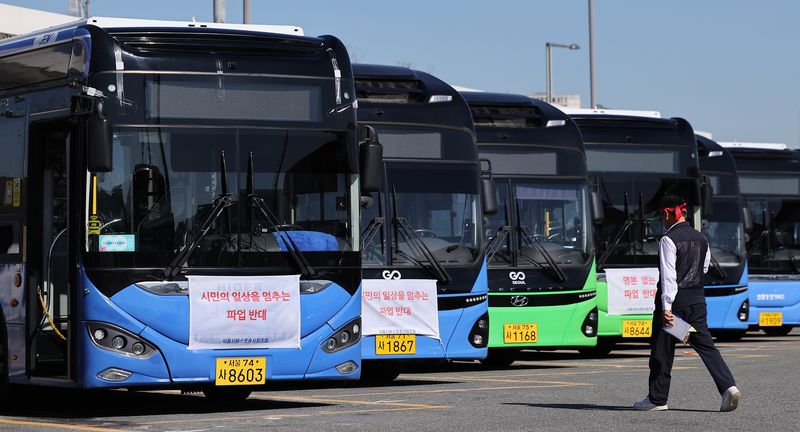
[Financial News] Seoul's labor and management failed to narrow their differences over the reference hours for calculating ordinary wages until the final stage of negotiations. As a result, the union will launch a strike, halting bus services from the first buses of the day on the 16th. The Seoul Metropolitan Government will activate an emergency transportation system, deploying 1,500 free shuttle buses and increasing subway services. Seoul's labor and management attended a second mediation meeting at the Seoul Regional Labor Relations Commission in Yeongdeungpo-gu from 2 p.m. on the 15th to mediate the labor dispute. After eight hours of mediation failed to bridge the gap, the union declared the negotiations collapsed at around 10 p.m. The two sides continued to contact each other until midnight, the mediation deadline, but ultimately failed to reach an agreement.
The biggest issue in the negotiations was the monthly reference hours to be used in calculating ordinary wages. Citing a Supreme Court of Korea ruling in April, the union argued that 176 hours per month should be applied. Management, however, proposed first restructuring the wage system based on 209 hours per month, then making a retroactive adjustment in line with the court's ruling if a different standard is established in the ongoing ordinary-wage lawsuit.
The Seoul Metropolitan Government maintains that the Supreme Court of Korea's April 30 ruling concerning Dong-a Transportation did not directly establish 176 hours as the reference hours for calculating ordinary wages. Yeo Jang-kwon, head of the Seoul Metropolitan Government's Transportation Office, said, "There has not yet been a definitive Supreme Court ruling on whether the monthly reference hours for ordinary wages are 176 hours."
The Seoul Metropolitan Government estimates that applying 176 hours as demanded by the union and additionally raising the hourly wage by 7.85% would result in an overall wage increase of about 24%. The resulting additional financial burden on the Seoul Metropolitan Government is estimated at approximately 220 billion won annually.
The union maintained that 176 hours must be applied in accordance with the court ruling. However, it said its demand for a 7.85% increase in the hourly wage was not fixed and could be negotiated within a range of 0% to 7.85%. The union also disputed management's claim that bus drivers earn an annual salary of 85 million won, saying that figure assumes they work all holidays and overtime hours. According to the union, bus drivers' annual salaries this year are approximately 59 million won.
With the second mediation meeting ultimately ending without an agreement, the union will launch a full-scale strike as scheduled at 4 a.m. on the 16th, when the first buses are due to begin service. In Seoul, about 7,000 city buses operated by 64 companies on roughly 390 routes have been in service.
The Seoul Metropolitan Government will implement emergency transportation measures to minimize inconvenience caused by the strike. Up to 1,500 free shuttle buses operated by autonomous districts will be deployed, while subway services will increase by 202 trips per day. Subway operations will also be extended, with the last trains running until 2 a.m. the following day, based on arrival at their terminal stations.
At an emergency situation review meeting the previous day, Seoul Mayor Oh Se-hoon said, "If city buses used by about 3.8 million people a day stop running, residents' daily travel, including commuting to and from work and school, will be severely disrupted." He added, "We will make thorough preparations by mobilizing every available means of transportation so that there is no gap in residents' mobility."
Meanwhile, in an online survey conducted by The Seoul Institute over two days starting on the 14th among 1,000 men and women aged 19 or older living in Seoul, 81.3% of respondents said they opposed a full-scale city bus strike. Of them, 43.0% said they "strongly oppose" it, while 38.3% said they "generally oppose" it.
[email protected] Seong Chorong Reporter