Seoul Bus Labor-Management Talks Break Down for Now... “Last-Ditch Negotiations Until Midnight”
- Input
- 2026-09-15 23:17:04
- Updated
- 2026-09-15 23:17:04
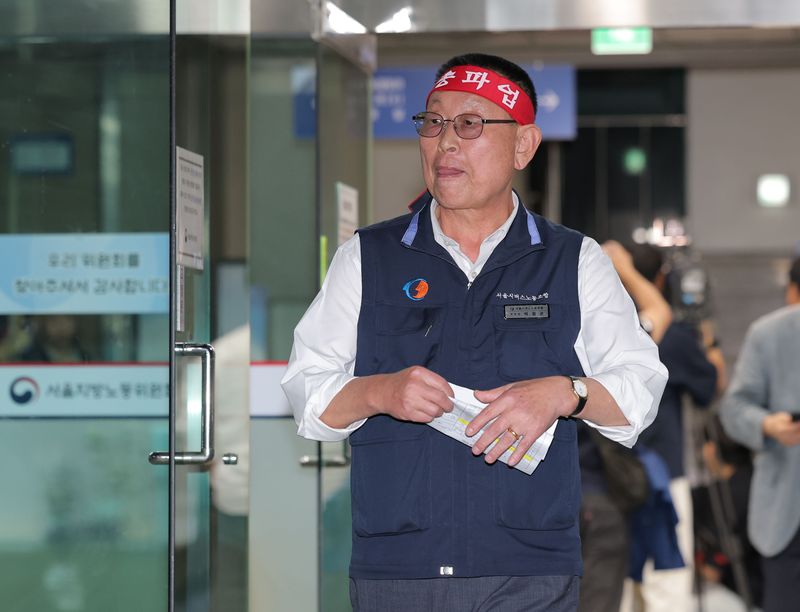
[Financial News] Seoul’s city buses are increasingly likely to go on strike from 4 a.m. on the 16th. Labor and management failed to narrow their differences over the reference hours used to calculate ordinary wages despite eight hours of mediation, and the talks broke down for now. However, the union’s negotiating committee members will remain on site and communicate with management until midnight, when the statutory mediation period ends, leaving open the possibility of a last-minute agreement.
The labor and management representatives of Seoul’s city bus system held their second mediation meeting to resolve the labor dispute at the Seoul Regional Labor Relations Commission in Yeongdeungpo-gu from 2 p.m. on the 15th. They failed to reach an agreement, and mediation broke down at around 10 p.m. Immediately afterward, the union announced, “We will go on strike from 4 a.m. on the 16th,” while explaining that “the negotiating committee members handling the practical aspects of the talks will remain on site and communicate with management until midnight, when the statutory mediation period ends.”
The central issue in the negotiations is the monthly reference hours to be used in calculating ordinary wages. Citing a Supreme Court ruling in April, the union argues that 176 hours per month should be applied. Management, meanwhile, proposes first restructuring the wage system based on 209 hours per month and then making retroactive adjustments in accordance with the outcome if a different standard is established in the ongoing litigation over ordinary wages.
The Seoul Metropolitan Government maintains that the Supreme Court’s April 30 ruling concerning Dong-a Transportation did not directly establish 176 hours as the reference for calculating ordinary wages. Yeo Jang-kwon, Director General for Transportation of the Seoul Metropolitan Government, said on the 15th, “The Supreme Court has not yet issued a definitive ruling on whether the reference for ordinary wages is 176 hours per month.”
The Seoul Metropolitan Government estimates that applying 176 hours, combined with the union’s demand for a 7.85% hourly-wage increase, would result in an overall wage increase of approximately 24%. The city’s additional financial burden is estimated at about 220 billion won annually.
The union continues to insist that 176 hours must be applied in accordance with the court ruling. However, it says its demand for a 7.85% hourly-wage increase is not fixed and that it can negotiate within a range of 0% to 7.85%. It also disputed management’s claim that bus drivers earn 85 million won annually, saying that figure assumes they work all holidays and overtime. According to the union, bus drivers’ annual salaries this year are around 59 million won.
If the additional negotiations fail to produce an agreement by midnight, the union plans to launch an all-out strike from the first buses at 4 a.m. on the 16th. In Seoul, more than 7,000 city buses have been operating across approximately 390 routes run by 64 companies.
The Seoul Metropolitan Government will activate emergency transportation measures in preparation for the strike. It plans to deploy up to 1,500 free shuttle buses operated by local districts and increase subway services by 202 trips per day. The final subway trains will also run until 2 a.m. the following day, based on their terminal stations.
At an emergency situation review meeting, Oh Se-hoon, Mayor of Seoul, said, “If the city buses used by approximately 3.8 million people a day stop running, citizens’ daily travel, including commuting to work and school, will be severely disrupted.” He added, “We will mobilize all available means of transportation and prepare thoroughly so that there is no gap in citizens’ mobility tomorrow morning.”
Meanwhile, an online survey conducted by The Seoul Institute over two days starting on the 14th among 1,000 men and women aged 19 or older living in Seoul found that 81.3% of respondents opposed a full-scale city bus strike. Of those surveyed, 43.0% said they “strongly oppose” it, while 38.3% said they “generally oppose” it.
[email protected] Seong Cho-rong Reporter