President Lee Holds Successive Summits on Kazakhstan’s Oil and Nuclear Power, Turkmenistan’s Railways and Investment
- Input
- 2026-09-15 19:00:00
- Updated
- 2026-09-15 19:00:00
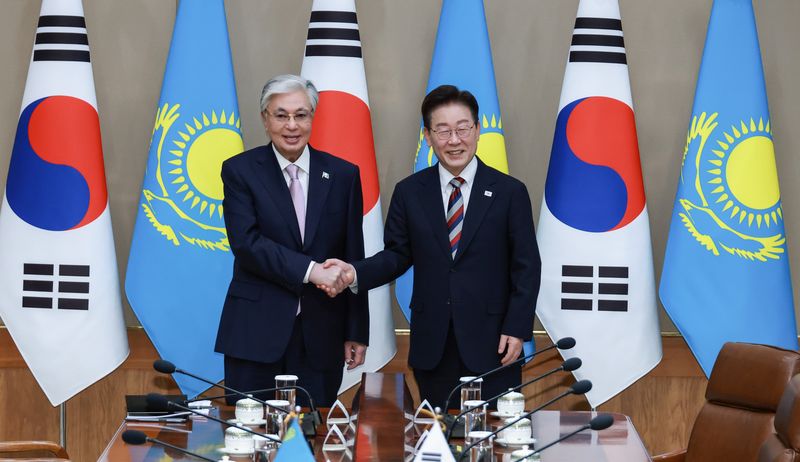
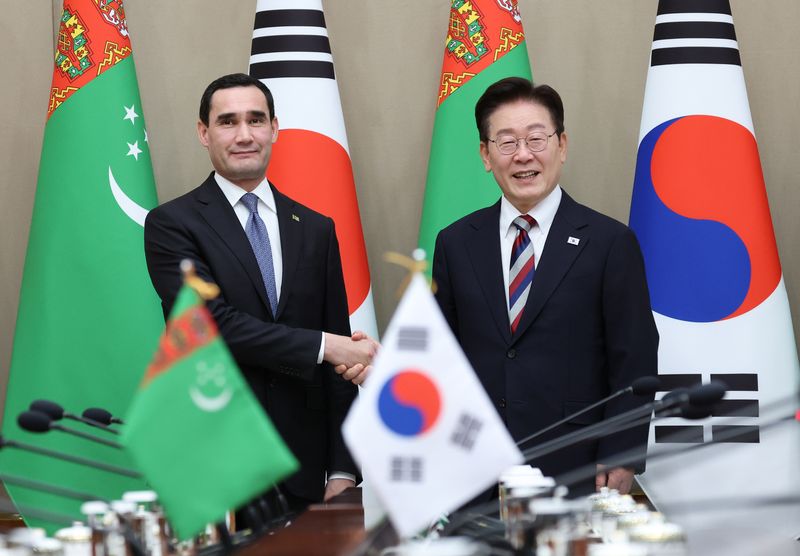
[Financial News] President Lee Jae Myung held successive meetings with the leaders of Kazakhstan and Turkmenistan on the 15th to discuss ways to expand economic cooperation, focusing on energy and infrastructure. South Korea and Kazakhstan agreed to upgrade their ties to a “future-oriented comprehensive strategic partnership” and strengthen cooperation in crude oil, nuclear power, and advanced transportation. South Korea and Turkmenistan agreed to broaden cooperation beyond energy and plants to areas including railways and shipbuilding.
At Cheong Wa Dae, President Lee held a summit with Kazakh President Kassym-Jomart Tokayev, who was on a state visit to South Korea, and agreed to upgrade bilateral ties to a “future-oriented comprehensive strategic partnership” for the first time in 17 years. The two countries also exchanged 13 intergovernmental agreements and memorandums of understanding (MOUs).
South Korea and Kazakhstan signed a basic agreement on crude oil cooperation in the energy sector. The two countries agreed to jointly respond to disruptions in global crude oil supply chains and expand cooperation to include the supply of Kazakh crude oil, geological exploration, crude oil and gas field development, and the petrochemical and gas industries.
The two countries will also expand nuclear cooperation. The Ministry of Trade and Industry and Kazakhstan’s nuclear energy authority agreed to cooperate on joint research and development involving nuclear power plants and small modular reactors (SMRs), exchanges on nuclear industry policies, nuclear and radiation safety, and the training of specialists. The government plans to use this cooperation as a foundation for South Korean companies to enter Kazakhstan’s new nuclear power plant projects.
The Ministry of Climate, Energy and Environment and Kazakhstan’s nuclear energy authority also signed an MOU on stabilizing the nuclear fuel supply chain, exchanging information on nuclear programs and safety, and conducting research and personnel training. The agreement is intended to enhance energy security by strengthening cooperation with Kazakhstan, one of the world’s major uranium producers, on the nuclear fuel supply chain.
Cooperation will also expand in advanced industries and infrastructure. In advanced air mobility, the two countries will pursue the introduction of traffic management systems for unmanned aircraft systems and urban air mobility (UAM), as well as technology transfers and exchanges. In renewable energy and the transition to clean energy, they agreed to cooperate on battery energy storage systems, power grid modernization, the development of clean hydrogen and ammonia value chains, and joint research and development.
Earlier that morning, President Lee held a summit with Turkmen President Serdar Berdimuhamedow. Kang Yoo-jung, a senior presidential spokesperson, said, “The two leaders agreed to build on the achievements of cooperation that the two countries have developed, centered on energy and plant projects since establishing a mutually beneficial partnership in 2008, and to expand the scope of bilateral cooperation into various areas, including infrastructure such as railways, shipbuilding, new city construction, water resources, forestry, and artificial intelligence (AI) and science and technology.”
South Korea and Turkmenistan signed 13 intergovernmental agreements and MOUs during the summit. The two countries agreed to expand cooperation in various areas, including investment promotion and protection; the chemical industry and plant projects; infrastructure such as construction, transportation, and logistics; water resources; railways; and combating transnational crime. In particular, the investment protection agreement, which provides an institutional foundation for protecting and promoting investment between the two countries, was concluded 16 years after negotiations began. Regarding cooperation in shipbuilding, Kang said, “The two leaders also valued the mutually beneficial cooperation model under which South Korean technicians and Turkmen personnel jointly build ships in Turkmenistan, and agreed to further expand this cooperation.”
[email protected] Choi Jong-geun Reporter