Strong Won Creates an 'Exchange Rate Variable' for K-Beauty Exporters
- Input
- 2026-09-16 14:09:51
- Updated
- 2026-09-16 14:09:51
[Financial News] As the won-dollar exchange rate falls, attention is being drawn to the impact it will have on K-Beauty, which has emerged as a major export item. While the prevailing view is that sales growth driven by the spreading popularity of K-Beauty will offset the burden, there are also concerns that the pace of export growth for K-Beauty, which has been expanding its growth trajectory, could be brought to a halt.
According to industry sources on the 16th, the decline in the won-dollar exchange rate is expected to moderate the growth of K-beauty exports. On the 7th, the won-dollar exchange rate fell to 1,334.7 won, dropping into the 1,330 won range for the first time in over two years. This represents a decrease of approximately 10% compared to the mid-1,400 won range maintained for the past year or so.
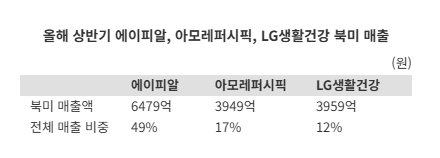
APR, where North America accounts for half of its sales, is expected to be most significantly affected by the decline in the won-dollar exchange rate. A simple calculation based on APR's North American sales for the first half of this year (647.9 billion won) due to a 10% drop in the exchange rate reduces the sales volume to the 580 billion won range. Assuming that sales in the second half remain at the level of the first half, the impact of the decline in sales due to the won-dollar exchange rate amounts to 100 billion won annually.
APR utilizes foreign currency earnings to cover expenses in order to minimize the impact of exchange rate fluctuations. This includes local advertising costs and sales commissions. Foreign exchange gains from foreign currency transactions in the first half of this year amounted to 16.9 billion won, representing 2.6% of North American sales. Given that the volatility of the won-dollar exchange rate was not significant through the first half of the year, foreign exchange losses are expected to increase in the third and fourth quarters. Increased local costs resulting from the rise in the won-dollar exchange rate are also expected to be a burden.
On the other hand, Amorepacific Corporation and LG Household & Health Care, which have a small proportion of sales in North America, are expected to be relatively less affected by exchange rate fluctuations.
In the first half of this year, North American sales accounted for approximately 17% and 12% of Amorepacific Corporation and LG Household & Health Care's sales, respectively. LG Household & Health Care projects that a 10% rise in the won-dollar exchange rate as of the end of the first half of the year will increase its net profit by about 2.5 billion won. This represents 0.6% of its North American sales (395.6 billion won) for the first half of the year. Since both companies internalize cosmetics manufacturing, they also benefit from reduced costs resulting from the decline in the won-dollar exchange rate. Cosmetic Original Design Manufacturer (ODM) companies such as Cosmax and Kolmar Korea are also expected to benefit from the drop in the won-dollar exchange rate.
However, the prevailing assessment is that the impact of the rise in the won-dollar exchange rate will be limited, as the growth rate of K-beauty exports is accelerating. According to the Ministry of Food and Drug Safety, the growth rate of K-beauty exports in the first half of this year was 27.3%, an increase of 12.7 percentage points compared to last year. Export regions are also diversifying, with K-beauty exports to Europe surpassing those to North America through July of this year. An official from the beauty industry stated, "While export companies are exposed to a certain degree of exchange rate fluctuations due to the nature of their business, the impact is expected to be limited as the popularity of K-beauty persists," adding, "We also need to watch whether the decline in the won-dollar exchange rate will continue in the long term."
[email protected] Kang Myeong-yeon Reporter