Jeju National University and Jeju Shinhwa World Expand Industry–University Cooperation from Field Training to Recruitment Links
- Input
- 2026-09-15 16:35:36
- Updated
- 2026-09-15 16:35:36
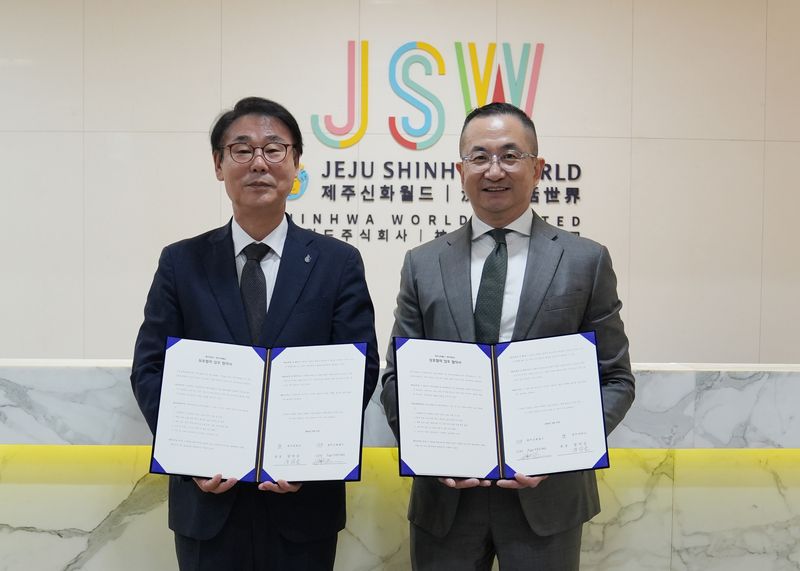
[Financial News Jeju = Jeong Yong-bok, Reporter] Jeju National University is expanding its existing field-training cooperation with Jeju Shinhwa World into a university-wide system for talent development and recruitment links. The initiative focuses on strengthening pathways for locally educated talent to enter regional companies by allowing students to apply their academic knowledge in the workplace and connecting field training and mentoring with employment support.
According to Jeju National University on the 15th, President Yang Deok-soon and Jeju Shinhwa World Chief Operating Officer (COO) Tigo Young signed a mutual cooperation agreement that day in the main conference room at Jeju Shinhwa World.
The scope of cooperation includes jointly planning and operating industry–university cooperation and talent development programs, as well as workplace-linked education such as company tours, special lectures, practical training, and mentoring.
The two sides will also cooperate in providing recruitment information, employment support programs, and activities linked to hiring. Exchanges in education, research, and public relations are also planned.
The significance of the agreement lies less in creating a new exchange than in expanding the student field training already in operation into an ongoing cooperation framework between the university and the company.
JNU also recruited students this year to participate in summer field training at Jeju Shinhwa World. Through JNU’s Center for Field Training Support and its Department of Tourism Management, students have taken part in programs that allow them to gain experience in actual corporate workplaces.
JNU’s standard field-training semester program is likewise designed to move beyond classroom-centered education. It enables students to acquire job-related knowledge and practical skills at companies, assess their suitability for specific roles, and ultimately connect the experience to employment.
The agreement provides an institutional foundation for expanding existing student-level training to include company tours, special lectures, mentoring, and the provision of recruitment information.

Jeju Shinhwa World operates hotels, resorts, theme parks, and water parks in Andeok-myeon, Seogwipo City. Because students can experience a wide range of roles—including lodging, food and beverage, customer service, culinary work, and tourism and leisure operations—the company has significant potential to serve as a corporate base connecting workplace education with employment.
For JNU as well, it is important to elevate cooperation with companies beyond short-term tours or one-off special lectures and center it on actual job experience.
If students can learn academic knowledge at the university, gain practical work experience at companies, and then access recruitment information and employment support, the gap between education and jobs can be narrowed. This is also why industry–university cooperation between regional universities and local companies is drawing attention.
Even when young people are educated locally, investment in regional talent development is unlikely to strengthen local industries if they move to the Seoul metropolitan area or elsewhere when seeking employment. If universities and companies jointly design the links between education, training, and recruitment, they can expand the options for locally educated talent to begin their careers in Jeju.
The agreement’s practical results will need to be assessed by examining how many students participate in field training and mentoring and how many of them ultimately secure actual employment.
Another challenge is determining how to reflect the roles companies need in university curricula. To ensure that field training does not remain merely a short-term work experience, pre-training job instruction, workplace mentoring, post-training evaluations, and employment links need to be designed as one integrated process.
Yang Deok-soon, president of Jeju National University, said, "We will join hands with Jeju Shinhwa World to foster talent suited to future industries and contribute to the development of the local community." He added, "We will also expand exchanges in research and education, beyond talent development, to create an opportunity for mutual growth."
[email protected] Jeong Yong-bok Reporter