'Robots That Won’t Get Lost in Unfamiliar Spaces'... AI Technology Developed for Spatial Awareness
- Input
- 2026-09-16 08:00:00
- Updated
- 2026-09-16 08:00:00
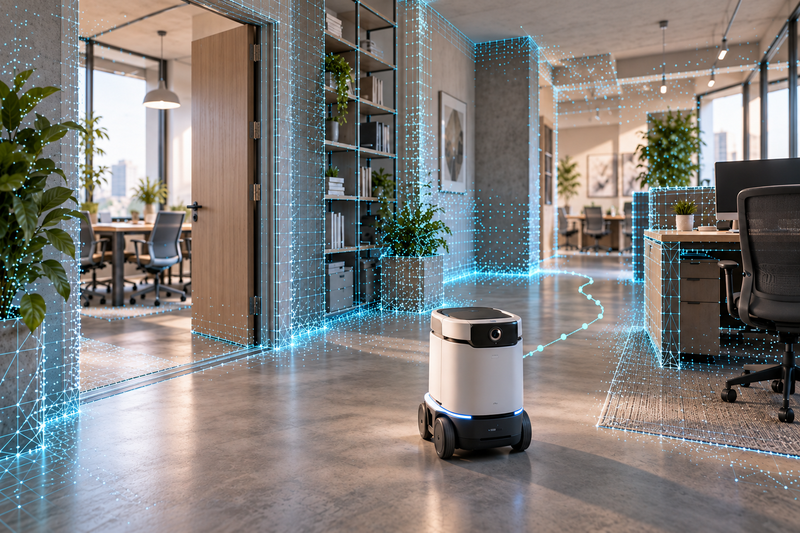
[Financial News] A new artificial intelligence (AI) technology has been developed that enables robots to understand their surroundings through cameras and determine their own locations within those spaces. The technology helps robots navigate unfamiliar environments without getting lost.
A research team led by Professor Kyungdon Joo of the Graduate School of Artificial Intelligence at Ulsan National Institute of Science and Technology (UNIST) announced on the 16th that it had developed UniSim-SLAM, an AI-based Simultaneous Localization and Mapping (SLAM) technology that improves both accuracy and speed.
AI-based Simultaneous Localization and Mapping (SLAM) technology enables AI to analyze camera footage from robots and other devices at different points in time, creating a three-dimensional map of the surroundings while determining the device’s location within it. The technology uses changes in the position and size of objects on screen as the camera moves.
Analyzing images from multiple viewpoints together can produce more accurate estimates. However, the process takes longer, making it difficult for moving robots or autonomous vehicles to determine their locations quickly.
UniSim-SLAM uses only two viewpoints to track location, while analyzing multiple viewpoints together to correct accumulated errors. This allows it to combine fast location tracking with accurate correction.
Results based on analyzing two images at a time and results based on analyzing multiple images can become misaligned, like maps of the same space drawn at different scales or orientations. The research team developed a technology to correct this discrepancy. It uses both the camera positions shared by the two analyses and the direction and distance the camera moved according to the shooting sequence. The system jointly scales, rotates, and shifts the three-dimensional reconstruction and movement trajectory so that the information aligns, reducing the difference between the two results.
When its performance was tested using 7-Scenes, a benchmark featuring footage of indoor spaces, the error in predicting the camera’s movement trajectory was reduced by up to 45.9% compared with the previous top-performing technology. Its ability to reconstruct real spaces in three dimensions also improved over existing technology. The time required to produce results after receiving the images needed for location estimation was reduced as well. VGGT-SLAM, an existing technology that analyzes multiple images together, took 3.41 seconds, while UniSim-SLAM took 0.197 seconds.
Professor Kyungdon Joo said, "SLAM technology can be used not only in robots and autonomous vehicles but also in augmented reality (AR), which requires real-time spatial reconstruction." He added, "By combining the advantages of fast and accurate analysis, UniSim-SLAM can simultaneously improve the precise location estimation and three-dimensional spatial reconstruction required in robotics, augmented reality, autonomous driving, and other fields."
The research was accepted for presentation at the 2026 European Conference on Computer Vision (ECCV), one of the most prestigious international academic conferences in computer vision. This year’s conference was held in Malmö, Sweden, from September 8 to 12.
[email protected] Yeon Ji-an Reporter