"Advancing Corporate Governance, Stablecoins Taking Forever"...Institutionalization Delayed
- Input
- 2026-09-15 17:09:52
- Updated
- 2026-09-15 17:09:52
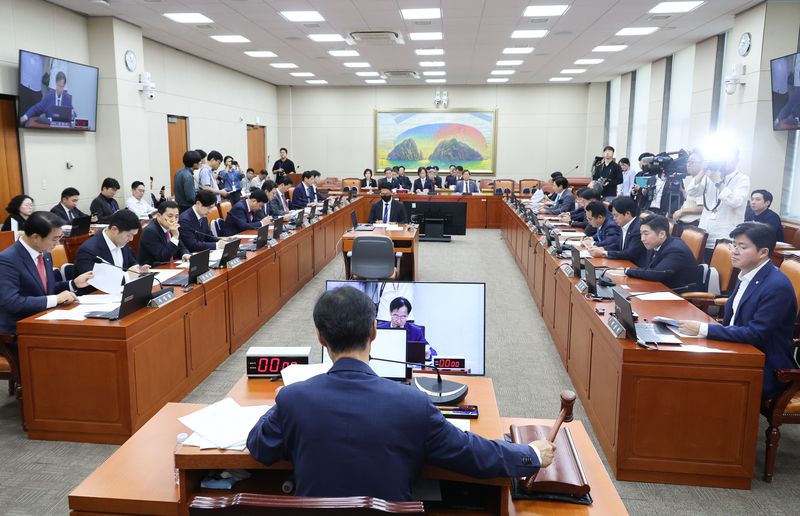
According to political and financial industry sources on the 15th, no discussions were held at that day's plenary meeting of the National Policy Committee of the National Assembly of the Republic of Korea or its First Subcommittee on Bill Review regarding the "corporate governance advancement plan" or the "Basic Act on Digital Assets." The committee is currently considering bills to amend the Act on Corporate Governance of Financial Companies, each introduced by Democratic Party lawmakers Kim Hyun-jung and Park Hong-bae and Shin Jang-sik, leader of the Rebuilding Korea Party. The bills aim to prevent the concentration of power resulting from long-term reappointments of financial company CEOs. Although their details differ, they would limit the number of consecutive terms or require a special resolution at a shareholders' meeting for reappointment in order to strengthen checks by boards of directors and shareholders.
Financial authorities have repeatedly expressed their intention to improve corporate governance in the financial sector since last year. In a work report in July, the Financial Services Commission (FSC) said it would devise measures to improve corporate governance by limiting the long-term reappointment of financial holding company chairmen and strengthening transparency and fairness in the chair-selection process.
Initially, legally limiting financial holding company chairmen to three consecutive terms emerged as a key issue. However, concerns have continued over possible infringements on managerial autonomy and unconstitutionality. In the National Assembly of the Republic of Korea, alternatives have been discussed, including requiring a special resolution at a shareholders' meeting for reappointment instead of banning three consecutive terms by law.
Kwak Hyun-jun, a senior expert adviser to the National Policy Committee of the National Assembly of the Republic of Korea, said in a review report presented at the plenary meeting on the 26th of last month, "The need to enhance the public nature and accountability of financial companies must be considered comprehensively alongside concerns that managerial autonomy could be restricted."
Lee Chan-jin, Governor of the Financial Supervisory Service, also said at an executive meeting that day, "The Corporate Governance Advancement Task Force, which has operated since January this year, has discussed various improvement measures to ensure that CEO appointments are not handled behind closed doors based on particular factions or personal relationships." He urged financial companies to "operate transparent and fair management succession procedures and contribute to enhancing shareholder value."
However, institutionalization is being delayed because the results of the Corporate Governance Advancement Task Force have not been made public, while the FSC has only announced a plan to make adjustments through legislation.
A financial industry official said, "Institutionalization will be possible only after personnel changes involving the policy chief have been completed and ruling and opposition lawmakers on the National Policy Committee of the National Assembly of the Republic of Korea have reached a consensus." The official added, "For now, it is on hold."
Legislation concerning won-denominated stablecoins is also being postponed. The key issue is which financial companies, and of what size, should be allowed to issue and distribute the coins. Significant differences remain over detailed regulations, including issuers' equity capital and reserve assets, as well as users' redemption rights. According to the report "The Impact of Stablecoins on Financial Markets and Its Implications," published by the National Assembly Budget Office (NABO), nine stablecoin-related bills had been introduced as of July. Six of them regulate digital assets broadly while including provisions on stablecoins, while the other three regulate stablecoins separately.
The bills differ in every respect, including eligibility and licensing for issuers, reserve assets, user protection, and supervisory systems. In particular, the equity capital required of issuers ranges from at least 500 million won to at least 5 billion won, depending on the bill. The NABO noted, "In the legislative process ahead, the scope and holding requirements for reserve assets must be set at an appropriate level."
A financial industry official said, "There are differences in the level of support among the bills," adding, "It is also true that the opposition party has shown little interest." The official predicted, "Passage within this year will be difficult because there is no single proposal even within the ruling party," and said, "The government and the ruling party should first develop a unified proposal."
[email protected] Park Moon-soo Reporter