Ewha Womans University Builds South Korea’s Largest AI- and Robot-Based Autonomous Laboratory
- Input
- 2026-09-15 15:33:20
- Updated
- 2026-09-15 15:33:20
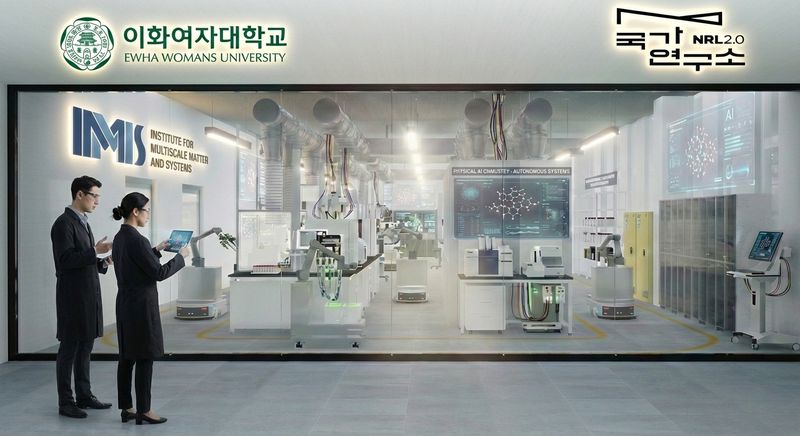
[Financial News] A cutting-edge laboratory where artificial intelligence (AI) designs experiments and robots autonomously synthesize materials will open on a university campus, operating even at night after researchers have gone home.
Ewha Womans University announced on the 15th that it will build an AI- and Robot-Based Autonomous Laboratory spanning 500 pyeong (approximately 1,650 square meters) in its Industry-Academic Cooperation Building, making it the largest of its kind among South Korean universities.
The autonomous laboratory was established to dramatically shorten the time required to develop new materials for key national advanced industries, including semiconductors, next-generation secondary batteries, and hydrogen. Conventional materials research requires people to manually mix substances and analyze the results, meaning that finding a single new material can take several years and enormous costs. Ewha Womans University plans to significantly accelerate materials development and secure leading global source technologies through an unmanned research environment that operates around the clock.
The autonomous laboratory operates as a fully automated closed-loop system. Once AI designs the optimal experimental conditions, unmanned robots mix the materials, synthesize the substance, and send it to analytical equipment. AI then immediately learns from the analysis results and independently instructs the next improved experiment. This process is repeated continuously, identifying optimal materials based on failure and success data without researcher intervention.
Ewha Womans University will be the first in the world to implement a technology that integrates five advanced future materials with entirely different characteristics on a single research platform. To achieve this, it will consolidate facilities in one location, including integrated infrastructure and specialized moisture-controlled research rooms, or dry rooms, capable of everything from material synthesis and precision analysis to solid-state battery production.
The facility was built under the leadership of Ewha Womans University’s Multiscale Materials and Systems Research Institute, which was selected for the National Research Laboratory (NRL 2.0) Development Program run by the Ministry of Science and ICT and the Ministry of Education. The institute will receive a total of 100 billion won in government funding over 10 years to develop advanced technologies and train future interdisciplinary talent.
Ewha Womans University President Hyang-Sook Lee said, "The autonomous laboratory is a fully automated research space in which AI and robots carry out the entire research cycle, from experiments and analysis to designing the next experiment." She added, "Through uninterrupted, 24-hour research, we will quickly secure technological competitiveness in key fields, including future-oriented semiconductors and next-generation batteries."
[email protected] Man-ki Kim Reporter