Ahead of the government's expansion of 'apartments without gas pipes'... Jeju launches demonstration of electrified heating, cooling and hot-water supply
- Input
- 2026-09-15 15:38:03
- Updated
- 2026-09-15 15:38:03
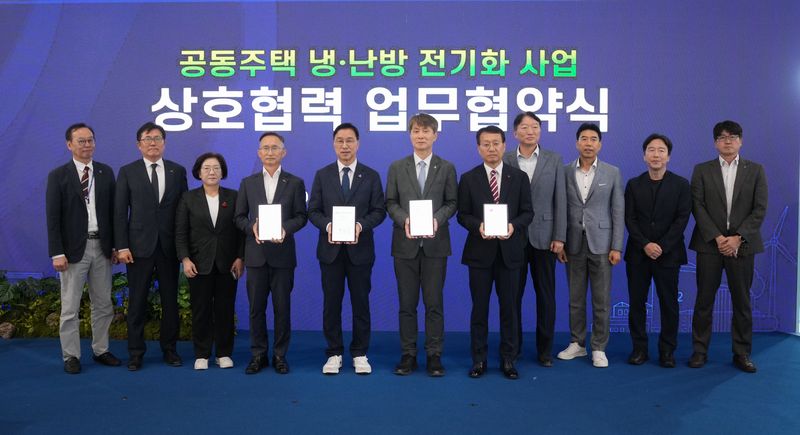
[Financial News Jeju = Reporter Jeong Yong-bok] A demonstration project is set to begin in Jeju’s public rental apartments, where residents actually live, to supply cooling, heating and hot water entirely with electricity without using boilers. The project is drawing attention because Jeju will be the first place to test an electrification model in an occupied apartment complex, as the government plans to increase next year’s heat-pump distribution budget 5.5-fold from this year and expand demonstrations to multi-unit housing.
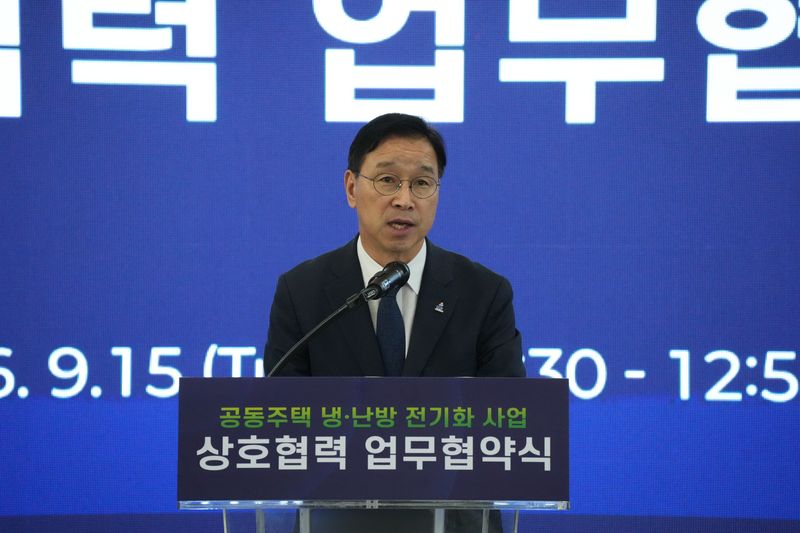
According to Jeju Special Self-Governing Province on the 15th, the province signed an agreement that day at International Convention Center Jeju with Jeju Development Corporation, the Korea Institute of Industrial Technology (KITECH) and LG Electronics for the ‘Demonstration Project for the Electrification of Heating and Cooling in Multi-unit Housing and Power-to-Heat (P2H) Conversion.’
The demonstration site is Sinhyo Apartment in Hyodon-dong, Seogwipo City. It is a 12-household public rental housing complex with one basement level and seven above-ground floors, operated by Jeju Development Corporation.
Sinhyo Apartment is scheduled to receive 2 kW of solar-generation capacity per household, 5 kW of solar capacity in common areas, high-efficiency electric induction cooktops and a smart energy-management system. Heat pumps will also be connected to electrify cooling and underfloor heating in each household, while hot water will be supplied through a central hot-water system.
Jeju Special Self-Governing Province explained that this is the first demonstration in the country to electrify heating, cooling and hot-water supply entirely on a heat-pump basis in an occupied multi-unit housing complex.
The core technology is power-to-heat (P2H). P2H converts electricity into thermal energy. When solar and wind generation is high, surplus electricity is converted into heat by heat pumps and stored in thermal-storage devices, then released when heating or hot water is needed.
Unlike systems that store electricity directly in batteries, this approach stores in the form of heat the energy needed for heating and hot-water demand, which ultimately requires heat.
In regions such as Jeju, where renewable-energy generation is high and electricity surpluses occur at certain times, this means buildings themselves can be used to help balance electricity supply and demand.
By operating heat pumps to store heat when electricity production is high and reducing their operation during peak-demand periods, they can serve as a ‘flexibility resource’ that eases the burden on the power grid.
The demonstration is also significant because it directly examines the practical obstacles to electrifying multi-unit housing. Unlike detached houses, apartments have limited space for mechanical equipment and must reliably supply hot water used simultaneously by multiple households.
In the Jeju demonstration, large heat pumps and high-density thermal-storage devices will be installed in common areas to supply hot water centrally, addressing space constraints, while heat pumps will integrate cooling and underfloor heating.
Government policy is moving in the same direction. In its plan announced last year to promote heat-pump deployment, the Ministry of Climate, Energy and Environment set a goal of deploying 3.5 million heat pumps and reducing greenhouse-gas emissions by 5.18 million tons by 2035.
The government’s recently released 2027 budget proposal includes 85.9 billion won for the heat-pump deployment project, a 447% increase from this year. The plan is to expand next year from this year’s detached-house-focused demonstrations to multi-unit housing and realize so-called ‘apartments without gas pipes.’
The government has not yet decided which regions and complexes will be included in next year’s multi-unit housing demonstration. It is considering multiple approaches, including installing heat pumps in individual households or placing large-capacity equipment centrally and supplying heat from there.
In that respect, the Sinhyo Apartment demonstration in Jeju could serve as a case for verifying the technology and operating methods in an actual residential environment before the government expands heat pumps in multi-unit housing.
Jeju Special Self-Governing Province said it was allocated 95% of the government-funded capacity for this year’s detached-house heat-pump deployment project.
The backdrop to Jeju’s accelerated heat-pump demonstrations is the power-supply-and-demand challenge created by the expansion of renewable energy. Wind and solar generation cannot easily be increased or reduced at will when needed. If generation exceeds consumption, output may have to be curtailed.
If residential heating and hot-water demand can be converted to electricity and usage times adjusted, it creates additional local demand that can consume more renewable electricity within the region.
Under the agreement, Jeju Special Self-Governing Province will handle institutional improvements and policy coordination. Jeju Development Corporation will be responsible for improving and operating the facilities at Sinhyo Apartment.
The Korea Institute of Industrial Technology (KITECH) will handle the design and construction of the central hot-water P2H system and analysis of operating data, while LG Electronics will be responsible for heat-pump design, product supply, technical support and performance evaluation.
“Electrifying apartment buildings has not been easy because of space constraints and existing facility systems,” said Saikee Oh, vice president of LG Electronics. “Through this demonstration, we will lay the foundation for a Korean-style apartment-building electrification model.”
Wi Seong-gon, Governor of Jeju Province, said, “This is a turning point in expanding innovation from detached houses to multi-unit housing,” adding, “We will continue to provide financial and institutional support for this demonstration.”
The key issue is the economic benefits and grid effects experienced by actual residents. For the boiler-free apartment model to spread nationwide, it must demonstrate competitiveness against existing heating methods not only in the stability of winter heating and hot-water supply but also in initial installation costs, electricity bills and maintenance expenses.
Actual operating data from the 12 households at Sinhyo Apartment in Jeju is expected to become the first test of whether the government’s ‘apartments without gas pipes’ initiative can be expanded to multi-unit housing nationwide.
[email protected] Jeong Yong-bok Reporter