K-water to Turn Water-Management Outcomes into Financial Indicators, Supporting Corporate ESG
- Input
- 2026-09-15 14:38:55
- Updated
- 2026-09-15 14:38:55
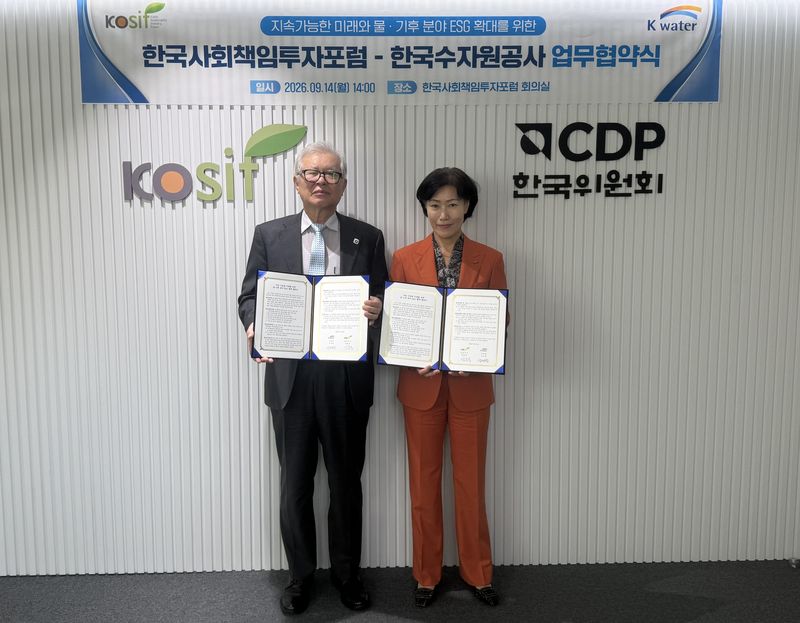
K-water announced on the 15th that it had signed a memorandum of understanding with the Korea Social Investment Forum (KoSIF) on the 14th at KoSIF’s meeting room in Gangnam-gu, Seoul, to cooperate on ESG in the water and climate sectors for a sustainable future.
The agreement was established to strengthen the capabilities of South Korean companies in response to tightening ESG regulations, including mandatory global disclosures and supply-chain due diligence.
KoSIF serves as the Korean committee secretariat for the Carbon Disclosure Project (CDP), an environmental-information disclosure platform involving more than 20,000 companies worldwide, and is an official global partner of RE100 (Renewable Energy 100%). K-water will apply nearly 60 years of accumulated water data, along with its clean-energy infrastructure and management experience in hydropower and floating solar power, to the cooperative projects.
The two organizations will jointly develop a standardized system for analyzing and assessing corporate water risks, as well as independent ESG management indicators. Based on these tools, they plan to provide consulting so that companies in South Korea and abroad can respond to the requirements of overseas investors and evaluation agencies.
K-water will also quantify the environmental outcomes generated through its water-management activities so they can be used in financial markets. The plan is to convert achievements in river-basin conservation and water-resource security into sustainable-finance indicators, thereby expanding private-sector investment in environmentally friendly projects.
Companies will be able to use the indicators to publicly present their water-positive achievements, returning more water resources to nature than they consume. K-water expects the indicators to also be used for corporate financing and regulatory responses.
Areas of cooperation include sustainable water management, such as water-positive initiatives; global ESG responses; carbon neutrality and RE100 implementation; valuing water-management outcomes and linking them to sustainable finance; the use of public- and corporate-water information and risk analysis; and cooperation on ESG policy, research, and financial-institution networks.
[email protected] Choi Ga-young Reporter