“Use the Money Now Instead of Waiting Until Death” — Applications for Death-Benefit Liquidity Plummet
- Input
- 2026-09-16 17:02:44
- Updated
- 2026-09-16 17:02:44

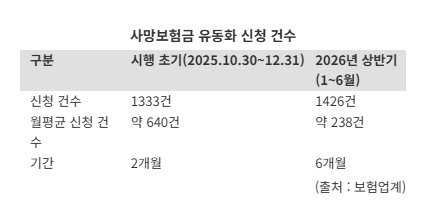
[Financial News] After benefiting from pent-up demand in the early stages of its implementation, the death-benefit liquidity program has seen applications slow sharply this year. The monthly average of applications, which reached 640 by the end of last year, plunged nearly 63% to 238 in the first half of this year. Some observers say the program’s original purpose of using post-death insurance benefits to improve financial stability in retirement is weakening.
According to the insurance industry on the 16th, the five major life insurers—Samsung Life Insurance, Hanwha Life Insurance, Kyobo Life Insurance, Shinhan Life Insurance, and KB Life Insurance—received a total of 2,759 applications for death-benefit liquidity from the program’s launch on October 30 last year through the end of June this year. The cumulative first-year payouts during the same period totaled 11.941 billion won.
Death-benefit liquidity is a program that allows whole-life insurance policyholders to receive part of the benefit payable after their death in advance and use it for retirement living expenses. Whole-life insurance typically pays the benefit after the policyholder dies, but under the liquidity program, part of the death benefit can be received earlier in the form of an annuity.
Applications surged in the early days of the program. A total of 1,333 applications were filed during the roughly two-month period from October 30 through December 31 last year. By contrast, only 1,426 applications were received during the six months from January through June this year.
The monthly average shows that applications have fallen sharply this year. About 1,333 applications were filed over roughly two months at the end of last year, averaging about 640 per month. In the first half of this year, 1,426 applications were filed over six months, averaging only about 238 per month. The monthly application rate has therefore declined 63% from the program’s early stage.
The industry believes demand for death-benefit liquidity has not disappeared, as more than 1,400 applications were still filed in the first half of this year. Although the pace slowed after the initial pent-up demand was exhausted, the program continues to be used steadily to secure retirement living expenses, industry officials explained.
First-year payouts declined slightly. The five major insurers paid 6.108 billion won in first-year payouts by the end of last year, but the figure fell to 5.832 billion won in the first half of this year. The average first-year payout per application also decreased from 4.58 million won at the end of last year to 4.09 million won in the first half of this year.
An insurance industry official said, “This year, applications have continued mainly among policyholders who genuinely want to use the program after the initial pent-up demand was exhausted.” The official added, “Although the application rate is lower than it was in the early stages, we currently view the program as being in the process of stabilizing.”
[email protected] Hong Ye-ji Reporter