Lee Chan-jin: "We Will Examine the Transparency of Bank President Appointment Procedures"
- Input
- 2026-09-15 15:19:43
- Updated
- 2026-09-15 15:19:43
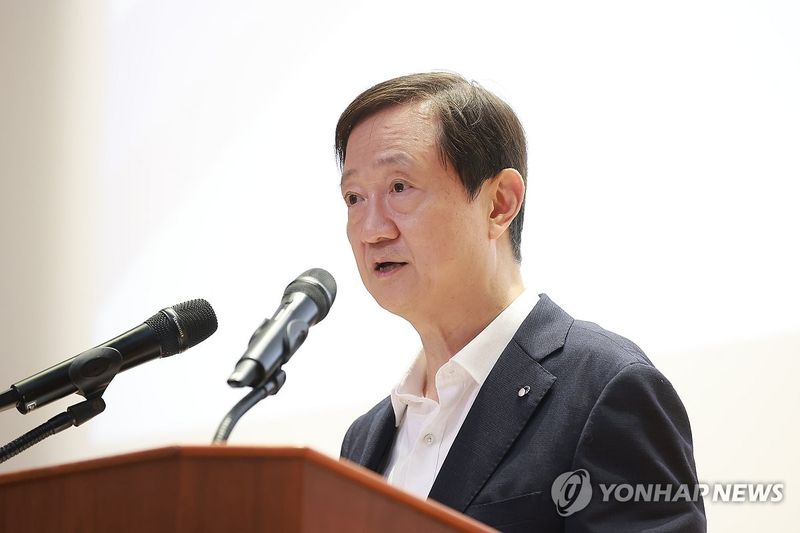
At an executive meeting on the 15th, Lee Chan-jin, Governor of the Financial Supervisory Service, pointed out, "Succession procedures for the CEOs of many financial holding company subsidiaries, including bank presidents, are scheduled to take place by the end of the year, but the subsidiary CEO succession procedures established by most financial holding companies' subsidiary CEO candidate recommendation committees are inadequate."
Lee Chan-jin said, "The role of subsidiary executive candidate recommendation committees also appears to be limited," and instructed, "Strengthen transparency and fairness throughout the CEO succession process, including candidate-pool selection, verification and evaluation, and record-keeping."
The Financial Supervisory Service believes that current regulations, under which holding companies' subsidiary CEO candidate recommendation committees provide only abstract definitions without specifying CEO qualification requirements, are making the appointment process less transparent. It also pointed out that minimum verification is not conducted at each stage of narrowing the candidate pool and that the management of standing candidate pools remains merely procedural.
The Financial Supervisory Service emphasized Principles 15 and 16 of its best practices for corporate governance. Principle 15 calls for standing candidate pools to be managed in connection with pre-established CEO qualification requirements and for effective development programs to be operated. It also requires that standing candidates be guaranteed opportunities to attend and speak at board meetings, with board briefings and other arrangements provided so that the board can continuously evaluate them.
Principle 16 requires holding companies to fully guarantee the role of legally mandated executive candidate recommendation committees even when they become involved in appointing bank presidents. The key point is that the executive candidate recommendation committee of a bank, a subsidiary of the holding company, must receive information on the pool of bank president candidates and the progress of the appointment procedure. In particular, the rule states that the bank committee must be able to perform a substantive and appropriate function in the appointment process while representing the bank's stakeholders. The Financial Supervisory Service criticized the fact that only a few holding companies are complying with Principle 16.
The Financial Supervisory Service said that various improvement measures had been discussed by the Corporate Governance Advancement Task Force, which has operated since January, to prevent CEO appointments from being handled behind closed doors on the basis of specific factions or personal relationships. Lee Chan-jin urged financial companies to operate transparent and fair management succession procedures and work to enhance shareholder value in line with the outcome of the discussions.
Meanwhile, the results of the Corporate Governance Advancement Task Force's discussions have not been made public. Observers believe the release has been delayed because the government and the National Assembly disagree over whether to formally codify a limit on CEOs serving three consecutive terms.
[email protected] Park Moon-su Reporter