"AI Is Deepening Labor Polarization Across Regions and Generations," BOK Warns
- Input
- 2026-09-15 14:10:23
- Updated
- 2026-09-15 14:10:23
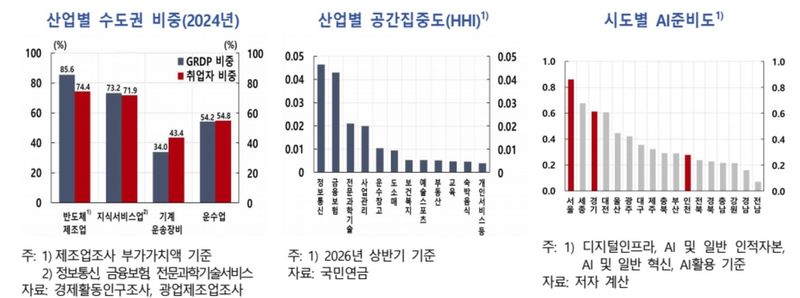
[Financial News] The explosive spread of artificial intelligence (AI) technology is intensifying the concentration of activity in Seoul and the Capital Metropolitan Area. Because the capital region effectively monopolizes the jobs created by AI, the divide between regions is widening. Young people in their 20s, who generally lack expertise and experience, are expected to suffer the greatest impact regardless of where they live, accelerating the structural vicious cycle of the “AI employment cliff.”
In its report released on the 15th, titled “AI and Regional Labor Markets—Risks of Widening Regional Gaps and New Opportunities,” the Bank of Korea warned of the early signs and mixed effects emerging in the labor market as generative and agentic AI spread.
At a regional economic symposium held in Daejeon that day, BOK Governor Hyun Song Shin said in connection with the “AI Labor Report,” "Whether AI will become a new growth engine for regional economies depends not on how quickly the technology is adopted, but on how regional economies are redesigned to maximize productivity through the use of AI."
According to the report, the number of high-AI-exposure jobs increased nationwide by 247,000 over the three years following 2023, when generative AI began spreading in earnest. However, as many as 80.8% of that increase, or 199,000 jobs, was concentrated in the Capital Metropolitan Area. Among occupations with high exposure to the recently emerging agentic AI, 88.3%, or 93,000, of the 105,000 jobs added last year were in the capital region.
In the Capital Metropolitan Area, the employment growth rate rose in proportion to the level of AI exposure, but no such pattern was observed outside the capital region.
The BOK diagnosed that this trend is intensifying the mismatch between labor demand and supply around the capital region, which is highly likely to lead to wage increases.
The BOK paid particular attention to people in their 20s, who are suffering the greatest impact in the employment market of the AI era.
Min Su Chung, head of the BOK’s Regional Economic Survey Team, said, "Among young people, the number of workers employed in highly AI-exposed occupations declined across the board in both the Capital Metropolitan Area and non-capital regions," adding, "This is because university education remains focused solely on accumulating traditional knowledge and information."
The BOK diagnosed that risks and opportunities coexist amid polarization in the AI labor market.
There are concerns that, along with the intensified concentration of talent and capital in the Capital Metropolitan Area, increasingly advanced physical AI will rapidly eliminate jobs even in traditional industries outside the capital region, including manufacturing, transportation, and lodging.
At the same time, the BOK projected that AI could create an opportunity by producing “upward leveling (equalizing effects),” substantially increasing the productivity of low-skilled workers outside the capital region and easing the outflow of young people from those areas.
To address employment polarization in the AI era, the BOK proposed strengthening customized AI-use education systems in each region; fostering the convergence of key manufacturing industries outside the capital region with knowledge services and nurturing startups; and expanding investment in “regional AI hubs” at regional flagship universities.
[email protected] Jung Sang-gyun Reporter