Mapo District Mayor Yoo Dong-gyun: "Opposes Incineration Plant Expansion Demanding Unilateral Sacrifices"
- Input
- 2026-09-15 13:29:09
- Updated
- 2026-09-15 13:29:09
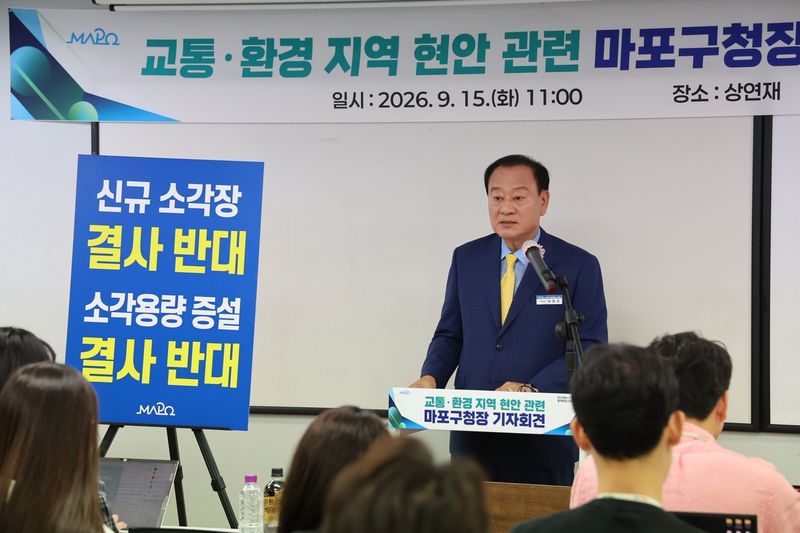
On the 15th, Mapo District, Seoul, held a press conference regarding local issues at the Anglican Church Building in Jung-gu and announced the district's position and response direction regarding major issues such as waste disposal and railway lines.
Mapo District Mayor Yoo Dong-gyun stated, "We must no longer shift unilateral burdens and sacrifices onto the residents of Mapo District," and emphasized the need for stable waste treatment through a cooperative system among the three northwestern districts—Mapo District, Eunpyeong District, and Seodaemun District—regarding the issues surrounding the Mapo Resource Recovery Facility and the Eunpyeong Metropolitan Resource Recycling Center.
Mapo District explains that although the three autonomous districts initially intended to establish a cooperative system in which Eunpyeong District would handle recyclables, Seodaemun District food waste, and Mapo District household waste, this intention is not currently being properly realized.
In particular, there was strong backlash when the Seoul Metropolitan Government did not completely rule out the possibility of resuming the new incineration plant in Sangam-dong during the work report to the Environment and Water Resources Committee of the Seoul Metropolitan Council on the 4th.
District Mayor Yoo stated, "Based on the Seoul Metropolitan Government's plan to expand metropolitan facilities by region since 2013 and the waste cooperation system for the three northwestern districts that has been under review, I will strongly urge the Seoul Metropolitan Government to ensure that when the Mapo Resource Recovery Facility is modernized and improved, it is operated under a system that utilizes only the three northwestern districts, rather than the current five autonomous districts of Mapo District, Seodaemun District, Yongsan, Jongno, and Jung-gu."
Mapo District made clear its position that it opposes the renewed push for the installation of a new incineration plant, the expansion of the incineration capacity of the existing Mapo Resource Recovery Facility, and the additional import of waste from areas other than the three northwestern districts.
It was emphasized that the issue regarding the Eunpyeong Metropolitan Resource Recycling Center must also be resolved based on cooperation and consultation among the three northwestern districts. However, regarding the problem that arose when the Eunpyeong Metropolitan Resource Recycling Center, for which the three northwestern districts shared the costs, was registered as the sole property of Eunpyeong District, it was decided to take necessary measures in accordance with the court's judgment.
Mapo District pointed out that it is the only autonomous district in Seoul with a resource recovery facility that is excluded from heating cost support and demanded that the Seoul Metropolitan Government and relevant agencies improve the system.
Regarding pending railway issues, they also expressed the position that projects should be pursued in a way that minimizes the burden on residents and enhances transportation convenience. Mapo District opposed the plan to install the Gangbuk Crossing Line train depot underground at World Cup Park, arguing that it would require the sacrifice of residents' safety and right to a healthy living environment. Instead, it proposed to the Seoul Metropolitan Government that alternative sites, such as the area beneath the Han River, be considered.
Along with the prompt promotion of the Daejang–Hongdae Line, they also demanded the installation of a Digital Media City Station transfer station to guarantee the right to mobility for Sangam-dong residents. District Mayor Yoo stated, "Although financial conditions are difficult, we will proceed even if it requires the beneficiary-pays approach as stipulated by law." Mapo District explained that Digital Media City Station is a transfer hub where Subway Line 6, the Airport Railroad, and the Gyeongui–Jungang Line pass through, and that economic feasibility has been secured with a benefit-cost ratio (B/C) of 1.01.
They also urged the relocation of Hongik University Station (Station 111) on the Daejang–Hongdae Line. The argument is that the station should be moved toward the Hongik University Station intersection, as proceeding with the project as currently planned raises concerns regarding reduced pedestrian space, increased safety hazards, and damage to commercial districts.
They also demanded the establishment of a new Mallijae Station on the Sinansan Line. Mapo District maintains that the station must be included before the project plan is finalized, given that the Mallijae area is currently a blind spot for railway transportation and traffic demand is expected to increase due to future redevelopment. District Mayor Yoo emphasized, "Now, while the private investment eligibility review is underway, is the golden time."
They demanded a complete re-examination of the plan to install a memorial sculpture for the Sampoong Department Store collapse in Noeul Park. While they sympathize with the intent to create a space to remember the accident and mourn the victims, they argued that there was insufficient explanation or consultation with residents regarding the installation in a location closely connected to the daily lives of Sangam-dong and Mapo District residents.
District Mayor Yoo stated, "Although the specifics of the issues differ, the principle that must be upheld is that unilateral burdens and sacrifices should not be demanded of specific regions or residents." He added, "As a district mayor representing the residents, I will take the lead in resolving these issues to prevent further damage, and I will continuously take necessary measures with relevant agencies to ensure that substantial compensation and consolation are provided."
[email protected] Lee Seol-young Reporter