"Discrimination against irregular workers in the public sector must be eliminated"... Federation of Korean Trade Unions (FKTU) urges government to engage in sincere negotiations
- Input
- 2026-09-15 14:48:07
- Updated
- 2026-09-15 14:48:07
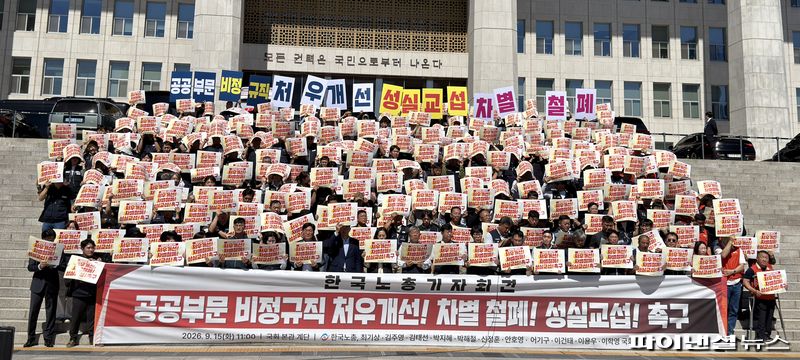
[Financial News] Three days before the relaunch of the Public Service Workers Committee, the Federation of Korean Trade Unions (FKTU) urged the government to improve the treatment of irregular workers in the public sector and to participate in negotiations in good faith.
The Federation of Korean Trade Unions (FKTU) held a press conference on the steps in front of the main building of the National Assembly of the Republic of Korea in Yeouido, Seoul, at around 11 a.m. on the 15th, welcoming the launch of the Public Service Workers Committee, while simultaneously demanding the elimination of discrimination, such as the resolution of wage and welfare gaps for non-regular workers in the public sector; sincere participation by the government in negotiations with the Public Service Workers Committee; promotion of supra-enterprise negotiations in the public sector; and legislation to make the Public Service Workers Committee permanent.
About 400 union members from the Public Sector Union Federation, United Union Federation, Public Social Industry Union, Public Sector Federation, Electric Power Federation, and Solidarity Union attended the press conference on this day.
The Public Service Workers Committee, which discusses the improvement of working conditions for public sector workers including public service workers, will launch as a statutory body on the 18th following the enforcement of the 'Act on the Establishment and Operation of the Public Service Workers Committee.' This comes three years and six months after its operation ended in March 2023, following its establishment in 2020 under a Prime Minister's Directive.
Kim Dong-myung, Chairman of the Federation of Korean Trade Unions (FKTU), stated, "The government is responsible for public sector policy and effectively determines working conditions," adding, "It must engage in dialogue commensurate with its authority and negotiate in good faith with the labor sector." He also emphasized, "The Public Service Workers Committee must reduce disparities based on agency and employment type and ensure that labor-management agreements are implemented through budgets and systems."
The Federation of Korean Trade Unions (FKTU) pointed out that the government's control over total personnel costs limits individual public institutions' ability to improve workers' treatment. Accordingly, they argued that the government, acting as the de facto employer, must engage in negotiations with the labor sector through the Public Service Workers Committee to establish common treatment standards applicable to the entire public sector.
Oh Gwang-cheol, chairman of the Jeonbuk State Public Service Workers' Union, stated, "When it suits them, they demand all kinds of duties and responsibilities by claiming we are 'employees of the same agency,' but when it comes to wages, welfare, and treatment, they draw a line by saying we are not civil servants." He added, "Allowances recognized by one local government are not recognized by another, and wage systems differ even when performing duties of the same nature. A nationally unified standard for public service workers is necessary."
Job insecurity and safety issues for outsourced workers were also raised. Kang Seok-hwa, Secretary-General of the United Union Federation, lamented that household waste collection and transport workers worry about job security whenever a contractor changes, and that their safety is further threatened by insufficient staffing amid a cost-cutting trend. He stated, "Even with safety standards such as daytime work and three-person teams, workers' lives cannot be protected if necessary labor and safety costs are not properly reflected in the outsourcing costs and contract conditions." He added, "The government, local governments, and labor unions must jointly establish a responsible discussion structure to ensure that safety standards are actually implemented in the field."
Secretary-General Kang stated, "While public services can be entrusted to the private sector, the responsibility for workers' lives and employment cannot be shifted to them," adding that employment succession must be institutionally guaranteed so that workers can continue to work even if the contractor changes.
In addition, there were calls to ensure the continuity of the Public Service Workers Committee and the implementation of its discussion results. Ryu Ki-seop, Secretary-General of the Federation of Korean Trade Unions (FKTU), stated, "Even if the committee is launched as a statutory body, there is a limitation in that it operates for a limited period of five years," adding, "To resolve the issue of irregular workers in the public sector, participation in discussions by all ministries, not just specific ones, and the enforceability of the discussion results must be guaranteed."
The Federation of Korean Trade Unions (FKTU) requested the National Assembly of the Republic of Korea to secure a budget for improved working conditions and amend the law to make the committee permanent. At the same time, they announced a plan to launch an organized struggle if tangible results are not achieved.
[email protected] Park Sung-hyun Reporter