Nuri (KSLV-II)'s Fifth Launch to Open 'Era of South Korea's First Satellite Constellation'... Real-Time Security Response
- Input
- 2026-09-15 15:00:00
- Updated
- 2026-09-15 15:00:00
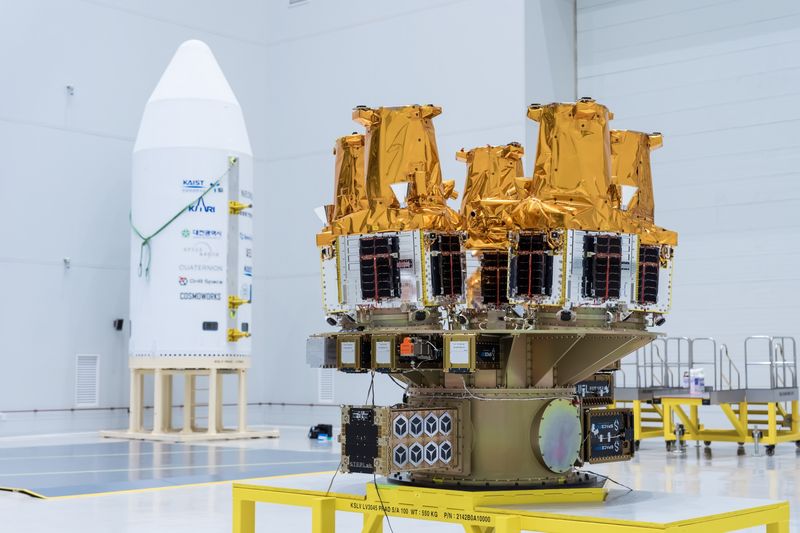
[Financial News] With South Korea's space launch vehicle Nuri (KSLV-II) set for its fifth launch next month, a satellite constellation will be launched as the primary payload for the first time in the country. A record 15 satellites are loaded onto the upper stage of Nuri, and final assembly of the launch vehicle will be completed by the end of this month.
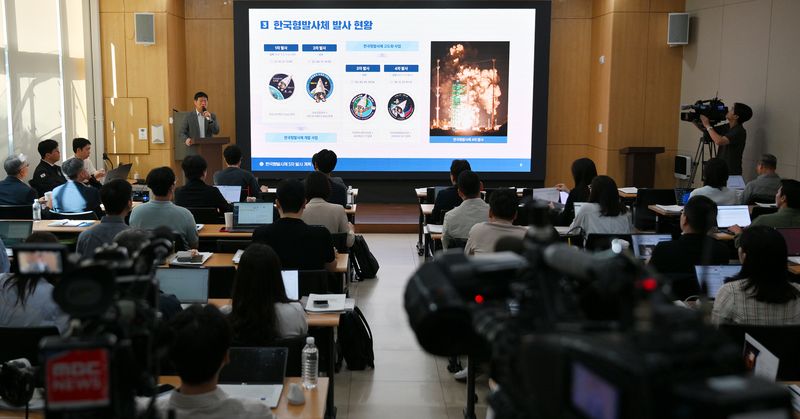
KASA and KARI held a media briefing in Gwanghwamun, Seoul, on the 15th to disclose the main missions of the satellites aboard Nuri's fifth launch and the status of preparations for the mission.
The fifth Nuri launch will carry a total of 15 satellites: five primary payloads, Neonsat Nos. 2 through 6, and 10 secondary CubeSats. Nuri will attempt the country's first satellite-constellation launch mission by sequentially placing five Neonsat satellites, which will perform the same mission, into orbit.
Jongchan Park, head of KARI's Korean Launch Vehicle Advancement Project, said, "After Nuri successfully completed three consecutive launches—the second, third and fourth—its fifth launch will carry 15 satellites, the largest number ever. A low-shock satellite separation device has been newly applied to the fifth Nuri launch to reduce the impact generated when the satellites are separated. We are preparing for the launch with the greatest technical focus on precisely separating each payload satellite."
To prevent collisions between the satellites, the five Neonsats will be separated at intervals of 35 to 40 seconds and directed in different directions.
Lee Sang-hyun, head of the Small Satellite Constellation Project at the Korea Advanced Institute of Science and Technology (KAIST) Satellite Technology Research Center, said, "We are preparing five antennas so that each of the five constellation satellites can use a different frequency. As the country's first satellite constellation, it is expected to establish a real-time precision surveillance system and improve the speed and accuracy of national security and disaster response."
Each Neonsat weighs less than 100 kilograms and carries an electro-optical camera with a resolution of about 1 meter for black-and-white images and 4 meters for color images. The images will be used not only for national security but also to respond to disasters and accidents such as wildfires and floods. A total of 10 Neonsats will be deployed across two orbital planes and operated as a constellation. Five first-batch production satellites will be launched on this fifth mission, followed by five second-batch production satellites on the sixth launch in 2027, completing the constellation. Once operational, the constellation will be able to image the Korean Peninsula at least three times a day and capture the same location again within 24 hours.
Ten secondary CubeSats developed by 10 research and development organizations, including universities, local governments and domestic companies, will also be launched. Their missions for public use include verifying the performance of domestically produced devices and components in the space environment through the second Space Verification Platform for Domestic Devices and Components, developed by KARI; surveying the low-Earth-orbit space environment through Jibisat, developed by KAIST; monitoring ocean currents carrying marine debris around Jeju Island through PERSAT02, developed by Quaternion; and analyzing fine-dust trends and sources through Ulysses, developed by the Unmanned Exploration Research Institute. Each development organization plans to verify its technologies, devices and components in the actual space environment and apply the results to future development and utilization.
All the satellites to be carried on the fifth Nuri launch have now arrived at the Naro Space Center in Goheung County. The satellites were mounted on Nuri's upper stage on September 14, and final assembly of the launch vehicle is scheduled for completion by the end of September. After final inspections through October 5, Nuri will be transported to the launch pad on October 6 if no problems are found. The launch is scheduled for October 7, while the exact launch time will be finalized by the Launch Management Committee on the day of the launch.
Oh Tae-seok, head of KASA, said, "The fifth Nuri launch is the country's first satellite-constellation launch and an important turning point as South Korea's satellite development advances toward mass production and constellation operations."
[email protected] Yeon Ji-an Reporter