It Stopped the Bleeding When Applied to a Wound... Hemostatic Material Found in Crab Shells [Health LAB]
- Input
- 2026-09-17 05:00:00
- Updated
- 2026-09-17 05:00:00
[Financial News] A biomaterial has been developed that rapidly adheres to wounds and stops bleeding. When coated onto glass or plastic, it also prevents water droplets from forming and makes water spread immediately upon contact. The material can be produced at room temperature within 30 minutes using oxygen in the air, raising expectations for applications ranging from hemostatic agents to medical devices, biosensors, and functional surface treatments.
According to the Korea Advanced Institute of Science and Technology (KAIST) on the 17th, a research team led by Professor Lee Haeshin of KAIST's Department of Chemistry developed CHI-B, a polyphenol bioadhesive material that combines adhesive and superhydrophilic surface-treatment properties. The team used chitosan (CHI), a natural polymer obtained from crustacean shells, and 1,2,4-benzenetriol (BTO), a biomass-based raw material obtainable from plants and other biological resources.
CHI-B's key feature is that a single material can provide both strong adhesion and a surface that allows water to spread easily. On wounds, it rapidly adheres to block bleeding sites. When coated onto glass or plastic, it creates a superhydrophilic surface on which water spreads widely as soon as it makes contact.
Superhydrophilicity is the property of allowing water to spread broadly and thinly across a surface immediately upon contact, rather than forming a rounded droplet. The research team successfully applied uniform coatings of CHI-B to a range of materials with different properties, including glass; polytetrafluoroethylene (PTFE), a fluoropolymer widely known as Teflon; PET, a plastic commonly used in beverage bottles; PS, a plastic used in packaging; and titanium dioxide (TiO2), which is used in photocatalysts and functional coatings. In particular, surfaces treated with CHI-B remained stable even after being washed for more than a month. Coatings that were one year old also showed excellent wettability, allowing water to spread easily.
The team also confirmed CHI-B's potential as a medical hemostatic material by leveraging its strong adhesive properties. In cytotoxicity tests, CHI-B demonstrated high biocompatibility, meaning it caused little harm when in contact with biological tissues or cells. When a CHI-B sponge was applied to a bleeding site on a mouse's liver, blood loss decreased significantly compared with the control group.
The manufacturing process was also greatly simplified. The team focused on BTO's ability to naturally oxidize when exposed to oxygen in the air. Oxygen converts BTO into a form that can readily bond with chitosan, replacing the role of conventional chemical cross-linking agents. Using this principle, CHI-B can be produced at room temperature within 30 minutes without a separate chemical cross-linking agent or heating. The team also scaled production to several dozen liters in a laboratory setting, confirming its potential for mass production.
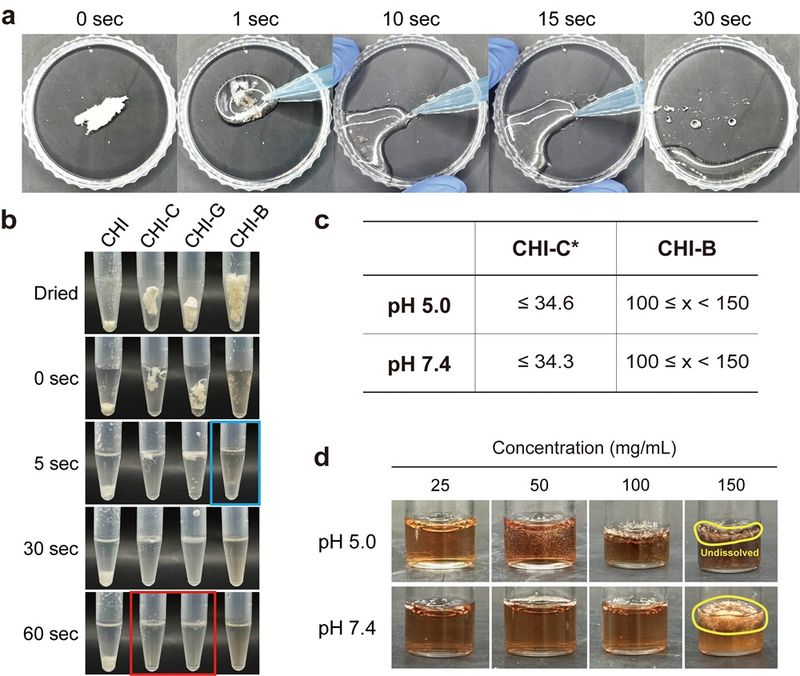
CHI-B also showed high water solubility. Conventional chitosan is not readily soluble in water, which limits its applications. However, a CHI-B sponge produced through freeze-drying, a process that removes moisture after freezing the material, dissolved completely approximately 15 seconds after coming into contact with water.
Professor Lee Haeshin said, "This study is significant because it demonstrates strong adhesion and a superhydrophilic surface property that allows water to spread rapidly in a single biomaterial." He added, "As we have also confirmed that the manufacturing process is simple and that production can potentially be scaled up, we expect it to be used in a wide range of fields, from hemostatic materials to medical devices, biosensors, and functional surface treatments."
The study was published in the international materials science journal Materials Horizons and was made available online on April 30.
[email protected] Yeon Ji-an Reporter