[Exclusive] "Privacy Law Must Be Strengthened to Protect People Repeatedly Reported Missing, Including Those with Dementia and Autistic Children" [Blind Spots in Repeated Missing-Person Cases]
- Input
- 2026-09-15 14:29:25
- Updated
- 2026-09-15 14:29:25

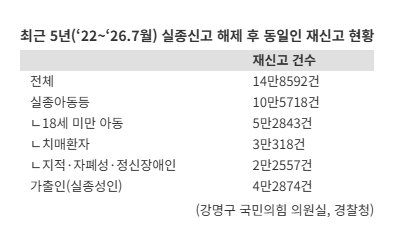
[Financial News] Although missing-person reports have been repeatedly filed for the same individuals, detailed statistics showing patterns of repeated disappearances—such as the time between reports and the final outcomes of repeat-report cases—are difficult to produce separately. Calls are growing for a framework to use relevant data so that people at risk of repeated disappearance can be identified more precisely and preventive measures developed based on the intervals and frequency of repeat reports.
According to data obtained by Financial News from the Korean National Police Agency through the office of Kang Myung-gu, a People Power Party lawmaker on the National Assembly's Security and Public Administration Committee, the police said on the 15th that their system makes it difficult to calculate the "status by time elapsed until a repeat report" and the "final outcomes of repeat-report cases."
■ Repeated Missing-Person Cases Blocked by a Lack of Detailed Statistics
For all missing-person reports, police track the time taken to close each case and the status of case closures by reason. However, they explained that there are limits to calculating, in a consolidated manner, how long after an earlier report was closed the same person was reported missing again and how the repeat-report case ultimately ended. The difficulty is partly due to restrictions on retaining missing-person information, which is personal information, for extended periods. It is also difficult to aggregate the data because the times of disappearance, reporting, and case closure differ.
Such detailed data, however, could provide a basis for varying the level of response according to the risk of repeated disappearance. A repeat report filed several years after an earlier report is difficult to view in the same way as multiple reports filed within a short period. If the intervals and frequency of repeat reports could be analyzed, the data could be used to identify high-risk groups and design preventive and support measures tailored to each group.
Professor Shin I-cheol of the Department of Police Studies at Wonkwang Digital University emphasized, "The shorter the gap between repeat reports, the more likely the person is to belong to a high-risk group," adding, "Stronger preventive measures than those currently in place must be introduced."
The issue is how extensively police may retain and use data related to repeated disappearances. Missing-person information is also personal information and is therefore subject to restrictions based on the purpose of collection and the retention period. At the same time, current law establishes separate grounds for using data for statistical purposes while making personal-information protection the general principle.
Article 28-2 of the Personal Information Protection Act allows pseudonymized information to be processed without the data subject's consent for statistical compilation, scientific research, or the preservation of records in the public interest. Article 28-4 of the same law allows a separate processing period to be set for pseudonymized information, taking into account the purpose of processing and other factors.
Accordingly, authorities could consider pseudonymizing the number and intervals of repeat reports, as long as individuals cannot be identified, to analyze overall patterns of repeated disappearances and use the findings to formulate prevention policies. This could involve using information retained for a certain period to calculate the frequency or intervals of repeat reports, or, when necessary, combining pseudonymized information for statistical analysis.
Statistical analysis, however, is different from identifying and managing actual individuals who are repeatedly reported missing. Article 28-5 of the Personal Information Protection Act prohibits processing pseudonymized information for the purpose of identifying a specific individual. Thus, even if pseudonymized information can be used to analyze risk factors for repeated disappearance, the same legal basis cannot be applied to reconnect that information to specific individuals, classify them as high-risk, and manage them continuously.
As a result, calls are growing for consideration of legal amendments that would allow personal information to be used for purposes directly linked to public safety, in order to build a system that accumulates the reporting histories of people repeatedly reported missing, identifies those at actual high risk, and connects them with necessary preventive measures. Professor Yeom Heung-yeol of Soonchunhyang University said, "More accurate statistics on missing-person cases could be obtained by using relevant procedures, such as deliberation by the Personal Information Protection Commission, to revise enforcement decrees or enforcement rules." However, experts also caution that excessive data use could lead to surveillance, making it necessary to balance personal-information protection with public safety.
■ Identifying High-Risk Groups Through Data and Connecting Them with Support
After accumulating and analyzing data on repeated disappearances to identify high-risk groups, a system is also needed to connect them with the support they require. For people with dementia, intellectual disabilities, autism, or mental disorders in particular, repeated disappearances are difficult to prevent through police searches alone. Community-level responses are therefore also considered necessary, including working with welfare agencies to monitor those at risk and using devices that can detect deviations from their locations or usual routes.
Professor Yeom Gun-woong of the Department of Police and Fire Administration at U1 University advised, "The key is to establish a social safety net for missing persons," adding, "It is necessary to specify procedures for handling missing-person cases so that high-risk individuals can receive priority measures, and to establish a one-stop system linked to medical and public-health services."
[email protected] Kim Ye-ji Reporter