Teachers, students, and parents intervene together when they witness school violence
- Input
- 2026-09-15 12:00:00
- Updated
- 2026-09-15 12:00:00
[Financial News] With the response rate among students reporting school violence victimization rising more than threefold in six years, the Ministry of Education is operating a school violence prevention practice model in 276 schools in which school members, including teachers, students, and parents, intervene from the early stages of conflict. Under this approach, anyone who witnesses a conflict assesses the situation, supports the victimized student, and connects them with the necessary assistance.
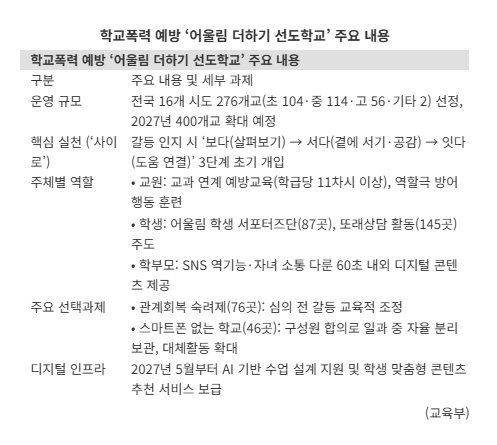
The Ministry of Education announced on the 15th that it would operate 276 ‘Eoullim Plus Leading Schools for School Violence Prevention’ starting in September. Following an open application process conducted by metropolitan and provincial offices of education, 104 elementary schools, 114 middle schools, 56 high schools, and two other schools were selected. The number of leading schools is scheduled to expand to 400 in 2027.
The measures focus on expanding the scope of school violence prevention from education for students to action by all school members. In the first 2026 survey on the state of school violence, announced by the Ministry of Education on the 9th, the victimization response rate was 2.9%, more than three times the 0.9% recorded in 2020. A total of 91,600 students reported being victims. In particular, the victimization response rate at elementary schools was 5.7%, higher than the perpetrator response rate of 1.6%.
The Ministry of Education explained that students may perceive the same behavior differently: a victimized student may regard it as school violence, while the student responsible may consider it a joke. The number of school violence cases reported to offices of education during the 2025 academic year was 56,880, down from the previous year, but 51.7% proceeded to deliberation. Of the cases reviewed, 22.1% were determined not to constitute school violence.
The core practical task of the leading schools is ‘Sairo,’ a conflict mediation behavioral framework. Participants include all school members—not only students and teachers, but also parents and caregiving, protective, and administrative staff. The framework applies three behavioral principles: ‘Look’ at the conflict situation, ‘Stand’ with students who feel uncomfortable, and ‘Connect’ them with necessary help from teachers, parents, or others. This behavioral language is repeatedly used in role-playing classes, teacher training, and campaigns.
Teachers provide school violence prevention education in connection with the curriculum, conducting at least 11 sessions per class each year. Students repeatedly practice social-emotional skills and protective behaviors for conflict situations. Schools also select and implement student-focused activities. Among the 276 leading schools, 87 selected the ‘Eoullim Student Supporters’ and 145 selected peer counseling as activities.
The roles of students and parents are also being strengthened. To prevent students from remaining bystanders, they take part in responding to conflict situations through activities such as the ‘Eoullim Student Supporters’ and ‘Peer Counseling,’ in cooperation with student councils. Parents are provided with digital video content of about 60 seconds covering smartphone overdependence, cyberbullying, and online gambling prevention through online school notices and other channels. The content is designed so that parents can watch short videos or combine multiple clips into educational materials, depending on the situation.
Programs focused on restoring relationships are also being operated. Among the leading schools, 76 operate the ‘Relationship Restoration Deliberation Program,’ while 46 voluntarily operate ‘Smartphone-Free Schools,’ in which smartphones are stored separately during school hours following agreement among school members. Each school determines how smartphones are managed based on its circumstances and the consensus of its members; uniform restrictions are not imposed.
The Ministry of Education plans to provide leading schools with an artificial intelligence (AI)-based lesson design support system starting in May 2027. Based on existing school violence prevention education materials, the system will support the creation of lesson plans, teaching materials, and student workbooks tailored to classroom situations. For students, it will recommend customized content by analyzing their learning history in prevention education.
Sim Min-cheol, Director General of the Student Health and Safety Policy Bureau at the Ministry of Education, said, "The starting point for preventing school violence is creating relationships of mutual respect within schools," adding, "We will transform the relationships and culture of students, families, and schools together and spread a school culture in which every student can live with peace of mind."
[email protected] Kim Man-gi Reporter