July Money Supply at 4,225 Trillion Won... Corporate Funds Up 20 Trillion Won, Household Funds Down 11 Trillion Won
- Input
- 2026-09-15 12:00:00
- Updated
- 2026-09-15 12:00:00

[Financial News] As funds flowed in massively into semiconductor companies enjoying a super-boom, the money supply in circulation increased by 230 trillion won last month compared to the same month last year. Non-financial companies, including major export conglomerates, poured more than 20 trillion won of their surplus cash into bank time deposits and short-term trust products last month. On the other hand, household funds flowed out by more than 10 trillion won in a single month due to loan repayments, housing purchases, and stock investments.
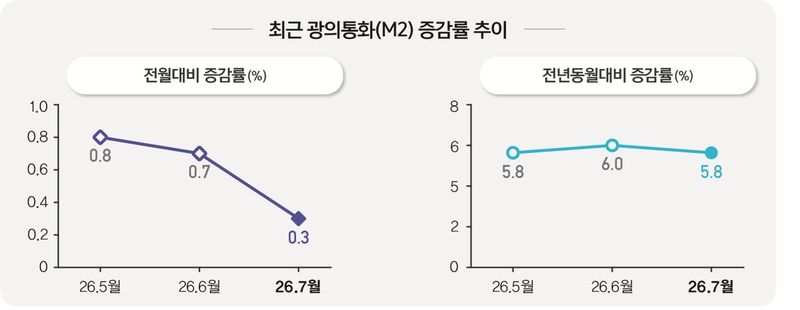
According to the monetary and liquidity indicators for July 2026 released by the BOK on the 15th, Broad Money (M2) stood at 4,225.6 trillion won last month, up 0.3% (12.7 trillion won) from the previous month. This continued a moderate upward trend following June (+0.7%).
The actual money supply (based on the original series), without adjusting for seasonal factors, increased by 5.8% (230.3 trillion won) compared to the same month last year. As of the first half of this year, the M2 growth rate is fluctuating in the high 4–5% range.
The biggest reason for the increase in money in circulation is the rise in profits of export companies. As of last month, companies looking to manage their surplus funds deposited 27.3 trillion won into time deposits and savings accounts with maturities of less than two years. Major semiconductor companies also deposited 11.4 trillion won into money trusts.
As such, the non-financial sector (excluding financial companies) increased by 20.6 trillion won, and the other sector increased by 6.3 trillion won, driving the growth. In effect, companies filled their coffers, boosting the overall money supply.
On the other hand, household funds decreased.
Funds from households and non-profit organizations flowed out by 11.6 trillion won this month as well. This marks a decline of over 10 trillion won for two consecutive months. This is attributed to household funds flowing out to repay loans amid high interest rates, secure funds for housing purchases and rent, and invest in stocks.
However, the growth of money in circulation appears to be slowing down in the second half of the year.
"narrow money (M1)," which consists of cash equivalents such as readily available cash and ordinary deposits, fell by 2.2% compared to a month ago.
Overall liquidity indicators, including banks and securities firms, also decreased slightly compared to the previous month. This means that the speed of the actual money supply circulating in the market has temporarily slowed down.
[email protected] Normal bacteria Reporter