Ulsan Metropolitan City Moves Ahead with Conversion to Publicly Operated City-Bus System, Implementation Plan Due by Year-End
- Input
- 2026-09-15 13:12:32
- Updated
- 2026-09-15 13:12:32
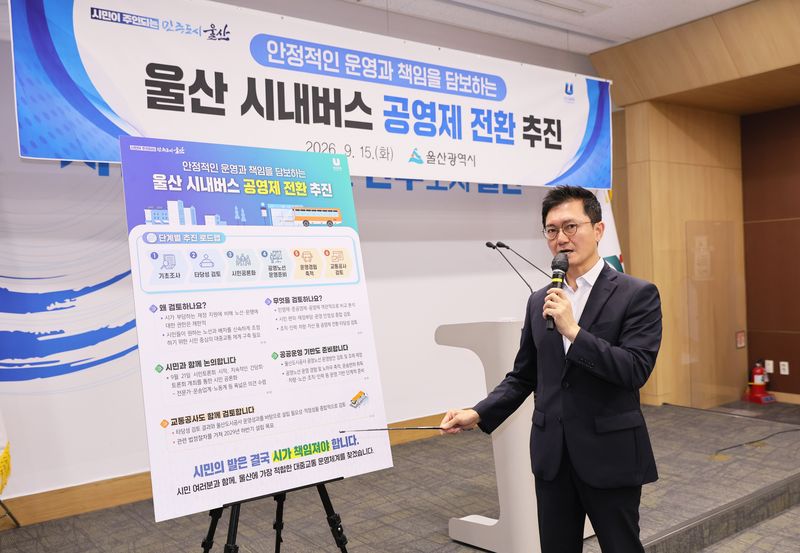
【Financial News Ulsan = Choi Su-sang】 Ulsan Metropolitan City, the only one of the country’s 17 special and metropolitan cities to operate a privately run city-bus system, has begun moving in earnest to convert to public operation to secure residents’ mobility rights and strengthen the public nature of public transportation. The system could be introduced as early as around 2029, following a feasibility review and pilot operation.
Kim Chang-hyun, Ulsan Metropolitan City’s transportation bureau chief, explained the conversion plan at a press briefing on the 15th.
City buses, Ulsan’s only form of public transportation, are currently operated by private transportation companies under a system in which Ulsan Metropolitan City compensates them for their deficits.
Ulsan Metropolitan City’s deficit compensation for city-bus companies totaled 80.2 billion won in 2020, with a 93% support rate; 94.2 billion won in 2021, or 95%; 118.3 billion won in 2022, or 96%; 117.8 billion won in 2023, or 96%; 117.6 billion won in 2024, or 96%; and 140.2 billion won in 2025, or 96%. This year’s figure is expected to reach approximately 151.9 billion won, or 97%.
The combined debt of the seven city-bus companies has also continued to rise and now stands at approximately 162.3 billion won. They are effectively in a state of capital impairment. Half of the debt consists of severance-pay provisions that must be set aside for bus drivers, while the shortfall in those provisions currently amounts to 81.3 billion won.
As a result, despite massive financial support, worsening business conditions and labor-management conflicts at the companies have led to instability in public transportation services, including city-bus strikes.
In response, the city plans to transform the operating system into a publicly operated model that gives it the responsibility and authority commensurate with the funds it provides, rather than merely compensating the companies for their deficits.
By the end of this year, it will work with the Ulsan Research Institute (URI) to establish the prerequisites and specific direction for introducing public operation.
Through a feasibility study, the city plans to comprehensively analyze all matters required for the conversion, including financial needs, organizational and staffing requirements, vehicles and depots, assets, and the fiscal burden. It will then develop a specific plan for introducing a publicly operated city-bus system suited to conditions in Ulsan.
The city also plans to build public-operation experience step by step through a consignment arrangement with Ulsan Urban Corporation, beginning with obtaining transportation licenses and continuing through the formation of its organization and workforce. Based on the research findings and residents’ opinions, it will also review the need for and feasibility of establishing a separate transportation corporation.
To actively reflect residents’ views in the process, the city plans to hold meetings and forums, beginning with its first public discussion on the 21st.
Kim Chang-hyun, the transportation bureau chief, said, "It is time to properly pursue the conversion to public operation, going beyond merely addressing the limitations of the current privately operated system."
[email protected] Choi Su-sang Reporter