Ruling and Opposition Parties Finalize 32 Non-Contentious Bills, Including Easing Preliminary Feasibility Study Criteria, Signaling Start of Bipartisan Cooperation
- Input
- 2026-09-15 10:25:13
- Updated
- 2026-09-15 10:25:13
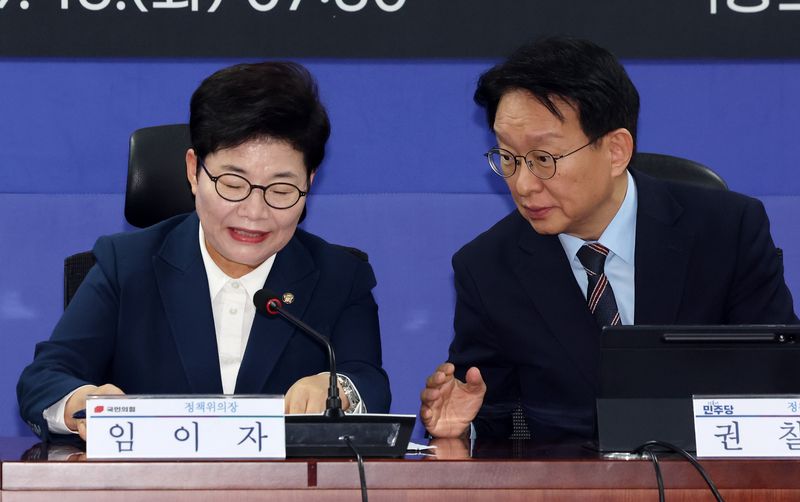
The policy committees of the two parties announced on the 15th that they had selected a total of 32 bills at a Joint Meeting on Livelihood Policies held at the National Assembly of the Republic of Korea. These bills were either proposed by both parties with the same intent or are non-contentious measures over which there are no major differences.
The most prominent of the 32 bills unveiled that day is an amendment to the National Finance Act that would ease the preliminary feasibility study criteria for SOC projects. Currently, SOC projects with a total cost of at least KRW 50 billion and government subsidies of at least KRW 30 billion must undergo a preliminary feasibility study. The two parties agreed to raise the total project-cost threshold to KRW 100 billion and the government-subsidy threshold to KRW 50 billion, judging that SOC development is necessary to promote balanced regional development. SOC projects below these amounts are expected to be exempt from the study.
The two parties also expressed agreement on the need to pass an amendment to the Financial Investment Services and Capital Markets Act to introduce a mandatory tender-offer system. The measure is intended to protect the rights of minority shareholders. When corporate control changes hands, the system would guarantee ordinary shareholders an opportunity to sell their shares on the same terms as the controlling shareholder. It is part of a shareholder-protection measure that has been repeatedly proposed because it would allow ordinary shareholders to dispose of their shares at a fair price during a change in control.
The two parties will also jointly pursue a Special Act on Support for Corporate Succession to facilitate smooth business succession as the owners of small and medium-sized enterprises grow older. They plan to expand the existing concept of family-business succession to corporate succession and provide tax and financial support for succession to third parties and through mergers and acquisitions (M&A).
An amendment to the National Pension Act to expand childbirth, child-rearing, and military-service credits was also selected as a common priority for the two parties. However, the parties have clashed over whether to add an accompanying opinion stating that structural reform must also be pursued, drawing attention to whether they will reach an additional agreement.
The 32 bills also include the Emergency Medical Service Act, aimed at preventing the practice of sending patients from one emergency room to another in search of treatment; the Foreign Investment Promotion Act, which would clarify the foreign-investment system; and a special act concerning housing for elderly care.
The two parties emphasized that the bills must go through review by the relevant standing committees. This leaves room for changes depending on the interests of the parties within each committee. However, Kwon Chil-seung, policy committee chair of the Democratic Party of Korea, urged swift action in line with the agreement reached by the two policy committees, saying, "I hope the leadership of both parties and the respective standing committees will respect the spirit of the Joint Meeting on Livelihood Policies and swiftly pass the bills concerning people's livelihoods."
The two parties plan to address contentious issues, including real estate and tax reform plans, by forming a one-on-one consultative body. The core idea is for the vice chairs of the two policy committees to take charge of key issues individually and establish regular one-on-one communication channels to narrow their differences.
After the joint meeting, Kwon told reporters, "It will not take long to form the one-on-one consultative body. We still need to discuss who will serve as the vice chair responsible for each issue, what the agenda will be, and whether to include the secretaries of the standing committees responsible for the bills so that the discussions can be expanded. We are coordinating our views while taking all of these factors into account. We intend to discuss everything together and move forward as quickly as possible."
[email protected] Kwon Chil-seung Reporter