"Bought for 9.6 billion won and sold for 17.3 billion won"... Hotel Resales Are Also Booming
- Input
- 2026-09-16 15:45:12
- Updated
- 2026-09-16 15:45:12
■ Rising tourism demand leads to exits after just two years and seven months
On the 16th, KIUDA LAB, a lodging-industry data analysis company, announced the results of a comprehensive survey of 1,200 hotel resales conducted from July 2016 through September this year. The median holding period was only two years and seven months. The average holding period was also less than three years.
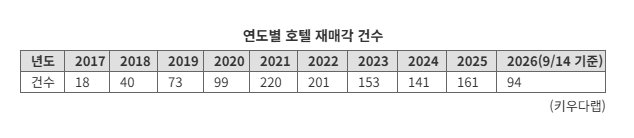
Rather than buying hotels and focusing on long-term operations, investors primarily pursued "strategic exits"—buying properties cheaply and selling them at fair value. The number of resales by year rose from 18 in 2017, 40 in 2018, 73 in 2019, and 99 in 2020 to a peak of 220 in 2021, when the COVID-19 pandemic dealt its heaviest blow. The easing of quarantine measures and expectations of a recovery in tourism demand in the post-COVID period appear to have prompted a large number of properties whose value had been raised proactively to find new owners.
South Korea's tourism market is in fact growing faster than before COVID-19. According to the Korea Tourism Organization (KTO), 10.71 million foreign tourists visited South Korea from January through June this year, up 21.3% from the same period last year and 126.9% from 2019, before the pandemic.
The median transaction price per square meter for lodging properties also reached 2.35 million won this year, the highest level since 2021, when it was 2.32 million won. Against this backdrop, an average of 164 hotel resales took place annually from 2022 to 2025. With 94 recorded so far this year, the total is expected to reach the recent annual average.
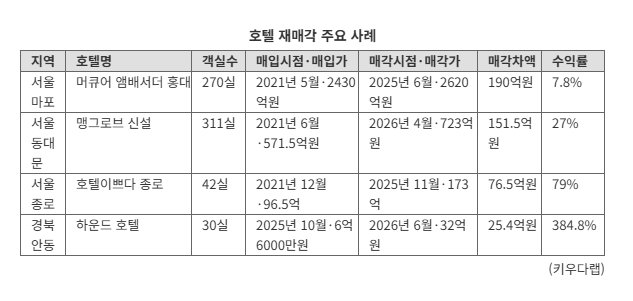
Most of the properties with the largest sale-price gains were purchased at the height of the COVID-19 pandemic and sold within the past two to three years. The largest gain came from Mercure Ambassador Seoul Hongdae, a 270-room hotel in Seoul's Mapo District, which generated 19 billion won. It was purchased for 243 billion won in May 2021 and sold for 262 billion won in June last year, producing a 7.8% return.
The second-largest gain came from Mangrove Sinseol, a 311-room co-living-style property in Seoul's Dongdaemun District. Purchased for 57.15 billion won in June 2021, it was sold for 72.3 billion won this April, generating a gain of 15.15 billion won and a 27% return.
■ A 344% return... Regional and small-scale investments hit the jackpot
Notably, strong investment performance was not limited to large hotels in central Seoul. Returns, which are considered more important than absolute gains in the investment market, reached 20% in Daegu, 19% in Daejeon, and 16% in Busan—higher than the 14% recorded in the Seoul metropolitan area.
Eight of the top 10 properties by return were located outside the capital region, excluding two properties in Uijeongbu and Yeoju City, Gyeonggi Province. All were small facilities with between eight and 45 rooms. Hound Hotel in Andong, North Gyeongsang Province, achieved a 384.8% return after being purchased for 660 million won and sold for 3.2 billion won just eight months later.
Small properties also posted notable returns in Seoul. This is because the larger the number of rooms, the higher the construction costs, including renovation expenses. Hotel Ippuda Jongno, a KIUDA LAB-affiliated brand in Seoul's Jongno District, was purchased for 9.65 billion won in December 2021 and sold for 17.3 billion won in November 2025, generating a 79% return. Construction costs amounted to only 100 million won, leaving an actual gain of 7.11 billion won out of the nominal 7.65 billion won difference. Hotel Ippuda Jamsil in Songpa District saved on costs by completing construction for just 30 million won.
The decisive factors in maximizing returns are believed to be "how cheaply the property was purchased" and "how much renovation it required." Kim Ji-hoon, CEO of KIUDA LAB and a director of the Korea Small and Medium Hotel Association, said, "If you choose a building whose structural frame and facilities do not need to be repaired and change only the operations, brand, and sales channels, you can drastically reduce costs. This is where insight can beat capital in the market for sale-price gains."
[email protected] Jeon Min-kyung Reporter