Bosch Bets on Technological Edge in Heavy Commercial Vehicles, Aiming to Double Revenue in the 2030s
- Input
- 2026-09-15 09:41:38
- Updated
- 2026-09-15 09:41:38
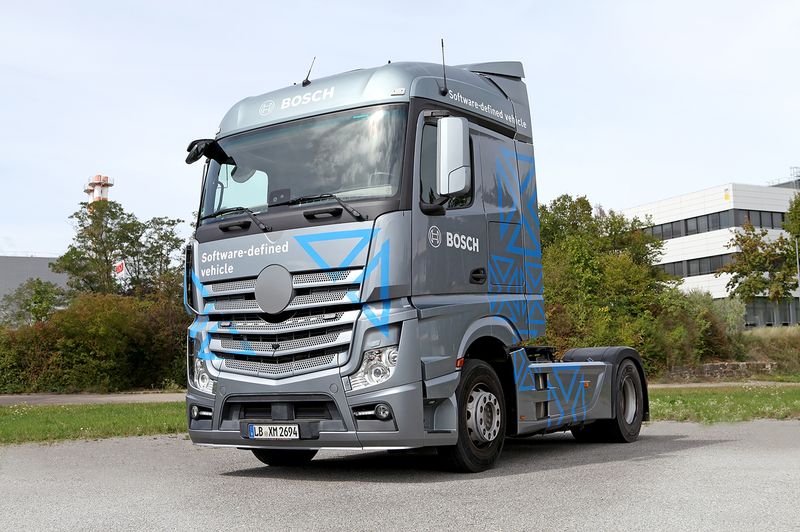
[Financial News] Global automotive supplier Robert Bosch GmbH is making a major technological push in the heavy commercial-vehicle market, which faces dual challenges from environmental regulations and rising logistics costs. The company plans to double related revenue by the mid-2030s by focusing on electrified powertrains, advanced driver-assistance systems (ADAS), and a software-centered integrated architecture. Beyond simply supplying components, it is mobilizing company-wide resources to transform the commercial-vehicle design paradigm into software-defined vehicles (SDVs) and significantly reduce the total cost of ownership (TCO) for global fleet operators.
Robert Bosch GmbH announced on the 15th that it had unveiled its mid- to long-term growth strategy for the commercial-vehicle division at IAA TRANSPORTATION 2026, held in Hanover, Germany.
Markus Heyn, vice chairman of the Robert Bosch GmbH board of management and chairman of its Mobility business sector, said, "Heavy commercial vehicles are a key growth area for Bosch. Our goal is to double revenue in this segment by the mid-2030s."
Global heavy commercial-vehicle production is expected to hold at around 3.3 million units this year, up approximately 1% despite the overall market downturn. Robert Bosch GmbH expects the market to expand to 4 million units by the mid-2030s. Based on this outlook, the company plans to dramatically increase its heavy commercial-vehicle technology revenue, which currently exceeds €4 billion (approximately 6 trillion won), by 2035.
The key driver is a diversified portfolio of eco-friendly powertrains. This year, Robert Bosch GmbH's electric motors and inverters will be installed in one out of every three newly registered battery-electric trucks in Europe. The company gained an early lead in the market by signing a major new supply agreement with Daimler Truck for electric powertrain components for the eActros.
Robert Bosch GmbH has also built a detailed supply chain for powertrains tailored to each region. Heyn emphasized, "Achieving global climate goals is not a matter of choosing one option over another. We must use every technology that helps move away from fossil fuels. In heavy long-haul transport and global markets, hydrogen and alternative fuels will complement batteries." To that end, the company is supplying fuel-cell power modules and key components for hydrogen internal-combustion engines at an early stage, while also optimizing diesel injection systems to meet Euro 7 standards.
The commercialization of intelligent sensors is also accelerating in response to tightening global safety regulations. Robert Bosch GmbH plans to begin mass production next year of next-generation multipurpose cameras and radar sensors with substantially enhanced computing performance. Digital rearview mirrors equipped with interior cameras that detect driver distraction entered commercial deployment this year through two major European manufacturers.
The company is also directly targeting the logistics industry's chronic driver shortage with Level 4 autonomous-driving technology. Its plan is to combine sensor data from inside and outside trucks in real time through intelligent software, improving driving safety and ultimately reducing the operational burden across logistics systems.
Robert Bosch GmbH is leading the transition of the traditionally hardware-centered commercial-vehicle ecosystem to SDVs. Together with its subsidiary ETAS, the company is developing a high-performance, scalable central computing platform and E/E architecture. These systems integrate distributed functions into a unified platform and support over-the-air (OTA) software updates, enabling new features throughout a commercial vehicle's life cycle.
Heyn explained, "Software-defined vehicles are gradually becoming a reality in the truck industry as well. They will reduce the complexity of day-to-day operations for fleet operators and address the total cost of ownership, the most important factor."
Meanwhile, Robert Bosch GmbH is aggressively expanding into new business areas. It has established a new joint venture with Brakes India and Wheels India, subsidiaries of TSF Group, to develop smart actuators and air-suspension systems for commercial vehicles.
[email protected] Dong-ho Kim Reporter