Trading Volume Six Times Higher, but Trading Value Nearly Even: KRX and NXT Post Contrasting Results on First Day
- Input
- 2026-09-15 13:57:34
- Updated
- 2026-09-15 13:57:34
[Financial News] On the first day that the Korea Exchange (KRX) opened its after-market, it recorded six times the trading volume of the existing alternative trading platform NextTrade (NXT), while the two markets engaged in a close contest in terms of trading value.
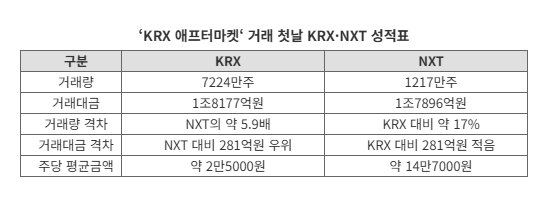
According to KRX on the 15th, after-market trading volume totaled 72.24 million shares that day, with trading value reaching KRW 1.8177 trillion. During the same period, 12.17 million shares were traded on the NXT after-market, generating KRW 1.7896 trillion in trading value.
By trading value, KRX led NXT by KRW 28.1 billion. In terms of trading volume, however, KRX was approximately 5.9 times higher than NXT. A simple calculation puts the average trading value per share at about KRW 25,000 on KRX, compared with approximately KRW 147,000 on NXT. Actual trading varies depending on the share price and order size of each stock, so this is not an absolute comparison metric. Still, it shows that the two markets had significantly different trading structures.
KRX Holds the Edge in KOSDAQ Trading Volume
A total of 72.24 million shares were traded on the KRX after-market across the KOSPI Composite Index and KOSDAQ. KOSPI trading volume stood at 22.18 million shares, while KOSDAQ recorded 50.06 million shares. KOSDAQ accounted for approximately 70% of the total. Trading value totaled KRW 1.8177 trillion, comprising KRW 1.3252 trillion on KOSPI and KRW 492.5 billion on KOSDAQ.A KRX official said, "KOSDAQ stocks are not heavily traded on NXT, but we list a substantial portion of the roughly 1,800 KOSDAQ stocks, so it is inevitable that KOSDAQ trading volume is higher on our platform."
NXT currently has about 600 tradable stocks. As a result, it offers fewer stocks overall, but trading is concentrated in high-priced and large-cap stocks, according to the explanation. An NXT official said, "It is true that trading was centered on high-priced and large-cap stocks. Since only about 600 stocks are available for trading, that difference emerged."
KRX significantly increased share-count trading volume by expanding the range of tradable stocks. On NXT, meanwhile, trading was concentrated in relatively higher-priced stocks, resulting in greater trading value relative to volume.
However, NXT’s after-market trading value had been declining recently. It fell from KRW 3.6662 trillion on the 8th to KRW 3.1772 trillion on the 9th, then declined to KRW 2.3463 trillion on the 10th and KRW 2.0217 trillion on the 11th, before reaching KRW 1.7896 trillion on the 14th. Compared with the 8th, that represents a decline of approximately 51%.
Industry observers say it would be difficult to attribute all of this decline to the launch of the KRX after-market. NXT’s trading value had already been falling before KRX opened.
In particular, NXT still recorded trading value of nearly KRW 1.8 trillion on the first day of KRX’s after-market. This makes it difficult to conclude that trading demand in the two markets immediately shifted to one side.
KRX also maintains that it is too early to determine whether new liquidity has entered the market or to assess the impact of opening its after-market. A KRX official said, "Since this is only the first day, we will need to observe the market longer to determine whether new liquidity has entered and how significant the effect of opening the after-market has been."
The Decisive Factor Will Be Liquidity, Not Trading Value
Based solely on the first-day figures, KRX secured a commanding lead in trading volume and narrowly surpassed NXT in trading value. NXT, however, maintained trading value close to KRW 1.8 trillion despite the launch of KRX’s new market, preserving a substantial portion of its existing trading demand.In the competition ahead, the quality of liquidity experienced by actual investors is expected to matter more than simply comparing trading volume or trading value.
Even when trading volume is high, investors may have difficulty trading at their desired prices if orders are concentrated in particular stocks or if the order book lacks sufficient depth. Conversely, a large trading value does not necessarily mean that the market as a whole offers greater trading convenience if transactions are concentrated in a few high-priced or large-cap stocks.
An official from the securities industry said, "It is difficult to say that either side gained an advantage based solely on first-day trading volume and trading value. Ultimately, the key to the competition will be which market investors return to repeatedly and which one provides a better trading environment in terms of quotes and execution."
[email protected] Kang Jung-mo Reporter