‘Squid Game’ or the next-generation ‘The Good Doctor’? The paradox of globalizing K-formats: “Ideas that can be repeated matter more than scale and spectacle” [BCWW]
- Input
- 2026-09-15 10:11:15
- Updated
- 2026-09-15 10:11:15
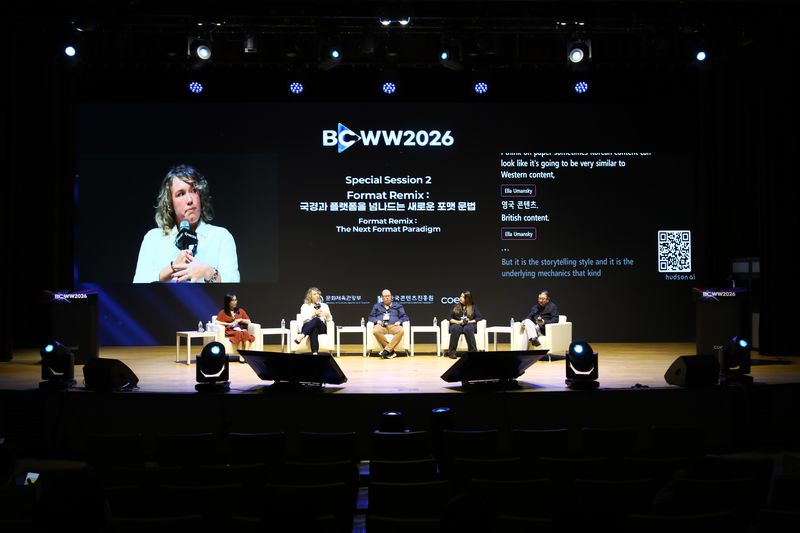
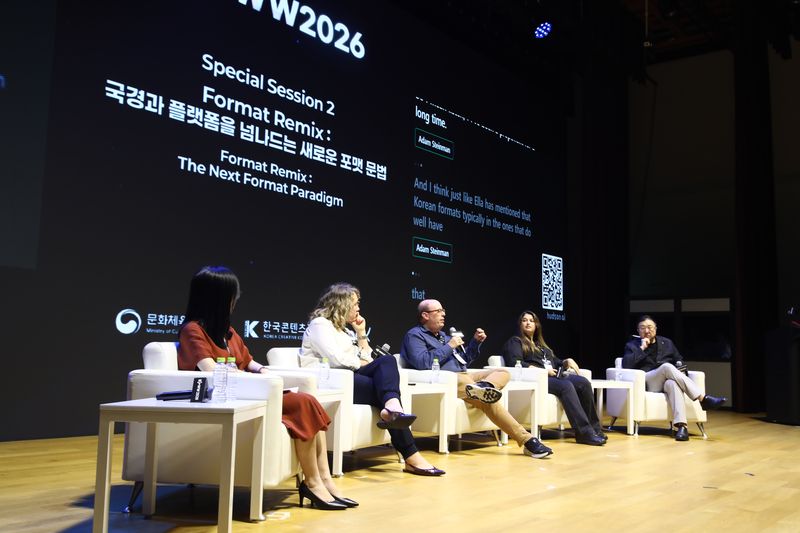
[Financial News] “Korean formats have become bigger and more spectacular.” However, overseas format executives attending the conference agreed that “what is needed is a simple idea that can be explained in one sentence, rather than something bigger and more elaborate.”
The special session ‘Format Remix: New Format Grammar Crossing Borders and Platforms,’ held on the 14th at the COEX Convention & Exhibition Center in Seoul as part of the ‘2026 International Broadcasting Video Market (BCWW),’ examined changes in the global format market and strategies for taking K-formats overseas.
Buyers from North America, the United Kingdom and Türkiye who attended the conference identified a ‘simple, repeatable core structure’ as the next challenge for Korean formats. They said that excessive complexity and perfection can become obstacles to expansion across diverse cultures. They also pointed out that the remake market has contracted as Korean originals are being consumed directly on global streaming platforms such as Netflix.
Hwang Jin-woo, head of Something Special, who moderated the discussion, also assessed that Korean formats are becoming overly complex as they focus too heavily on the preferences of global streaming platforms.
K7 Media: “Korea has emerged as the largest source of new scripted formats”
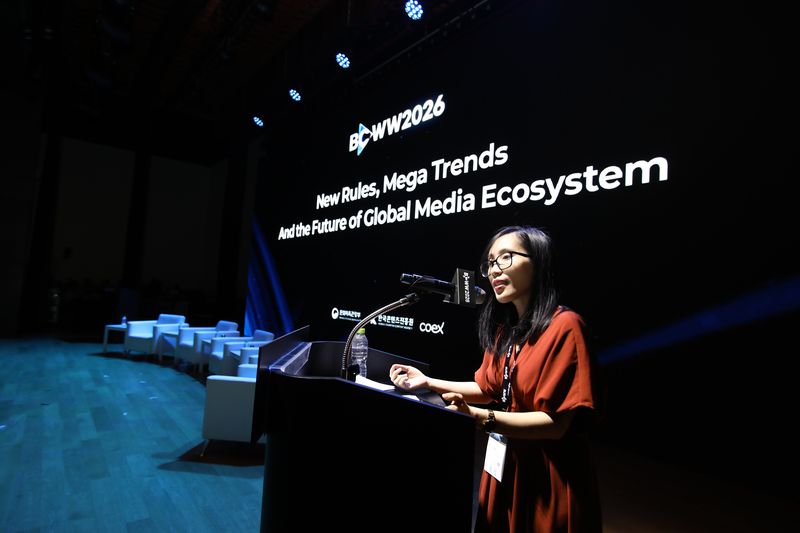
Trang Nguyen, K7 Media’s manager for Asia-Pacific, the Middle East and Africa, who delivered a presentation, said, “From July 2024 through the end of 2025, Korea was the largest source country, accounting for 22% of new scripted formats worldwide.” She added, “More than one in five newly produced scripted remakes originated in Korea.”
By contrast, Korea’s presence was relatively limited in the unscripted market, which excludes dramatic programming such as dramas and sitcoms. Asian formats accounted for only 7% of the world’s top 100 formats in circulation. Japan had five, while Korea had two.
Among unscripted formats, reality shows and game shows were identified as promising areas for Korean formats. Nguyen said, “BLOODY GAME X proved that Korean formats can also compete in the reality genre.” She added, “Korea is particularly strong in hybrid game shows that combine multiple genres.”
Global buyers recently assessed that Korean content has been moving toward excessively complex and costly structures. The sharp rise in production costs is widely cited as a major factor weakening the global competitiveness of K-content.
Adam Steinman, executive vice president of global formats and acquisitions at Blink49 Studios, said, “At the heart of successful Korean formats such as the variety show ‘King of Mask Singer’ and the drama ‘Good Doctor was simple and creative DNA.” He added, “Recently, there have been more complex and expensive formats that can only be made by major streamers such as Netflix.” ‘Good Doctor,’ starring Joo Won and Moon Chae-won, was remade by ABC in the United States as the U.S. version ‘The Good Doctor’ in 2017, and a total of seven seasons were produced through 2024.
He emphasized, “‘Physical: 100’ is an excellent Korean format, but it is expanding into local versions within the Netflix ecosystem.” He added, “There is a greater need for formats that broadcasters in countries around the world can afford and produce repeatedly across multiple markets.”
Is the high quality of K-dramas a double-edged sword for format exports?
Some also analyzed that the high quality of Korean content has become a double-edged sword for format exports.
Steinman, the executive vice president, noted, “Korean dramas are so well made, and viewers are not reluctant to watch subtitled content, so other countries do not feel the need to remake them.” He added, “The more successful Korean originals become on streamers, the more the scripted format market can shrink.”
Ella Umansky, vice president of format acquisitions at ITV Studios, identified a ‘Korean perspective’ as a competitive strength of K-formats. She said, “‘King of Mask Singer’ transformed a talent show, which was a competition to select singers, into a mystery game.” She added, “Following its success, the mystery device spread to various genres, including cooking and dating.”
She continued, “If you try to create a Korean format similar to the globally successful psychological game ‘The Traitors’ or dating reality show ‘Love Island,’ you ultimately end up competing with the originals.” She advised, “Rather than imitating successful Western programs, you should focus on what makes those works special in Korea.”
Türkiye: The magic of old K-dramas has faded... ‘Authenticity and familiarity’ remain strengths
Ceren Ergenecon, co-CEO of Türkiye’s HECE Media, defined the strengths of Korean dramas as ‘authenticity and familiarity.’
She said, “Korea and Türkiye are similar in their family relationships and in the way they develop stories.” She added, “The appeal of Korean dramas lay in their honest and warm portrayal of ordinary people’s lives and hardships.”
She continued, “As more high-budget, high-concept productions have emerged, the magic of older K-dramas, which dealt with ordinary people’s lives, is disappearing.” She added, “I want to see stories about everyday life again—not fantasy, time travel or adaptations of webtoons.”
There was also advice that local partners should be involved from the early development stage to enter the U.S. market.
Steinman, the executive vice president, said, “Simply describing a program as ‘the third-most successful program of all time in Korea’ will not persuade a U.S. broadcaster to make a decision.” He added, “You need to explain which program ended and created a scheduling gap, and why this project can fill that slot.”
He emphasized, “You need to involve U.S.-proven showrunners and writers from the outset, and prepare a mood reel and format bible to reduce the buyer’s risk.” He added, “What matters is not how much you receive in option fees, but whom you partner with and what kind of partnership you establish.”
[email protected] Shin Jin-a Reporter