GIST to Develop Foundational Medical AI Technology and Train Emerging Researchers
- Input
- 2026-09-15 09:15:59
- Updated
- 2026-09-15 09:15:59
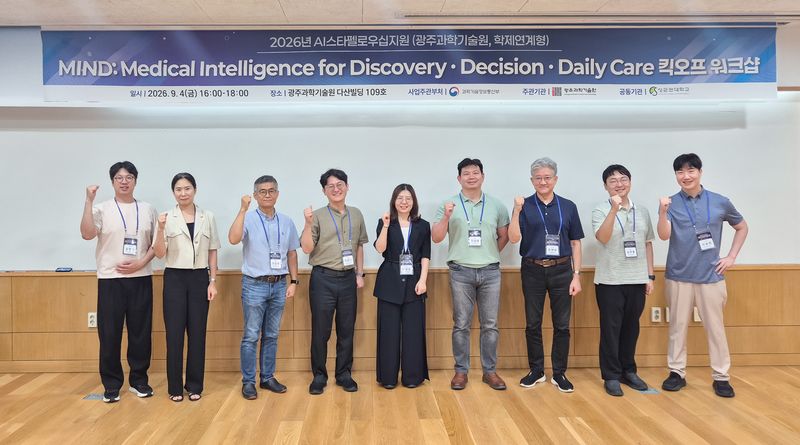
【Financial News, Jeonnam-Gwangju = Reporter Hwang Tae-jong】 Gwangju Institute of Science and Technology (GIST) will develop foundational next-generation medical artificial intelligence (AI) technology and train top-tier emerging researchers—postdoctoral researchers or faculty members within seven years of their first appointment—to lead the effort.
On the 15th, GIST said it had been selected for an interdisciplinary project under the '2026 AI Support Program for Top-Tier Emerging Researchers,' led by the Ministry of Science and ICT and the Institute for Information and Communications Technology Planning and Evaluation (IITP).
The research will run for five years and six months, through December 2031, with total government research and development funding of 11 billion won. GIST will lead the project, while Sungkyunkwan University will participate as a joint R&D institution.
The core of the research is to develop foundational technology called 'MIND'—Medical INtelligence for Discovery, Diagnosis, and Daily care—which enables AI to perform different roles depending on the medical context, from disease discovery and clinical decision-making to daily health management.
The research team plans to develop the three technologies that make up MIND—Scientist AI, Clinician AI, and Home Doctor AI—and connect them into a unified medical AI system.
Scientist AI will analyze complex medical data, including diverse biological information such as genomics and proteins (omics), medical images, and single-cell data, to identify the mechanisms behind cancer and brain diseases and discover new biomarkers and therapeutic targets.
Clinician AI will operate reliably even when hospitals, patients, medical equipment, or testing methods differ. It will predict and assess diagnoses, prognoses, and treatment responses while also presenting the basis for its decisions and the associated uncertainty.
Home Doctor AI will analyze long-term lifestyle data, including sleep, activity, and behavior data collected through wearable devices and sensors at home, to detect early signs of health abnormalities.
In addition, GIST plans to collaborate with hospitals and companies, including Samsung Seoul Hospital, VUNO, and Neurophet, to conduct multicenter clinical validation and develop prototypes so that the medical AI technology can be tested in real-world medical settings.
Lee Hyunju, a professor in GIST's Department of AI, will serve as the principal investigator, while Park Hyunjin, a professor at Sungkyunkwan University, will serve as co-principal investigator. Emerging researchers participating in the project include GIST professors Mansu Kim and Jiyeon Kang from the Department of AI and Hwang Geonho from the Department of Mathematical Sciences, as well as Sungkyunkwan University professors Lee Seungwon from the Department of Medicine, Jeon Ilyong from the School of Electrical and Electronic Engineering, and Kyuhong Shim from the Department of Software. Mid-career researchers Sung Chan Jun of GIST's Department of AI and Hyunseung Choo of Sungkyunkwan University's Department of Software will jointly carry out the project.
Because training world-class emerging researchers in next-generation medical AI is also a key goal of the program, the research team plans to have emerging researchers lead projects as independent project leaders (PLs), rather than merely participate as research staff. It will provide research funding, GPU infrastructure and clinical data needed for AI research, hospital networks, and opportunities for international collaboration.
Through these efforts, GIST aims to create a research environment in which emerging researchers can gain direct experience ranging from the development of foundational medical AI technology to clinical validation and commercialization, enabling them to grow into world-class independent researchers.
Professor Lee Hyunju emphasized, "Through this program, we will connect medical AI research with real-world medical settings and everyday life, while creating an environment where emerging researchers can demonstrate their research capabilities independently."
[email protected] Hwang Tae-jong Reporter