"How Did I Become Pregnant Without Undergoing Treatment?" Woman in Her 40s Achieves Natural Pregnancy Through NaProTECHNOLOGY
- Input
- 2026-09-15 09:00:55
- Updated
- 2026-09-15 09:00:55
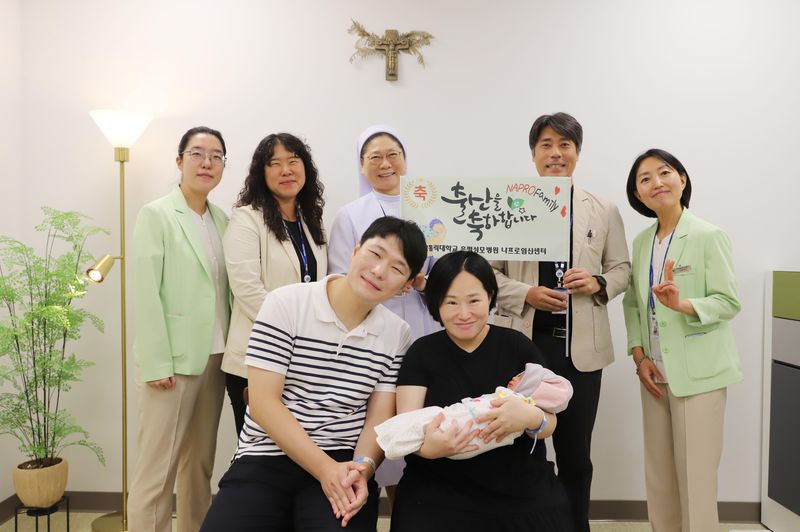
[Financial News] The NaPro natural fertility method, which enables couples to have children through natural conception without assisted reproductive procedures, brought a miracle to a couple in their 40s who had dreamed of becoming pregnant after more than 10 years of marriage. The mother, who achieved a natural pregnancy through the NaPro FertilityCare Center at The Catholic University of Korea Eunpyeong St. Mary's Hospital, gave birth to a healthy 3.5-kilogram boy on the 8th.
NaProTECHNOLOGY (Natural Procreative Technology) is a scientifically validated natural fertility treatment that focuses on a woman's menstrual cycle and biological rhythms to maximize fertility. Because it excludes invasive procedures, it places less physical strain on the body, while its success rate of approximately 30% is not significantly different from that of infertility treatments.
The couple at the center of the story are Kim Hye-won, 42, and Kim Ki-min, 40. After more than 10 years of marriage without a pregnancy, they conceived for the first time in early 2025 but suffered a miscarriage. Drawn to the possibility of achieving a healthy pregnancy through a natural approach, they chose NaProTECHNOLOGY. After learning that a NaPro FertilityCare Center had opened at The Catholic University of Korea Eunpyeong St. Mary's Hospital near their home in Seodaemun District, they joined the program in July last year.
The mother's menstrual cycle was somewhat irregular, and initial tests showed hypothyroidism and borderline blood sugar levels. Through immediate multidisciplinary care, the factors interfering with pregnancy were treated. The couple also took part in NaProTECHNOLOGY education together as they prepared for pregnancy. Rather than becoming impatient, they encouraged each other and carefully recorded their NaPro charts to identify the optimal fertile period. Six months after beginning treatment, they achieved a natural pregnancy in January 2026.
The hospital's multidisciplinary care system also played a major role in maintaining the pregnancy. Although the couple faced challenges, including high-risk factors associated with advanced maternal age and gestational diabetes, they overcame each hurdle through coordinated care involving the departments of obstetrics and gynecology and endocrinology. The High-Risk Maternal and Neonatal Intensive Care Center remained on alert in case of an emergency. Thanks to the medical team's meticulous care, both the fetus and the mother remained healthy.
The mother said, "I was very afraid as I prepared for another pregnancy after experiencing pain and reaching an age that is not considered young. But I am truly happy that NaProTECHNOLOGY helped me recover physically and emotionally and hold a healthy child in my arms." She added, "I hope our story of overcoming difficulties and meeting our baby, Heemang-i, will reach many people struggling with infertility as a warm message of hope that they, too, can become parents."
Bae Jae-young, a professor of obstetrics and gynecology specializing in NaProTECHNOLOGY, explained, "Although the circumstances were not easy, the couple supported each other and faithfully followed every step of NaProTECHNOLOGY, which enabled them to welcome a healthy new life." He added, "I am delighted to have shared this moment as their physician when the couple facing infertility finally found hope."
The core of NaProTECHNOLOGY lies in the Creighton Model System, which identifies the optimal fertile period by observing and analyzing a woman's vaginal secretions. When a woman records her daily biological indicators on a NaPro chart, medical staff analyze the information and provide counseling to help the couple attempt natural conception during the optimal fertile period. The method is characterized by tracking hormonal changes throughout the woman's reproductive cycle, accurately identifying the causes of infertility in both partners, and treating them through medical and surgical approaches. It is a scientific and healthy approach to pregnancy that helps restore the couple's health and fertility at their foundation and enables natural conception during the optimal fertile period.
The NaPro FertilityCare Center at The Catholic University of Korea Eunpyeong St. Mary's Hospital is staffed by veteran medical professionals who have completed specialized training at the U.S.-based Saint Paul VI Institute, which developed NaProTECHNOLOGY and has researched it for more than 40 years. Alongside multidisciplinary care based on medical diagnoses, the center provides psychological counseling and Catholic spiritual counseling, supporting both physical recovery and emotional stability. Building on the accumulated clinical expertise of Catholic Central Medical Center, which introduced NaProTECHNOLOGY in Korea for the first time, the center provides systematic, personalized care for a wide range of complex infertility cases.
Kwon Ji-young, director of the NaPro FertilityCare Center and a professor of obstetrics and gynecology, said, "The Catholic University of Korea Eunpyeong St. Mary's Hospital is doing its utmost to maintain the infrastructure needed to protect the health of mothers and babies from natural conception through delivery." She added, "We will continue to serve as a reliable partner so that couples facing infertility do not lose hope and can safely welcome new life through systematic multidisciplinary care and coordination with the High-Risk Maternal and Neonatal Intensive Care Center."
Rev. Antonio Hwang Jae-ho, vice president for spiritual affairs, had prayed for the health of the fetus and mother before the birth. After hearing the news, he visited the mother and offered a blessing, saying, "I offer my heartfelt congratulations to the couple who overcame past hardships and numerous challenges and finally welcomed a new life. I pray that their baby, born through God's blessing and the love of the parents, will grow up healthy and become a source of hope to the world."
The Catholic University of Korea Eunpyeong St. Mary's Hospital has recently surpassed 5,000 cumulative deliveries and 1,000 deliveries annually, becoming a strong support for mothers in the region amid an era of extremely low birth rates. Based on a multidisciplinary care system led by obstetricians and gynecologists and neonatologists, the High-Risk Maternal and Neonatal Intensive Care Center provides prompt, specialized care and operates the Maternal-Fetal Intensive Care Unit (MFICU) and the Neonatal Intensive Care Unit (NICU) reliably. The hospital is also taking the lead in building a community-centered maternal and child healthcare safety network. It proactively joined the pilot project for collaborative maternal and child healthcare, sharing relevant information with other medical institutions in real time to improve maternal and child health in the community.
[email protected] Medical Correspondent Jeong Myeong-jin Reporter