Jeju Wind-Power Profit Sharing Split into Two Tracks: Public Return and Resident Investment Separated
- Input
- 2026-09-15 09:17:44
- Updated
- 2026-09-15 09:17:44

【Financial News Jeju=Reporter Yong-bok Jeong】 In Jeju’s wind-power sector, development-profit returns for all residents and resident participation, through which residents of areas slated for power-generation projects invest directly and earn returns, will be handled under separate systems. The Jeju Special Self-Governing Provincial Council divided the two systems into different provisions, eliminating room for interpretation that resident investment returns could replace an operator’s development-profit contribution.
According to the Jeju Special Self-Governing Provincial Council and other sources on the 15th, the Council’s Future Economy and Industry Committee passed with amendments the full-revision bill for the “Ordinance on the Licensing of Wind Power Generation Projects and the Designation of Districts, etc., of Jeju Special Self-Governing Province” at a meeting held the previous day during the first regular session of the 454th council meeting.
The original bill submitted by Jeju Special Self-Governing Province last month called for a comprehensive overhaul of licensing for wind-power generation projects, district designation, community acceptance, development-profit sharing, and the role of management institutions.
The biggest issue was Article 35, “Profit Sharing in Wind Power Generation Projects.” The original bill required operators to return to Jeju the development profits earned by using wind as a public resource, and allowed the governor to require them to submit a “development-profit sharing plan that includes a resident participation plan.”
The problem was that development-profit sharing and resident investment have different characteristics. Under Jeju’s existing development-profit-sharing system, wind-power operators return part of the profits earned from their projects to the public, and the funds are used for energy welfare and renewable-energy projects.
Resident participation, by contrast, involves residents of areas designated for projects investing money in a power-generation project and receiving returns based on their investment amount or equity stake. The beneficiaries of the returns are different from the outset.
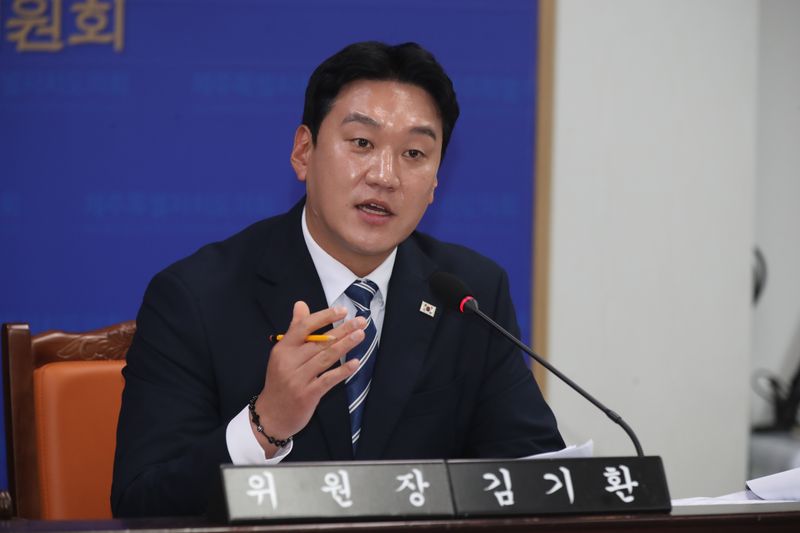
The Council reflected this distinction in the provisions. The committee’s amendment deleted the phrase “resident participation plan” from Article 35 on development-profit sharing. It instead newly established Article 36, “Resident Participation in Wind Power Generation Projects,” providing a legal basis for requiring the preparation and submission of a resident participation plan so residents in areas slated for projects can participate in power-generation projects.
In effect, public returns and resident investment will be operated independently rather than being handled under a single profit-sharing plan.
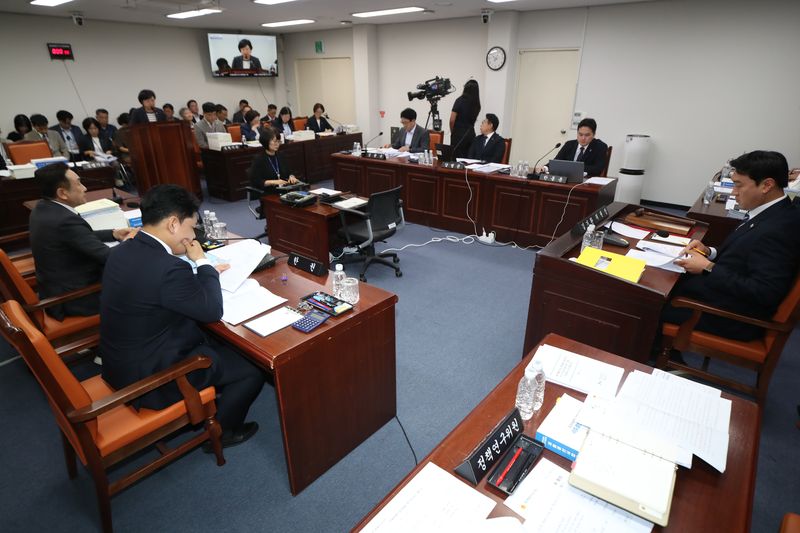
The change was prompted by concerns that operators’ obligations could be reduced. During the Council’s review, critics argued that if returns received by residents from investing their own money were counted toward an operator’s development-profit contribution, the amount returned to the public at large could decline.
Jeju Special Self-Governing Province explained that the structure would maintain the existing development-profit-sharing fund while adding resident participation.
Cho Seon-hee, head of Jeju Special Self-Governing Province’s Climate and Energy Bureau, explained during the committee review that the plan was “not to give up the development-profit-sharing fund, but to receive a certain portion while adding resident participation.”
Jeju’s current development-profit-sharing system uses 17.5% of net profit or 7% of the corresponding revenue as the benchmark.
However, 17.5% and 7% are not figures specified as uniform statutory contribution rates in this ordinance. They are operating standards formed through past reviews of wind-power generation projects and development-profit-sharing plans and agreements with individual operators.
An audit by the Jeju Special Self-Governing Provincial Council also confirmed that wind-power operators have been subject to profit sharing equivalent to 7% of revenue or 17.5% of net profit.
Jeju Special Self-Governing Province has not said it will abolish these standards. Rather, the significance of the amendment is that it clarifies the principle of operating the existing public-return system separately from resident investment returns.
The difference between the two systems can also be seen in actual projects. The Wind Resource Sharing Fund, which receives wind-power development profits, is used for energy welfare for Jeju residents. This year, Jeju Special Self-Governing Province is providing 600 million won from the fund to help cover summer electricity bills for people with disabilities and households headed by grandparents raising grandchildren.
From 2018 through last year, 4.3 billion won was spent on energy assistance for vulnerable groups using wind-power development profits, benefiting 36,372 households.
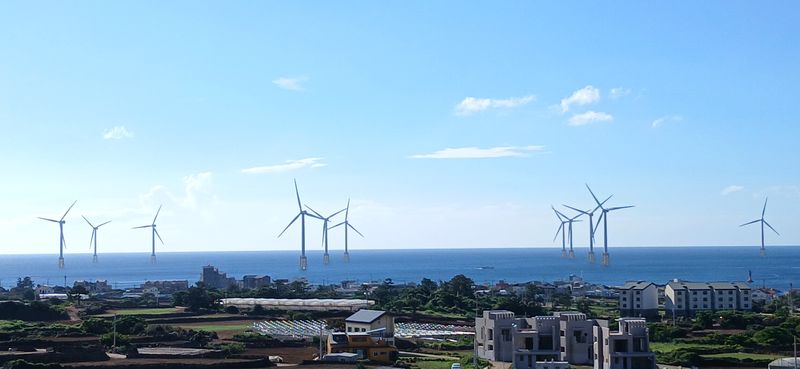
The model in which residents of project areas invest directly has a different character. The 100-megawatt Jeju Hanlim Offshore Wind Farm adopted a resident participation model in which residents of three villages—Suwon-ri and Hansu-ri in Hallim-eup, and Gwideok 2-ri—invested a combined 30 billion won in the project. Residents become investors and receive dividends from part of the project’s profits.
One system returns profits from the use of a public resource to an unspecified number of Jeju residents, while the other allows local residents who host power-generation facilities to participate directly in the project and earn investment returns.
Jeju’s institutional characteristics as a special self-governing province also underpin its separate management of wind-power profit sharing. The Jeju Special Act stipulates that Jeju’s wind resources are to be managed as “public resources.” It also grants special authority allowing the governor of Jeju Special Self-Governing Province to exercise substantial power in licensing wind-power generation projects and designating districts, and to establish related standards through ordinances.
The full-revision bill also reflects in its purpose the principles of public management of wind resources and allowing Jeju residents to benefit from development profits.
The creation of a separate provision for resident participation does not mean that resident investment will automatically become mandatory for every wind-power project.
The revised Article 36 likewise states that the governor “may require” the submission of a resident participation plan. The projects covered, the scope of residents eligible to participate, investment limits and methods, risk disclosures, and profit-distribution standards must be specified in subsequent notices and detailed guidelines.
Because resident investment carries risks tied to the profitability of power-generation projects, separate standards are needed to prevent it from being mistaken for a structure that guarantees principal or returns, unlike public returns.
Oversight of changes in project scale has also been strengthened. The original bill required review when the designated area of a wind-power generation district changed by at least 10%, but the committee also included changes of at least 10% in generation capacity as matters subject to review.
This brings within the scope of review cases in which an operator significantly increases total generation capacity by enlarging the turbines or adjusting their number, even without substantially expanding the project site.
The scope of management institutions responsible for the public management of wind resources has also been expanded. The original bill submitted by Jeju Special Self-Governing Province allowed local public enterprises to be designated as management institutions, but the committee broadened the scope during its amendment process to include institutions invested in or funded by local governments.
The Jeju Special Self-Governing Provincial Council’s separation of resident participation from development-profit sharing has reduced the immediate possibility of institutional conflicts.
The next task is to determine how clearly the two flows of money can be distinguished in actual projects. In large-scale offshore wind projects, public-return payments made by operators, resident investment funds, investment returns distributed to residents, and support funds for surrounding areas may all arise at the same time. Unless their amounts, calculation methods, and beneficiaries are distinguished, disputes over the scale of profit sharing could resurface.
This will become even more important if large-scale offshore wind projects are fully launched in places such as the Chujado Islands, as policymakers will need to balance operator obligations, community acceptance, and the public interest of all Jeju residents.
Although the bill has cleared the committee stage, it still requires a vote by the full council. The final ordinance and subsequent notices must provide more specific details on the projects and calculation standards covered by development-profit sharing and resident participation, the methods of resident investment, and the role of management institutions.
The future test will be whether Jeju’s wind-power profit-sharing system can become a structure in which the value generated from a public resource is shared separately by all Jeju residents and the communities hosting the projects, rather than remaining merely an operator donation or investment returns for residents of a particular area.
[email protected] Yong-bok Jeong Reporter