A Day After Yong Hye-in’s Resignation, Basic Income Party Proposes Banning Concurrent Service as Constituency and Proportional-Representation Lawmakers and Ministers
- Input
- 2026-09-15 09:23:09
- Updated
- 2026-09-15 09:23:09
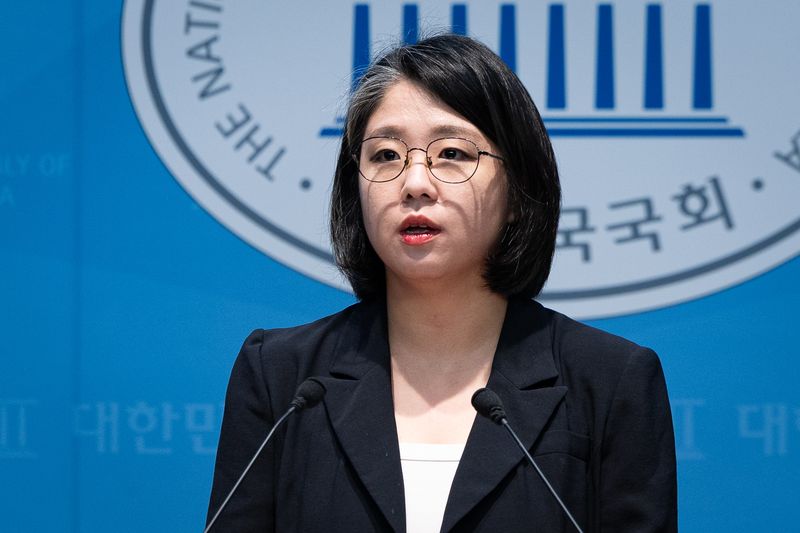
[Financial News] Yong Hye-in, a lawmaker from the Basic Income Party, voluntarily resigned as a nominee for minister of the Ministry of Gender Equality and Family. Her party, the Basic Income Party, proposed to the Democratic Party of Korea that it pursue an amendment to the National Assembly Act banning National Assembly members from concurrently serving as State Council members. The proposal came one day after Yong withdrew from consideration as a ministerial nominee.
According to Yonhap News Agency and other outlets on the 14th, Basic Income Party leader Oh Joon-ho said at a supreme council meeting that day, "Let us properly resolve the issue of lawmakers concurrently serving as State Council members. If the principle of mutual checks and balances between the executive and legislative branches is important, there is no reason to allow a ministerial post to constituency lawmakers while requiring only proportional-representation lawmakers to resign."
He continued, "Yong and the Basic Income Party chose to protect the trust of the democratic and progressive camp and the conditions for coalition politics rather than hold on to a single ministerial post. Now, I ask the Democratic Party of Korea to show that it is taking responsibility for coalition politics." He added, "Let us bring forward for public debate an amendment to the National Assembly Act that would prevent lawmakers from concurrently serving as State Council members, without distinguishing between constituency and proportional-representation lawmakers."
After Yong was nominated as a minister, controversy arose over whether a proportional-representation lawmaker could concurrently hold the post, and she faced mounting pressure to resign. She ultimately stepped down as a ministerial nominee, and the proposal to pursue the amendment came just one day after she withdrew.
Oh said, "The key task in preventing the emergence of satellite parties while advancing the cause of multiparty coalition politics is to expand proportional-representation seats and strengthen proportionality in the electoral system. Let us ensure that the votes citizens give each party are reflected as fully as possible in the number of seats in the National Assembly."
He added, "From the time the Basic Income Party was offered a ministerial post until now, we have stood by the cause and principles of multiparty coalition politics. Using this challenge as a stepping stone, we will work even harder toward democracy for everyone and basic income for everyone."
Meanwhile, Yong voluntarily resigned as a nominee for minister of the Ministry of Gender Equality and Family on the 13th. This came 14 days after President Lee Jae Myung nominated her for the post.
Yong had previously stated that she would retain her proportional-representation seat even if appointed minister, and faced pressure to resign not only from the opposition but also from some members of the ruling camp. She emphasized that "a lawmaker’s concurrent service as a State Council member is a principle permitted by law" and appeared determined to confront the issue head-on. However, amid a decline in support for the ruling camp among people in their 20s and 30s in various recent opinion polls, she ultimately decided to resign.
At a press conference, Yong said, "The Democratic Party of Korea conveyed to me that, while it respects the situation facing the nominee and the Basic Income Party, it asked the nominee to make a decision in light of the limited public consensus on concurrently holding a proportional-representation seat and a ministerial post." She added, "Knowing what that meant, I also gave it deep consideration."
She continued, "Because State Council members must connect the National Assembly and the government organically and draw out cooperation, I judged that it would be difficult in practical terms to perform the role while even the ruling party was expressing concern." She added, "I also judged that resigning as a nominee was necessary to carry on the spirit of solidarity within the democratic and progressive camp."
She concluded, "I am grateful to the president for trusting me and entrusting me with an important responsibility, and I am sorry that I was unable to fulfill that duty completely." She added, "I will return to my original purpose, reflect on myself, and devote myself to my parliamentary activities with a humble and mature attitude."
[email protected] Kim Soo-yeon Reporter