September Housing Business Outlook Falls 8.7 Points, Highlighting Capital Region–Non-Capital Region Divide
- Input
- 2026-09-15 11:00:00
- Updated
- 2026-09-15 11:00:00
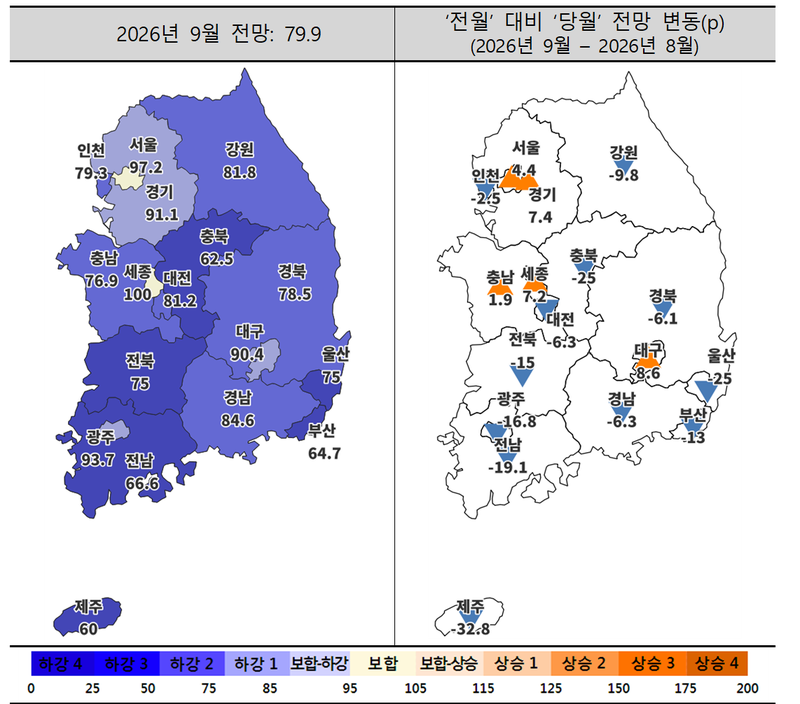
According to a survey of housing business operators conducted by the Housing Industry Research Institute on the 15th, the September housing business outlook index for the capital region came to 89.2, up 3.1 points from the previous month. By contrast, the index for non-capital regions fell 11.2 points to 77.9, pulling down the nationwide figure.
In the capital region, Seoul rose 4.4 points from 92.8 to 97.2, while Gyeonggi Province climbed 7.4 points from 83.7 to 91.1. Incheon fell 2.5 points from 81.8 to 79.3.
The Housing Industry Research Institute analyzed that home prices in Seoul continued to rise, particularly in areas such as Nowon District and Jungnang District, where relatively affordable homes are concentrated. In Gyeonggi Province, it said price gains also widened, especially in the southern area, which has benefited from strong semiconductor industry conditions.
However, the burden of financing costs and a contraction in transactions were cited as sources of uncertainty in the capital region housing market. The Housing Industry Research Institute assessed, "The burden of financing costs caused by mortgage lending regulations and rising market interest rates continues, while uncertainty in the market persists as the volume of home transactions in the capital region is also declining."
The outlook index declined in most non-capital regions. Jeju Province fell 32.8 points from 92.8 to 60.0, while Ulsan dropped 25.0 points from 100.0 to 75.0. North Chungcheong Province also declined 25.0 points, from 87.5 to 62.5.
Over the past several months, the index for non-capital regions had been rising on expectations that the upbeat mood in the capital region would spread to other parts of the country. However, business operators’ outlooks deteriorated sharply as a policy imposing heavier taxes on multiple-home owners was announced, while the buildup of unsold homes and weak demand continued.
The burden of unsold homes in regional housing markets is also continuing. As of July, approximately 85% of the 29,000 homes nationwide that remained unsold after completion were concentrated in non-capital regions.
Meanwhile, the September financing index was projected at 75.4, up 2.0 points from the previous month. Despite the increase in the index, business operators continued to face difficulties securing funds as financial costs rose following two recent base-rate hikes and increases in market interest rates, according to the survey. The materials supply index was expected to fall 6.6 points to 88.7.
[email protected] Choi Ga-young Reporter