Gangnam-gu property tax exceeds 1 trillion won... Seoul total surpasses 4.8 trillion won
- Input
- 2026-09-15 08:09:52
- Updated
- 2026-09-15 08:09:52
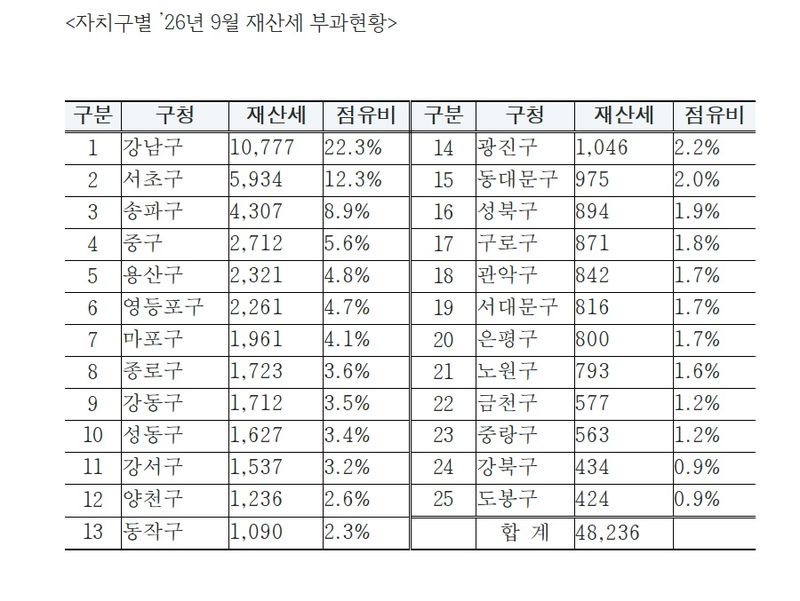
[Financial News] Property tax levied in September by Seoul’s Gangnam-gu exceeded 1 trillion won. Seoul’s total property tax also surpassed 4.8 trillion won, up 8.9% from last year, due in part to higher officially assessed prices. The Seoul Metropolitan Government said on the 15th that it had finalized 4.8236 trillion won in property tax for September 2026 and sent out a total of 4.43 million tax notices. This represents an increase of 395.1 billion won, or 8.9%, from last year’s 4.4285 trillion won.
Property tax is levied on people who own homes, land, buildings or other taxable property as of June 1 each year. In July, half of the property tax on homes is levied, along with taxes on buildings, aircraft and ships. In September, taxes are levied on land and the remaining half of the property tax on homes.
By type of taxable property, land property tax amounted to 2.885 trillion won, while the housing portion totaled 1.9386 trillion won. Land property tax rose by 139 billion won, or 5.1%, from 2.746 trillion won last year as officially assessed individual land prices increased 4.90%.
The increase in the housing portion was larger. As officially assessed prices for apartment complexes and individual homes rose 18.67% and 4.34%, respectively, housing property tax increased by 256.1 billion won, or 15.2%, from 1.6825 trillion won last year.
Among the autonomous districts, Gangnam-gu recorded the highest levied amount at 1.0777 trillion won, accounting for 22.3% of the total.
It was followed by Seocho District at 593.4 billion won, or 12.3%; Songpa District at 430.7 billion won, or 8.9%; Jung-gu at 271.2 billion won, or 5.6%; Yongsan District at 232.1 billion won, or 4.8%; and Yeongdeungpo District at 226.1 billion won, or 4.7%. The combined levied amount in Gangnam’s three districts—Gangnam-gu, Seocho District and Songpa District—was 2.1018 trillion won, or 43.6% of Seoul’s total.
Seongdong District posted the highest year-on-year growth among the 25 autonomous districts, at 15.6%. Its levied amount rose by approximately 22 billion won, from 140.7 billion won last year to 162.7 billion won this year. It was followed by Songpa District at 12.5%, Yongsan District at 11.5%, and Seocho District and Dongdaemun District, both at 10.9%.
The deadline for paying property tax is the 30th. A 3% late-payment surcharge may be added if payment is made after the deadline. Payments can be made through the Seoul ETAX internet tax payment system; the Seoul STAX mobile app; simple-payment apps such as Kakao Pay, Naver Pay and Toss; designated bank accounts; and bank cash dispensers or ATMs.
Taxpayers who apply for electronic delivery or automatic payment can receive a tax credit of 800 won per notice for each service. Those who apply for both can receive a maximum credit of 1,600 won.
The Seoul Metropolitan Government provided notices with voice-conversion QR codes for people who are blind or have low vision. It also sent separate Braille information sheets to 2,249 people with visual impairments. Foreign taxpayers were provided with information translated into six languages, including English, Chinese and Japanese. For September property tax this year, there were 25,400 foreign taxpayers and 28,153 taxable cases.
Seoul Metropolitan Government tax division chief Shin Ae-seon said, "On the payment deadline, people may experience inconvenience due to congestion at financial institutions and increased internet traffic." Shin added, "Please pay as early as possible to avoid disadvantages such as late-payment surcharges."
[email protected] Seong Cho-rong Reporter