Complex Development Planned Around Seonjeongneung and Konkuk University Stations... Floor Area Ratio of Up to 1,300% Applied
- Input
- 2026-09-15 10:00:00
- Updated
- 2026-09-15 10:00:00
■ Creating Complex Hubs Around Transfer Stations
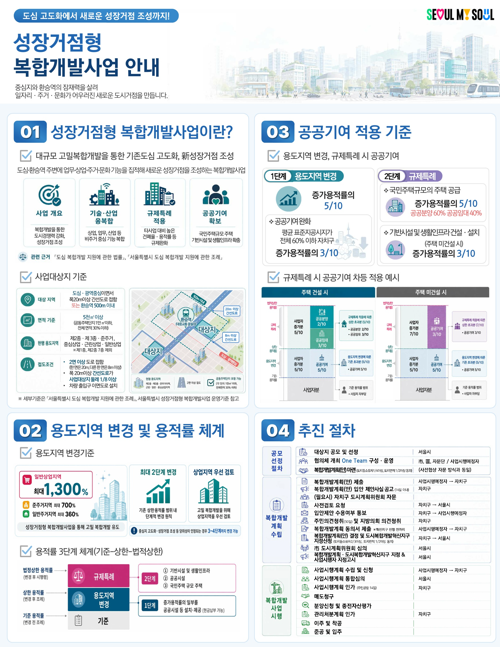
Seoul announced on the 15th that it had selected six sites in total: two for growth-hub complex development projects and four for growth-potential area revitalization projects.
Growth-hub complex development projects create large-scale mixed-use hubs around urban and metropolitan centers and transfer stations, combining cultural, industrial, business and residential functions. Eligible sites include areas located in urban or metropolitan centers that either abut an arterial road at least 20 meters wide or lie within 500 meters of a transfer station. They must cover at least 5,000 square meters and be designated as Class 2—excluding areas limited to seven floors or fewer—or Class 3 general residential areas, quasi-residential areas, neighborhood commercial areas, general commercial areas or central commercial areas. If the location and road-access requirements are met, a floor area ratio of up to 1,300% may be applied under general commercial-area standards. For 11 autonomous districts with relatively low project feasibility, Seoul will ease the public-contribution requirement on the increased floor area ratio from 50% to 30% to encourage private-sector participation.
The selected sites are 680-1 Yeoksam-dong, Gangnam-gu, and areas around 17-1 Jayang-dong, Gwangjin District. The site at 680-1 Yeoksam-dong, Gangnam-gu, is in the Seonjeongneung Station transfer-station area and fronts the 48-meter-wide Eonju-ro. Seoul plans to pursue a mixed-use development combining commercial, cultural and leisure functions, drawing on its convenient transportation access and links to nearby office facilities.
The area around 17-1 Jayang-dong, Gwangjin District, is located at the center of the Seongsu area. It is in the Konkuk University Station transfer-station area and fronts the 35-meter-wide Achasan-ro. Through complex development, Seoul plans to turn it into a new growth hub in the northeastern part of the city, linking the advanced industries, young talent, cultural functions and commercial functions of Seongsu and the Konkuk University area.
To expand growth-hub complex development projects, Seoul will introduce “recommended growth-hub zones” as a separate policy-based management tool. Independently of district designations under the law, the system will manage areas with high growth potential in line with Seoul’s spatial-planning direction from the project-concept stage. The two recommended growth-hub zones designated this time are the area around Euljiro and Dongdaemun Design Plaza (DDP) in Jung-gu, and the metropolitan center around Chang-dong and Sanggye in Dobong District.
■ Creating New Daily-Life Hubs Along Arterial Roads
The sites selected for the growth-potential area revitalization project are areas around 448-1 Seongnae-dong, Gangdong District; 715-1 Chang-dong, Dobong District; 587-2 Junggok-dong, Gwangjin District; and 1066-2 Doksan-dong, Geumcheon District. The project focuses on transforming areas along arterial roads outside station catchment areas, where aging buildings and underused land have accumulated, into new daily-life hubs.
Eligible sites are at least 1,500 square meters in size and located along arterial roads at least 35 meters wide, within Class 2—including areas limited to seven floors or fewer—or Class 3 general residential areas and quasi-residential areas. Depending on the project type, the zoning may be upgraded to general commercial areas at most, while business, commercial, cultural and daily-life social infrastructure facilities will be supplied through public contributions.
Sites between 1,500 and 10,000 square meters are eligible. Seoul will receive 50% of the increased floor area ratio as a public contribution, although the rate may be eased to as low as 30% depending on the conditions of each autonomous district. The city plans to reflect the pilot projects’ results and feasibility reviews in its operating standards and expand the number of sites covered by the growth-potential area revitalization project to 42 by 2030.
Seoul will also designate six major arterial roads—Dobong-ro, Dongil-ro, Tongil-ro, Gonghang-daero, Gyeongin-ro and Siheung-daero—as “growth-potential corridors” so that the results of the growth-potential area revitalization project spread beyond individual sites to surrounding areas. In addition to evaluating each site individually, the city will consider the roads’ transportation and daily-life functions, the need for balanced development and street continuity.
For each pilot site, Seoul will establish a collaborative system involving the Seoul Metropolitan Government, autonomous districts, prospective project operators and experts. It will prepare plans by December this year and begin administrative procedures, including proposals for plan formulation, in January 2027. Kim Chang-gyu, head of Seoul’s Urban Space Bureau, said, “We will upgrade urban and metropolitan centers into growth hubs that lead Seoul’s future, while developing the arterial-road areas between stations into daily-life hubs that support residents’ everyday lives and local economies. In this way, we will reorganize the entire city into a closely connected polycentric city.”
[email protected] Kwon Jun-ho Reporter