[Exclusive] Missing-Person Reports Repeated After Cases Were Thought Closed...148,592 in Five Years [The Blind Spot in Repeated Disappearances]
- Input
- 2026-09-15 13:51:58
- Updated
- 2026-09-15 13:51:58
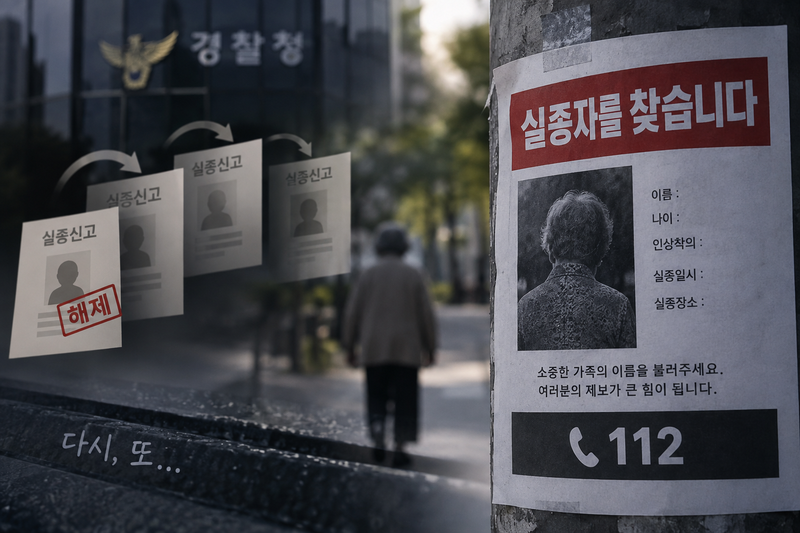
[Financial News] Over the past five years, nearly 150,000 missing-person reports were filed again for the same individuals after an earlier report had been closed. More than 50,000 repeat reports involved people requiring protection, including people with dementia and those with intellectual, autistic-spectrum, or mental disabilities.
According to data obtained by Financial News from the Korean National Police Agency through the office of Kang Myung-gu, a People Power Party lawmaker on the National Assembly’s Security and Public Administration Committee, a total of 148,592 reports were filed again for the same individuals after earlier missing-person reports were closed between 2022 and July this year.
Of these, 105,718 were repeat reports involving “missing children and others,” including children under 18 and people with intellectual, autistic-spectrum, or mental disabilities, as well as people with dementia. Runaway persons (missing adults) accounted for 42,874 cases. The statistics exclude the initial reports and count only reports filed again afterward.
By category, children under 18 accounted for the largest number, at 52,843 cases. They were followed by people with dementia, at 30,318 cases, and people with intellectual, autistic-spectrum, or mental disabilities, at 22,557 cases. In particular, the combined number of repeat reports involving people with dementia and those with intellectual, autistic-spectrum, or mental disabilities reached 52,875.
There were also many cases in which a report was closed after the person’s whereabouts were found, only for another report involving the same individual to be filed later.
When police analyzed the initial reports in repeat-report cases, they found that 14,237 of the 19,416 cases involving children under 18, or 73.3%, were closed after the children’s whereabouts were found. Among people with intellectual, autistic-spectrum, or mental disabilities, 5,301 of 7,122 cases, or 74.4%, were closed after their whereabouts were found.
For people with dementia, 10,443 of the 12,930 initial reports, or 80.8%, were closed after their whereabouts were found. Among runaway persons, 21,042 of 29,080 cases, or 72.4%, were closed that way. These were the initial cases in which the individuals’ whereabouts had been confirmed and the cases closed, but a missing-person report involving the same individuals was filed again later.
As the scale of repeated missing-person reports becomes clear, critics say authorities should go beyond simply finding missing people and examine the causes of repeated disappearances, focusing on those at high risk of disappearing again.
Kang Myung-gu said, "The fact that more than 140,000 repeat missing-person reports occurred over five years is too large a figure to be dismissed as mere coincidence." He added, "As disappearances involving people who require protection, such as people with dementia and people with disabilities, continue to recur, the Korean National Police Agency must analyze the causes of repeated disappearances and inspect blind spots in the missing-person response system." He emphasized, "For those at high risk of disappearing again, the necessary support should continue after they are found by connecting them with local governments and other relevant agencies."
[email protected] Kim Ye-ji Reporter