An Era of 540,000 Socially Isolated and Withdrawn Young People: “Employment and Restoring Social Connections Must Be Supported Together”
- Input
- 2026-09-14 16:56:11
- Updated
- 2026-09-14 16:56:11
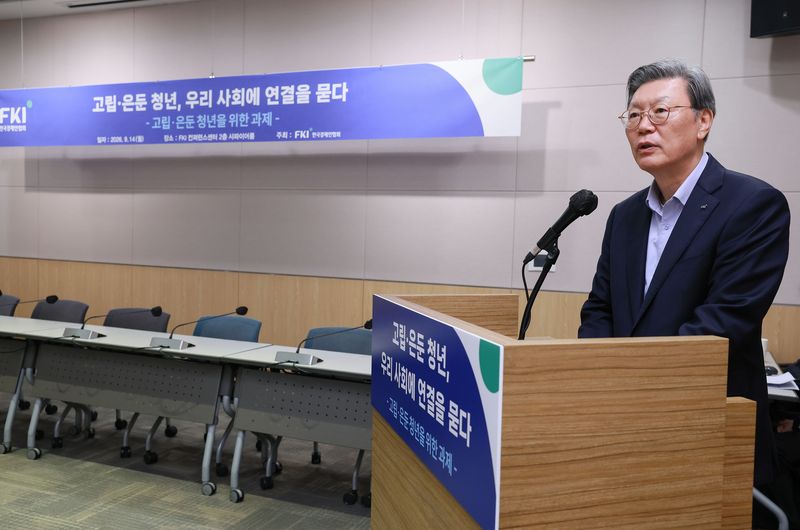
[Financial News] The Federation of Korean Industries (FKI) announced on the 14th that it held a seminar titled “Socially Isolated and Withdrawn Young People: Asking Our Society About Connection—Tasks for Socially Isolated and Withdrawn Young People” at the conference center of FKI Tower in Yeouido, Seoul.
The seminar was the third initiative in FKI’s “Youth with Jobs series,” which seeks to examine the various difficulties faced by young people and explore practical solutions.
It was organized to examine the increasingly serious problem of social isolation and withdrawal among young people and explore policies and public-private cooperation to support their recovery and independence so they can reconnect with society.
In his opening remarks, Kim Chang-beom, vice chairman of FKI, said, “There are approximately 538,000 socially isolated and withdrawn young people in South Korea, and the social and economic costs amount to approximately 5.3 trillion won. Their isolation and withdrawal can no longer be viewed solely as an individual problem.” He added, “Various social factors that cannot be resolved through individual effort alone lie behind young people’s isolation and withdrawal, including difficulties finding employment, weakened social networks, and anxiety about the future.”
He continued, “The most powerful tool for breaking down the walls of isolation and withdrawal is ‘connection.’ The government, the private sector, and businesses must join forces to help them rebuild relationships that have been severed from the outside world.”
Kim, Seong-Ah, a research fellow at the Korea Institute for Health and Social Affairs (KIHASA), delivered the first presentation. She analyzed young people’s isolation and withdrawal as the result of accumulated difficulties in becoming independent members of society, including finding employment and forming relationships. She said systematic support is needed, from early intervention before isolation and withdrawal become prolonged through independence after recovery. In particular, “difficulty finding employment” accounted for the largest share among the main reasons for withdrawal, while the likelihood of withdrawal increased as the period of job seeking grew longer.
Yoo Seung-gyu, head of An Museoun Hoesa, who delivered the second presentation, explained that new jobs could be created by drawing on the experiences of socially isolated and withdrawn young people who had overcome their difficulties.
Yoo said, “We must move beyond the goal of simply returning socially isolated and withdrawn young people to existing society and the labor market.” He pointed out, “It is difficult to provide stable jobs within the existing labor market to all young people whose careers and relationships have been severed for long periods, and even after they return to society, there is a considerable risk that they will become isolated again.”
Meanwhile, during the panel discussion, youth panelists emphasized the importance of policy accessibility tailored to the perspectives of socially isolated and withdrawn young people, as well as the formation of safe social networks. They drew on their experiences directly supporting such young people and their observations from the field.
Lee Si-hyeon, one of the youth panelists and operator of “Nawa, Nawang,” an information platform supporting socially isolated and withdrawn young people, said, “When we meet socially isolated and withdrawn young people, many want to receive support but do not know where to find information or how to apply, so they often fail to access actual assistance.” Lee suggested, “It is necessary to improve access to policies for socially isolated and withdrawn young people by expanding easy-to-understand guidance tailored to their perspective and customized support programs.”
[email protected] Im Su-bin Reporter