Seoul and Young Voters Flash a Red Warning Light; Party-Government Team Pours Resources Into Housing Supply
- Input
- 2026-09-14 16:00:08
- Updated
- 2026-09-14 16:00:08
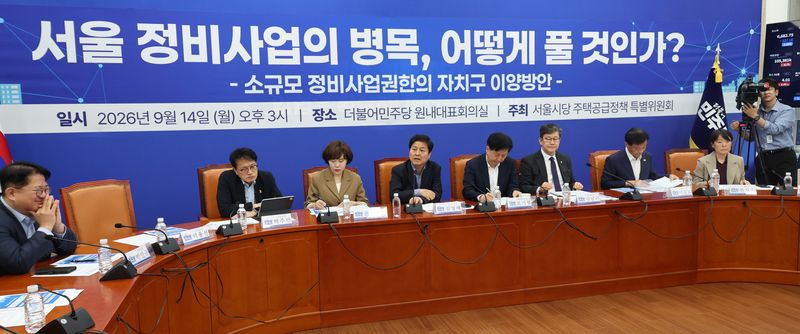
On the 14th, the Democratic Party of Korea’s Seoul chapter special committee on housing-supply policy discussed transferring authority over small-scale redevelopment projects to autonomous districts to accelerate redevelopment and reconstruction in Seoul. The proposal aims to reduce bottlenecks in the approval and review processes concentrated in the Seoul Metropolitan Government and bring forward the timing of housing supply in the city center. The Democratic Party of Korea believes that Seoul Mayor Oh Se-hoon’s “Rapid Integrated Planning” alone will not resolve the housing shortage. Oh Gi-hyoung, a Democratic Party of Korea lawmaker and member of the special committee, said that only about 89,000 of the roughly 310,000 housing units in Rapid Integrated Planning project areas represent a net increase after excluding existing homes. He argued that additional supply measures are needed.
The party is also moving to increase fiscal spending on youth housing. The special committee is pursuing a plan to secure an additional KRW 6 trillion, including KRW 4 trillion from the Future Response Fund and KRW 2 trillion in fiscal support for the Housing and Urban Fund, to expand the supply of youth housing in the Seoul metropolitan area.
The government is also moving in step with the party. It plans to announce a “Youth Housing Welfare Plan” before the Chuseok holiday and is pursuing measures to lower the eligibility threshold for public rental housing, which has focused on low-income households, to include young people from middle-income families. It also plans to specify the eligibility criteria, rents and residency periods for “universal rental housing,” a signature housing policy of the Lee Jae Myung administration.
The worsening public mood is behind the party-government team’s successive moves to accelerate housing measures for Seoul and young people. In a Realmeter poll released that day, Lee Jae Myung’s positive assessment for his handling of state affairs stood at 33.8%, falling for the ninth consecutive week and reaching its lowest level since he took office. Among those aged 18 to 29, the figure plunged 10.2 percentage points from the previous week to 18.6%. The Democratic Party of Korea’s support among people in their 20s also fell 18.8 percentage points in one week to 15.0%. In overall party support, the Democratic Party of Korea, at 36.1%, was overtaken by the People Power Party, at 42.1%, for the first time in about two months.
Warning signs have already emerged in Seoul. In a Hangil Research poll conducted on the 30th and 31st of last month, Lee Jae Myung’s positive rating in Seoul was 27.3%, while his negative rating was 70.2%. Concern is also surfacing within the ruling camp. Yun Kun Young, a non-mainstream Democratic Party of Korea lawmaker, publicly advised Lee Jae Myung, who was preparing to hold a press conference with the public that day over the decline in his approval ratings, saying, “You must not try to defeat the people.”
Alongside its supply measures, the Democratic Party of Korea is also intensifying its calls to hold Oh Se-hoon responsible. Democratic Party of Korea lawmaker Jeon Hyun-hee said that “the fundamental reason for the current surge in home prices is the failure to provide enough housing in Seoul.” She added that the party would support legislation under which the public retains ownership of the land while the Korea Land and Housing Corporation (LH) and Seoul Housing and Communities Corporation (SH) build homes and supply them affordably to young people and those without homes.
The Realmeter poll on the president’s job approval, cited in the article, was commissioned by Energy Economy Newspaper and conducted from the 7th to the 11th among 2,515 people aged 18 or older nationwide using wireless automated response surveys (ARS). The margin of error was ±2.0 percentage points at a 95% confidence level, and the response rate was 4.5%. The party-support poll was conducted from the 10th to the 11th among 1,003 people aged 18 or older nationwide using the same method. Its margin of error was ±3.1 percentage points, and the response rate was 3.6%. The Hangil Research poll was commissioned by Poli News and conducted on the 30th and 31st of last month among 1,038 adults nationwide, using landline telephone interviews for 5.8% of respondents and wireless ARS for 94.2%. Its margin of error was ±3.0 percentage points at a 95% confidence level. For further details, refer to the website of the Central Election Poll Deliberation Commission.
[email protected] Song Ji-won Reporter